
The Short Version
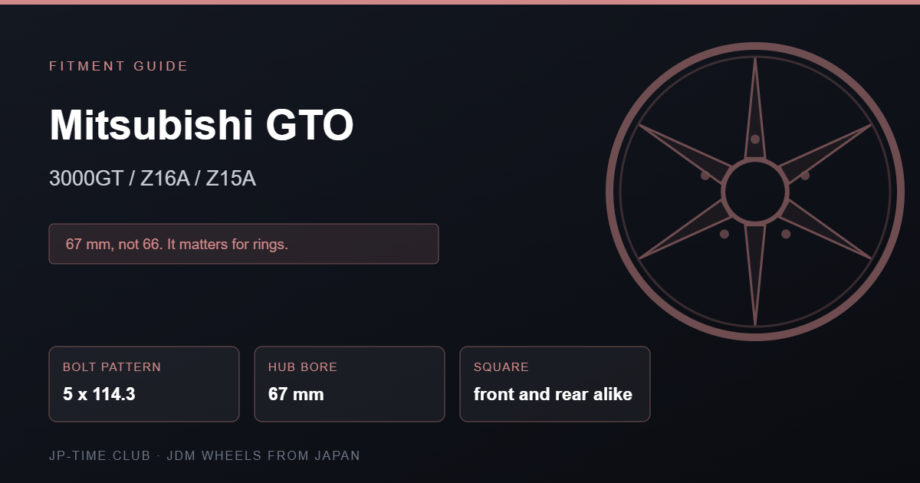
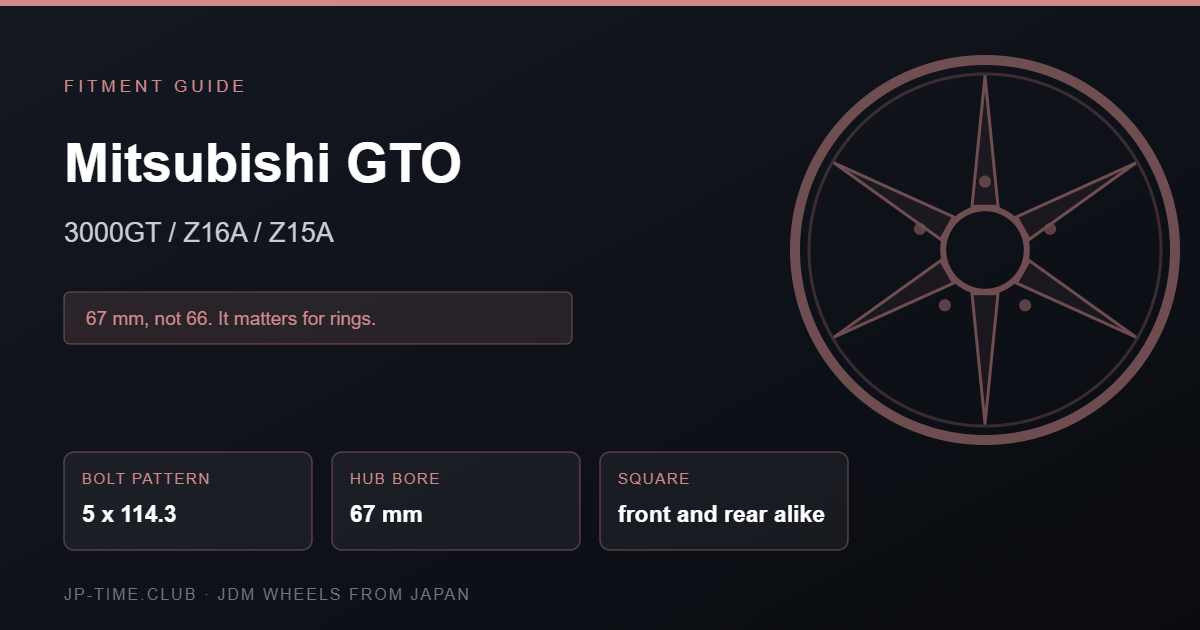
- 5×114.3 with a 67 mm hub bore. Note the 67 — not 66, and not the 60 mm you find on much of the Toyota range.
- Square, not staggered. Front and rear are identical on every grade we opened, including the twin-turbo.
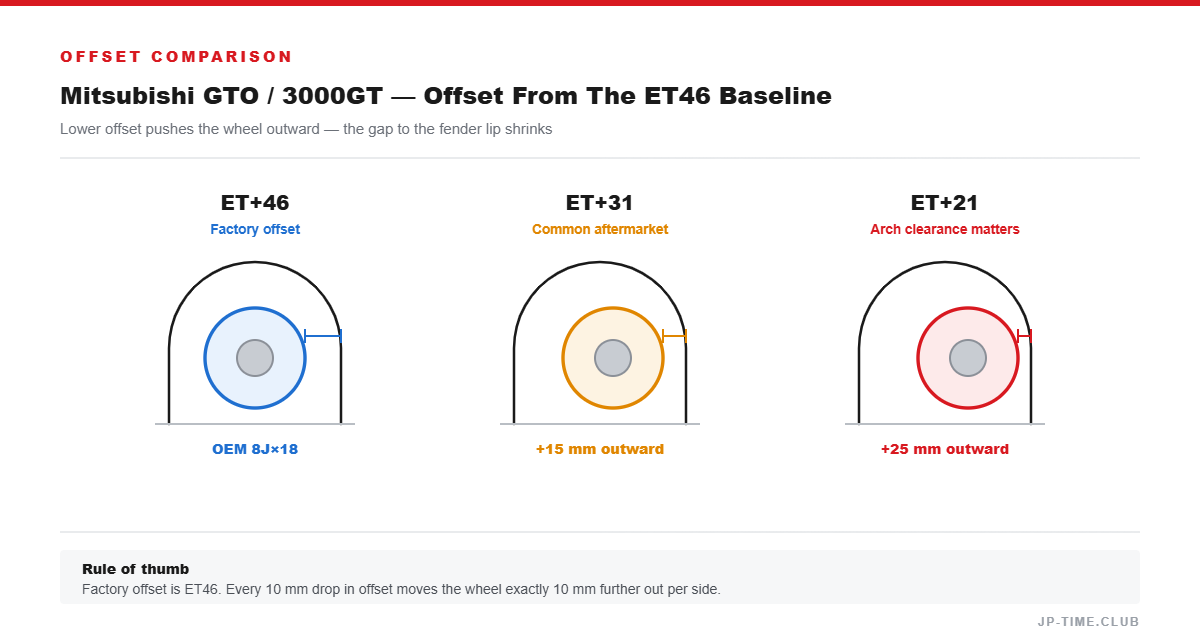
- Offset is +46 across the range. Only the diameter changes: 17×7.5J on the SR, 18×8J on the Twin Turbo.
- The whole model is US-import eligible. Production ended around September 2000.
Factory Specification
| Grade | Chassis | Period | Wheel | Tyre | PCD / Holes / Bore |
|---|---|---|---|---|---|
| Twin Turbo 6MT | E-Z16A | 1996.08–1997.08 | 18×8J +46, front and rear | 245/40R18 | 114.3 / 5 / 67 |
| SR 5MT | E-Z15A | 1996.08–1997.08 | 17×7.5J +46, front and rear | 225/50R17 | 114.3 / 5 / 67 |
The 67 mm Is the Point
Most of what a GTO buyer will look at in the Japanese used-wheel market was made for Toyotas and Nissans, and those cluster around 60 mm and 66 mm registers. The GTO is 67 mm.
One millimetre sounds trivial. It is not, in this direction: a wheel with a 66 mm bore will not go onto a 67 mm hub at all. It is not a loose fit, it is an interference. And a hub ring sized 66 mm will not help you.
Going the other way is fine — a wheel bored 73 mm drops on happily and takes a 67 mm ring. So when you are shopping, the number to check is the wheel’s bore, and 67 is your floor.
Square, Which Surprises People
The GTO is a wide, heavy, four-wheel-drive turbo car and everyone assumes it must be staggered. It is not. Both grades we opened run the same wheel, same width, same offset, same tyre front and rear.
That is good news for buying used: a set of four matching wheels is correct, and you are not hunting for mismatched pairs the way you are on a Chaser Tourer V or an MR-S.
Offset and Sizing
+46 on a 8J at 18 inch is a moderate factory figure for a car this wide. The usual aftermarket move is 18×9J to 19×9.5J in the +30 to +45 range, which fills the arches on a car that has plenty of them.
Watch weight. The twin-turbo GTO is around 1,700 kg with four-wheel drive, four-wheel steering and active aero on some cars, and it is not a vehicle that rewards heavy wheels. It also is not a vehicle where you want an under-rated wheel — check the load rating, and note that most Japanese makers do not publish one.
The Dodge Stealth
North America got this car twice: as the Mitsubishi 3000GT and, badge-engineered, as the Dodge Stealth. Both were built alongside the JDM GTO at Mitsubishi’s Nagoya plant.
US fitment data gives the Stealth 5×114.3 with a 67.1 mm bore, which matches the figure we read from the Japanese table allowing for the usual rounding. We treat that as corroboration rather than as an independent source — it is an aggregator, not a factory document — but it is consistent, and it means a JDM GTO wheel should fit a Stealth or a 3000GT.
Importing
The GTO ran from October 1990 to around September 2000, so the entire model is past the 25-year mark and importable today.
The grades worth importing are the JDM-only ones and the right-hand-drive twin-turbos. If you simply want the shape, the US had it for a decade and 3000GTs are plentiful there.
What We Could Not Verify
- The early 1990–1993 base and front-drive grades. The database’s grade names for those years do not carry an explicit drivetrain label the way the later ones do, and we did not open them. Do not assume they match the 1996–97 figures above.
- Whether the active-aero and four-wheel-steering cars differ in any way. We did not open their pages.