The Short Version
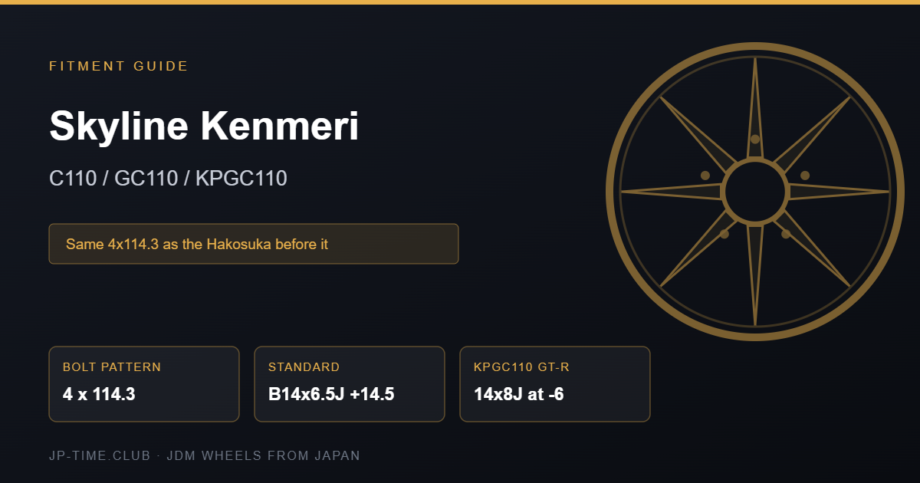
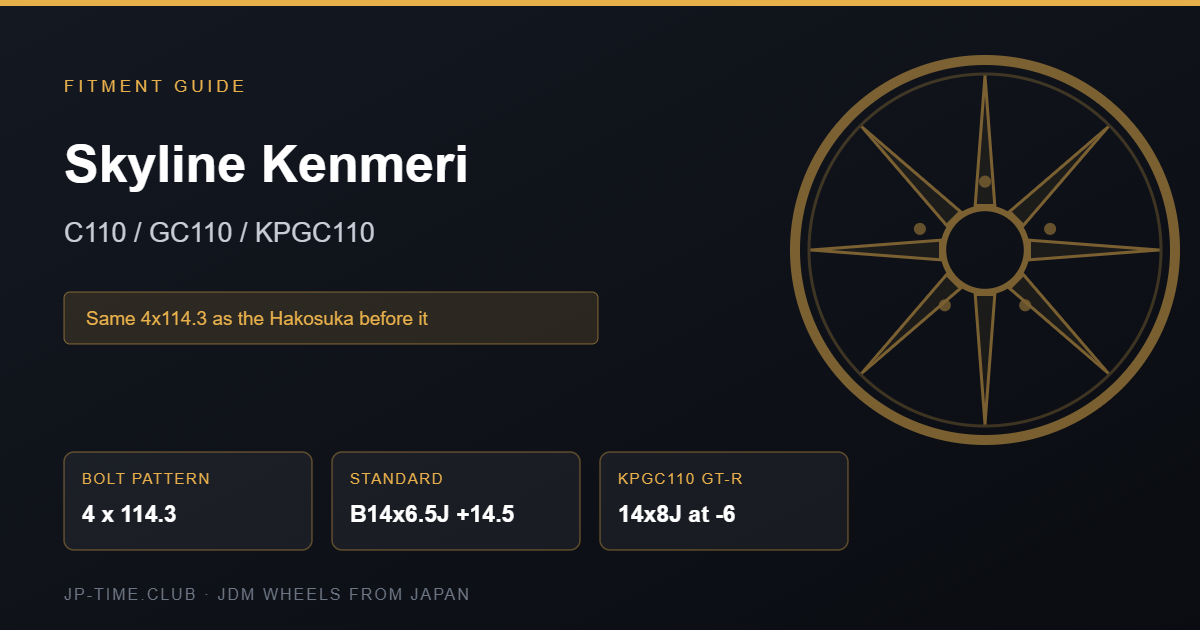
- 4×114.3, the same as the Hakosuka C10 before it.
- Standard cars: B 14×6.5J at +14.5, front and rear. Not staggered.
- The KPGC110 GT-R is staggered and negative: 14×8J at −6 front, 14×8.5J at −13 rear.
- No hub bore — and the Kenmeri gets exactly the same blank treatment as the Hakosuka, which we think is meaningful.
What RS Watanabe Publishes
| Car | Chassis label | PCD | Front | Rear | Hub note |
|---|---|---|---|---|---|
| Kenmeri Skyline, standard grades | GC110 | 4×114.3 | B 14×6.5J, +14.5 | B 14×6.5J, +14.5 | none |
| Skyline GT-R | KPGC110 | 4×114.3 | R 14×8.0J, −6 | R 14×8.5J, −13 | none |
The Japanese factory wheel databases have no Kenmeri data at all — their Skyline coverage begins with the R32 in 1989. RS Watanabe is the only source.
The Same Silence as the Hakosuka
In our Hakosuka guide we made an argument: RS Watanabe publishes hub-bore machining notes for plenty of classics on the same page — the Sunny, the 510 Bluebird, the CSP311 Silvia, the Y30 Cedric — and publishes none for the C10 Skyline. We read that silence as meaning the bore is not the locating dimension on these tapered-seat fitments.
The Kenmeri is treated identically. Blank remarks column, no φ figure, on both the standard row and the GT-R row.
What makes this more than a coincidence is the neighbouring generation. The S54 2000GT, the Skyline immediately before the Hakosuka, does carry a machining note: a φ70 bore option. So RS Watanabe is not simply silent on all old Nissans. They are silent on the C10 and C110 specifically.
Two consecutive Skyline generations, both blank, with a flagged generation on either side. We think that is a pattern rather than an omission — and the practical conclusion is the same as for the Hakosuka: make sure the wheel clears the hub, and let the tapered nuts do the centring.
The GT-R Numbers
197 KPGC110 GT-Rs were built and it is one of the rarest Skylines there is, so the fitment is academic for most readers. It is also striking: 14×8J at −6 front and 14×8.5J at −13 rear, against the standard car’s 6.5J at +14.5.
That is more than 20 mm of offset difference and an inch and a half of extra width, front and rear. The GT-R had the track to carry it. A standard Kenmeri does not, and fitting GT-R-spec wheels to one is a bodywork project rather than a wheel purchase.
What RS Watanabe Does Not Break Out
They fold everything except the GT-R into a single row labelled GC110. That means we cannot tell you whether the four-cylinder C110 sedan and van take the same fitment as the six-cylinder 2000GT cars — the table does not distinguish them.
Given the weight and track differences between those cars, we would not assume they match. If you have a four-cylinder Kenmeri, measure and ask.
Sizing
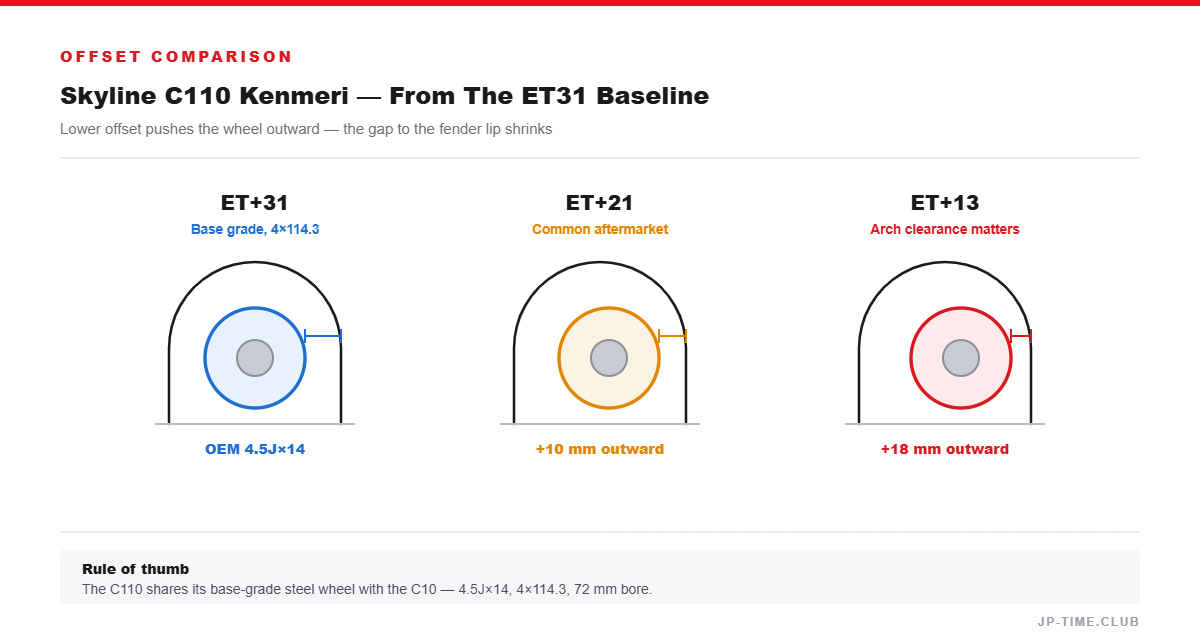
The standard 14×6.5J at +14.5 is the period-correct baseline and it is where most restorations land. The classic Japanese 14 and 15-inch four-lug wheels are made for exactly this, which is why Kenmeris and Watanabes go together so consistently.
The same caution applies as on any fifty-year-old car: parts get swapped over decades, and the car in front of you may not match the table. Count the studs yourself.
Importing
The C110 ran 1972–1977. Every one is decades past the US 25-year mark. Nothing was sold in North America.
What We Could Not Verify
- Hub bore. Not published, in the same way it is not published for the Hakosuka.
- Whether the single GC110 row covers four-cylinder cars as well as the 2000GT.
- Production years, which RS Watanabe’s table does not carry — the 1972–1977 span here is general knowledge.
- Factory wheel specifications as distinct from RS Watanabe’s recommended fitments.
Related Guides
- Nissan Skyline GT-R Hakosuka Wheel Fitment Guide
- Nissan Skyline R30 / R31 Wheel Fitment Guide
- Datsun 240Z / Fairlady Z Wheel Fitment Guide
- RS Watanabe: The Company Behind the Wheels
Seen on the road
Which wheels are you looking for? Tell us the wheel, the size and the fitment — send us a request and we will go and find it.
Wheel identification is taken from the hashtags the owner applied to their own post.
Correction, August 2026
Earlier in this guide we said RS Watanabe publishes no hub bore figure. That was wrong, and it is our error rather than theirs.
Watanabe does publish a hub bore table on its own site. What misled us is that it is not organised the way we expected: there is no bore column on the individual product spec tables, and the figures are not given per vehicle. They are given per wheel model, per rim size, and per PCD band — one figure for bolt circles up to 108 mm, another for 109 mm and above.
For the sizes most relevant to this car, the published figures are φ63 mm on the smaller PCD band and φ70 mm on the larger, across the 14, 15 and 16-inch A, B, R-Type and F8 models. Watanabe also states that φ58 mm is the minimum bore for its die-cast aluminium wheels, and offers hub bore machining as a cost-price option at ¥2,500.
The reasoning we gave was sound even though the fact was not. Watanabe wheels are nut-centric with 60° tapered seats — the company confirms both — so the bore does not need to match your hub, it only needs to clear it. That is why two coarse options per model and size are sufficient, and why they will simply machine it larger if your hub needs more room.
The practical instruction is therefore different from what we normally tell you: measure your hub and confirm it is smaller than the wheel bore, rather than matching the two. We have set out the full table and the marking system in a dedicated article on Watanabe authenticity elsewhere on this site.