The Short Version
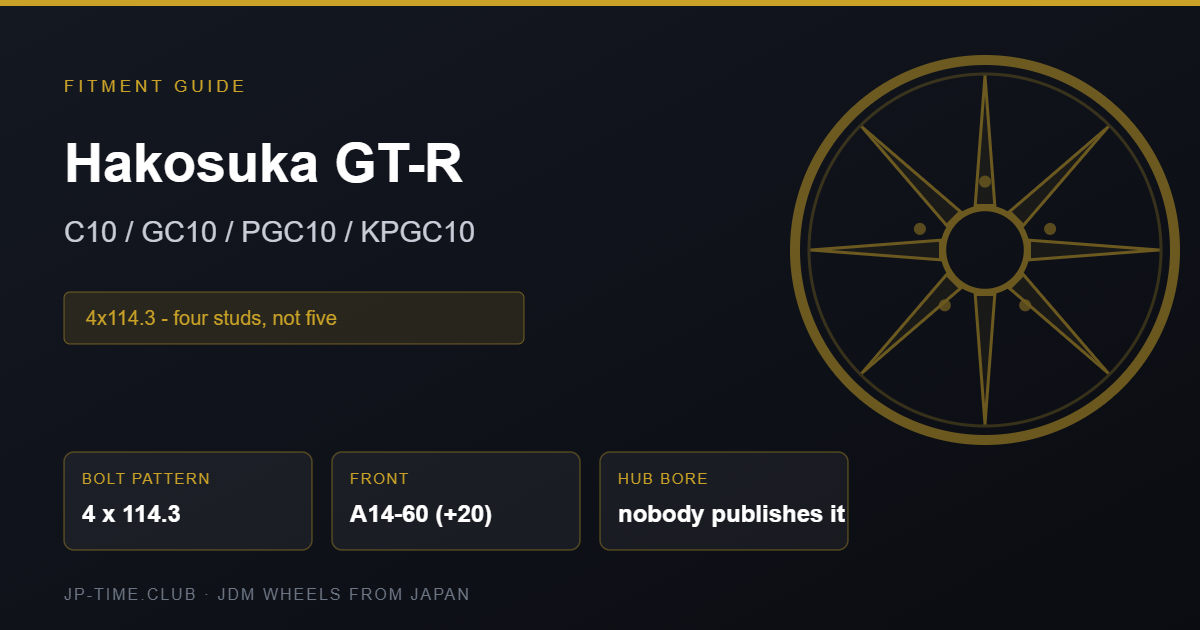
- 4×114.3. Four studs, not five. This is the single most common error made about this car, and it is expensive to get wrong.
- The hub bore is not published by anyone we could find — including RS Watanabe, the company that actually machines wheels for these cars.
- That absence is meaningful, not accidental. RS Watanabe does publish hub bores for other classics on the same page. It publishes none for the Hakosuka. We explain why below.
- The KPGC10 two-door splits into over-fender and no-over-fender fitments, and they are not the same wheels.
Four Studs. Say It Again
The C10 Skyline — including both GT-Rs — runs a 4×114.3 bolt pattern. Not 5×114.3. The five-lug 114.3 pattern that runs through nearly every later Skyline, from the R32 onward, is not what is on this car.
We are being blunt about it because the two numbers share the 114.3 and because “Skyline GT-R” means the R32 to most of the world. A set of R32 wheels will not go on a Hakosuka, and a listing that says “fits Skyline GT-R” is telling you nothing until you know which one.
Our source for this is RS Watanabe’s own matching list, which prints 114.3-4 against every C10-series row: GC10 and KGC10, the four-door PGC10 GT-R, and the two-door KPGC10 GT-R.
What RS Watanabe Actually Publishes
RS Watanabe is the company most people fit to these cars, and its matching list is unusually specific. Here is what it prints, transcribed:
| Model | PCD | Standard fitment | Maximum fitment | Note |
|---|---|---|---|---|
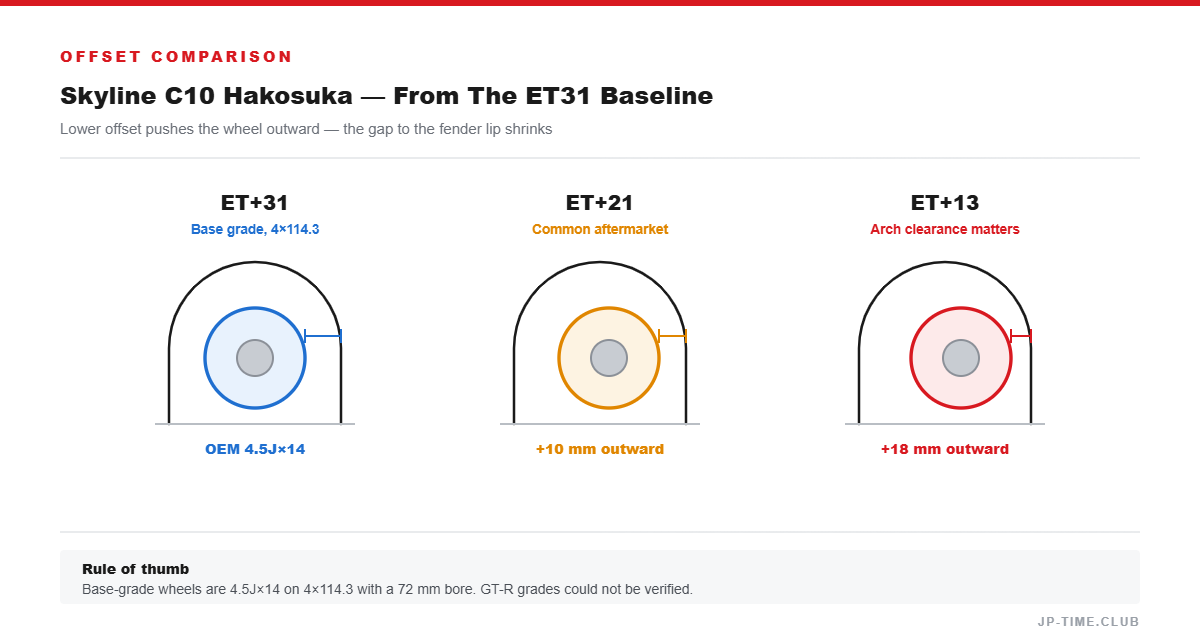
| GC10 / KGC10 Hakosuka | 114.3-4 | F/R: A14-60 (+20) | F: A14-60 (+20) / R: A14-60 (+16); F/R: F8 15-60 (+23) | tyre 195 |
| PGC10 (4-door) GT-R | 114.3-4 | F: A14-60 (+20) / R: B14-65 (+14.5) | F: F8 15-60 (+23) / R: F8 15-70 (+21) | — |
| KPGC10 (2-door) GT-R, no over-fender | 114.3-4 | F: A14-60 (+20) / R: R14-90 (−19) | F: F8F 16-65 (+25), F8 15-60 (+23) or MG F8F 15-60 (+23) / R: 16-90 (−13) or R15-90 (−13) | F: 185, R: 245 |
| KPGC10 (2-door) GT-R, with over-fender | 114.3-4 | F: F8 15-80 (+3) or R15-80 (±0) | R: R15-90 (−13) | F: 195, R: 245 |
Two things jump out. First, the rear runs a much lower offset than the front on the GT-Rs — −19 at the rear against +20 at the front on the two-door. That is not a typo; it is how the car was made to fill its arches. Second, the over-fender cars are a different fitment entirely, moving the front out to +3 or zero. If you are buying wheels for a KPGC10, whether it has flares is the first question, not a detail.
The Hub Bore, and Why It Is Missing
We have had this car blocked in our backlog for months because we could not confirm its hub bore. We have now read RS Watanabe’s matching list end to end, and the answer is that they do not publish one.
What makes that interesting is the company they keep. On the same document, RS Watanabe volunteers hub-bore information for a long list of other classics: the Sunny B110 and B310 at φ73 front, the Bluebird 410 and 411 at φ73, the 510 Bluebird at φ67, the CSP311 Silvia at φ74 machined, the S54 Skyline with a φ70 machining option, the Y30 and Y31 Cedric and Gloria at φ73. It even flags the SR311 Fairlady roadster with an explicit ハブ径要確認! — hub bore, please confirm — because they themselves are not sure.
The C10 rows get none of it. No figure, no caution, nothing.
Our reading — and we are labelling this as our reading, not as something RS Watanabe states — is that these wheels are nut-centric. Watanabe’s A, B, F8 and R-type wheels locate on the 60-degree tapered seat of the lug nut, not on the hub register. On a nut-centric wheel the hub bore only has to clear the hub; it is not the locating surface. That would explain why Watanabe flags the bore when machining is needed to make a wheel clear a particular hub, and stays silent when it is not.
If that is right, the practical answer for a Hakosuka owner is that hub bore is not the dimension that gates your purchase — clearance is. Make sure the wheel’s centre hole clears the hub without interference, and let the tapered nuts do the centring, as the car’s designers intended.
We will not go further than that. We found forum claims of 66.1 mm, reasoned backwards from later Nissans, with no C10 measurement behind them. We are not repeating that number.
PGC10 and KPGC10
Both are GT-Rs. The PGC10 is the four-door sedan, built first; the KPGC10 is the two-door hardtop that followed and that most people picture. RS Watanabe’s own row labels confirm the split, and only the KPGC10 has the over-fender variant.
The fitments differ meaningfully. The four-door’s standard rear is B14-65 at +14.5. The two-door’s is R14-90 at −19. That is a 33 mm offset difference and 2.5 inches of extra width. These are not interchangeable specifications.
Buying for This Car
Hakosukas are now valuable enough that wheels are a restoration decision rather than a styling one. A few practical notes:
- Get the chassis code, not the model name. GC10, KGC10, PGC10 and KPGC10 all want different things.
- Establish whether the car has over-fenders before you shop. It changes the answer completely.
- Ask us before you commit. We can check a physical wheel’s centre bore against your hub, which is more use than any published figure would be here.
Importing
The C10 ran from 1968 to 1972. Every one of them is decades past the US 25-year mark. The constraint on this car is not regulatory, it is supply and price — the KPGC10 GT-R in particular is a car of which fewer than two thousand were made.
What We Could Not Verify
- Hub bore, front or rear. No source we saw publishes one, including RS Watanabe.
- Wheel stud thread and pitch. RS Watanabe gives thread notes on some rows — M12×P1.5 on the S54 Skyline, 7/16 on the SR311 — and gives none on any C10 row. Do not assume M12×1.25.
- Factory steel wheel size. We saw auction listings describing 14×4.5J steels as period-correct, but that is a seller’s description, not a specification.
- Front and rear brake differences between GT-R and non-GT-R C10. Commonly repeated; not sourced by us in this pass.
Related Guides
- RS Watanabe: The Company Behind the Wheels
- Nissan Skyline R32 Wheel Fitment Guide
- Toyota AE86 Wheel Fitment Guide
Seen on the road
Which wheels are you looking for? Tell us the wheel, the size and the fitment — send us a request and we will go and find it.
Wheel identification is taken from the hashtags the owner applied to their own post.
Correction, August 2026
Earlier in this guide we said RS Watanabe publishes no hub bore figure. That was wrong, and it is our error rather than theirs.
Watanabe does publish a hub bore table on its own site. What misled us is that it is not organised the way we expected: there is no bore column on the individual product spec tables, and the figures are not given per vehicle. They are given per wheel model, per rim size, and per PCD band — one figure for bolt circles up to 108 mm, another for 109 mm and above.
For the sizes most relevant to this car, the published figures are φ63 mm on the smaller PCD band and φ70 mm on the larger, across the 14, 15 and 16-inch A, B, R-Type and F8 models. Watanabe also states that φ58 mm is the minimum bore for its die-cast aluminium wheels, and offers hub bore machining as a cost-price option at ¥2,500.
The reasoning we gave was sound even though the fact was not. Watanabe wheels are nut-centric with 60° tapered seats — the company confirms both — so the bore does not need to match your hub, it only needs to clear it. That is why two coarse options per model and size are sufficient, and why they will simply machine it larger if your hub needs more room.
The practical instruction is therefore different from what we normally tell you: measure your hub and confirm it is smaller than the wheel bore, rather than matching the two. We have set out the full table and the marking system in a dedicated article on Watanabe authenticity elsewhere on this site.