
The Short Version
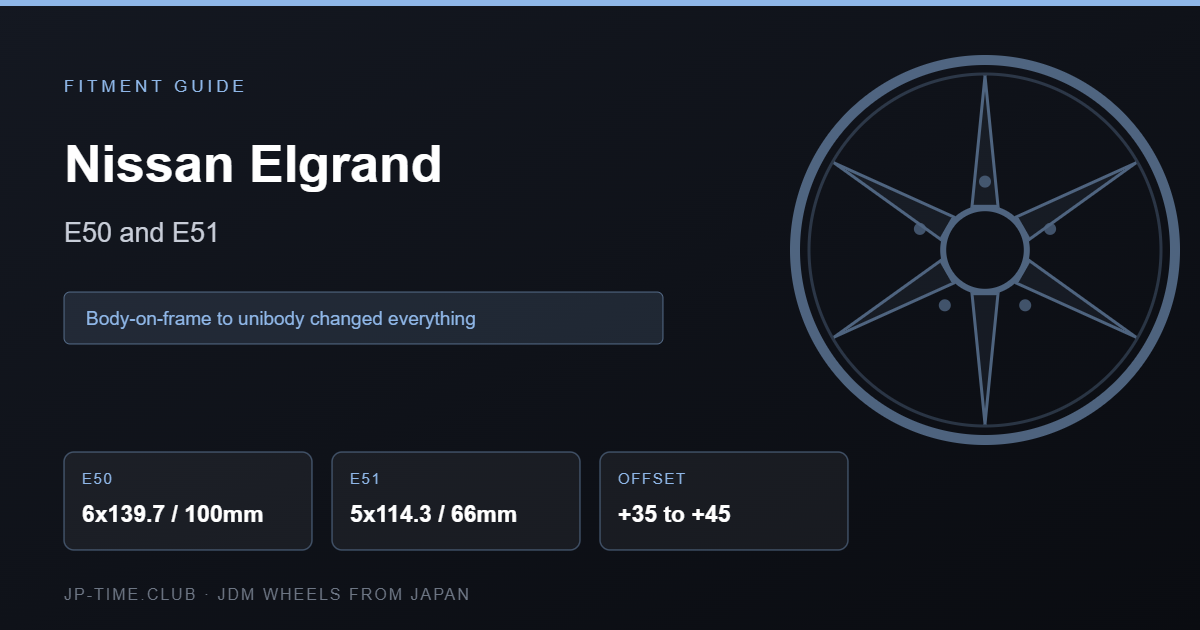
- E50: 6×139.7 with a 100 mm hub bore. Body-on-frame, truck hardware.
- E51: 5×114.3 with a 66 mm bore. Unibody, passenger-car hardware.
- The change is at the generation break in May 2002. Nothing crosses.
- The offset moved too, from +35 on the E50 to +45 on the E51.
Everything Changed at Once
This is one of the cleanest changeovers we have documented, and it happens for a structural reason.
The E50 Elgrand (1997–May 2002) is body-on-frame, built on Nissan’s light-truck architecture. Every grade we checked — the base taxi-spec car, the Field Base X, the top X — reads 6×139.7 with a 100 mm hub bore, on 15 or 16 inch at +35.
The E51 (May 2002–2010) is a unibody. Every grade reads 5×114.3 with a 66 mm bore, on 16 or 17 inch at +45 — confirmed on both the 2002 launch Highway Star and a 2008 350 Rider, so it held across two facelifts. A second Japanese database independently gives the same E51 figures.
Three things changed at once: the pattern, the bore and the offset. There is no partial compatibility here. An E50 wheel and an E51 wheel have nothing in common.
This is exactly the pattern we found on the Delica, where the body-on-frame 4WD cars are 6×139.7 and the unibody D:5 is 5×114.3. When a Japanese van goes unibody, it goes to car wheels.
Factory Specification
| Generation | Chassis | Period | Grade | Wheel | Tyre | PCD / Holes / Bore |
|---|---|---|---|---|---|---|
| E50 | ALE50 | 1997–2002 | 2WD 3.3, 10-seat 4AT | 15×6J +35 | 215/65R15 | 139.7 / 6 / 100 |
| E50 | FLWGE50 | 1997–2002 | 4WD 3.3 Field Base X, 7-seat | 16×6J +35 | 205/65R16 | 139.7 / 6 / 100 |
| E50 | APWE50 | 1997–2002 | 4WD 3.5 X, 8-seat | 15×6J +35 | 215/65R15 | 139.7 / 6 / 100 |
| E51 | UA-E51 | 2002–2004 | 4WD 3.5 Highway Star | 17×6.5J +45 | 215/60R17 | 114.3 / 5 / 66 |
| E51 | CBA-E51 | 2008–2010 | 2WD 350 Rider | 17×6.5J +45 | 215/60R17 | 114.3 / 5 / 66 |
The 100 mm Bore Is Unusual
Worth calling out on its own. The E50’s 100 mm hub register is large even by light-truck standards — the Hilux Surf and the Prado are 106 mm, the Pajero 107 then 67, the Bighorn unpublished. 100 mm is its own figure.
The practical effect is that a 6×139.7 wheel from another vehicle may not clear the E50’s hub, even though the studs line up. Check the bore before you buy, and do not assume that because a wheel says 6×139.7 it will go on.
Sizing
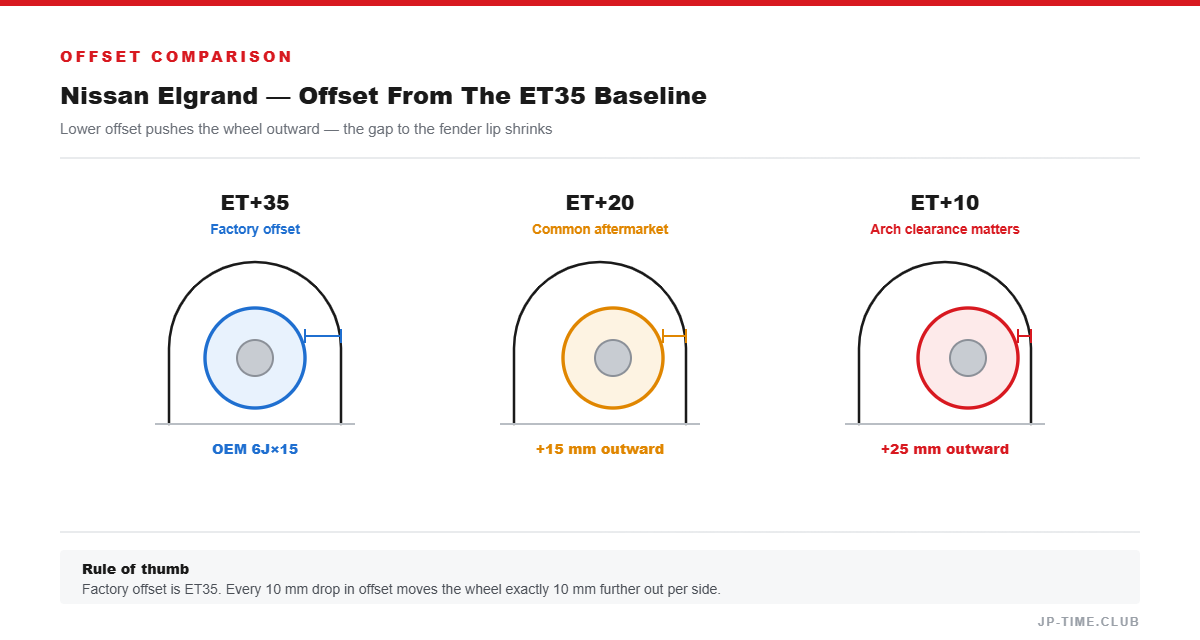
The E50 at 15 or 16 inch and +35 is modest for a large van, and most builds go up. From +35 the usual window is 17×7.5J to 18×8J at +25 to +40, in 6×139.7 — which limits you to the light-truck wheel pool.
The E51 at 17×6.5J and +45 is on a much more common fitment. 18×7.5J to 19×8J at +35 to +45 is the usual territory, and 5×114.3 with a 66 mm bore is one of the best-supplied combinations in Japan.
Both are heavy eight-seat vehicles. Load rating matters more than weight, and most Japanese makers do not publish one.
Importing
The E50 ran 1997 to May 2002. Cars built through August 2001 are eligible for US import now, with the final months following to 2027. The E51 launched in May 2002 and starts becoming eligible in 2027.
The Elgrand was never sold in North America. It is a common import in the UK and New Zealand, where the E50 in particular has a following as a camper base.
What We Could Not Verify
- The exact day of the changeover. The databases give the model-year grouping; the May 2002 date comes from Japanese market sources rather than the wheel tables.
- Whether any leftover E50 stock was registered after May 2002.
- Only three E50 and two E51 grades were sampled, though all were consistent.