

The Short Version
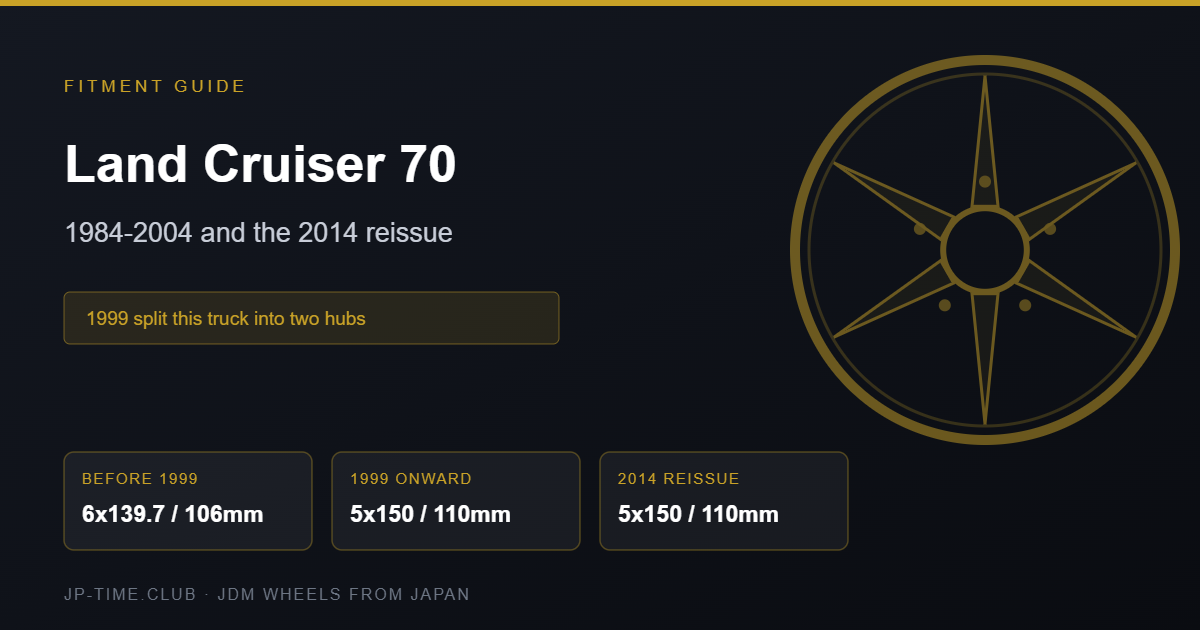
- The 70 series is two different vehicles at the hub, and the split is 1999.
- Before the 1999 facelift: 6×139.7 with a 106 mm bore — the same as the Land Cruiser 80.
- From 1999 onward, and including the 2014–2015 reissue: 5×150 with a 110 mm bore — the same as the Land Cruiser 100.
- They do not interchange, despite being the same truck by name.
The Finding
We had the 70 series flagged as unresolved. It is now resolved, and the answer is more interesting than a single number.
The pre-facelift trucks — the S- and KC-prefixed chassis codes, covering the soft-top PZJ70, the PZJ70V and PZJ77V, and the HZJ77V — all read PCD 139.7, 6 holes, 106 mm bore.
The post-1999 trucks — KG-prefixed onward — read PCD 150, 5 holes, 110 mm bore. We opened the KG-HZJ76V page ourselves to be sure. The modern diesel GDJ76W and the entire 2014–2015 GRJ76 and GRJ79 reissue read the same.
So the 70 series changed from a six-stud light-truck hub to the five-stud 150 mm pattern that Toyota used on the Land Cruiser 100, and it did it at the 1999 facelift.
Where the 70 Sits Against the Rest
| Vehicle | Bolt pattern | Hub bore |
|---|---|---|
| Land Cruiser 70, pre-1999 | 6×139.7 | 106 mm |
| Land Cruiser 80 | 6×139.7 | 106 mm |
| Prado J90 / J120 | 6×139.7 | 106 mm |
| Land Cruiser 70, 1999 onward | 5×150 | 110 mm |
| Land Cruiser 100 | 5×150 | 110 mm |
Read that table twice. An early 70 shares its hub with an 80 and a Prado. A late 70 shares its hub with a 100. And the early and late 70s share nothing with each other.
So the first question for any 70-series wheel purchase is not what the truck is. It is which side of 1999 it falls on — and the chassis prefix tells you: S- and KC- are the old pattern, KG- and later are the new one.
Factory Specification
| Era | Chassis | Body / grade | Wheel | Tyre | PCD / Holes / Bore |
|---|---|---|---|---|---|
| Pre-facelift | S-PZJ70 | soft top, 2-door | 16×5.5 ±0 | 215/80R16 | 139.7 / 6 / 106 |
| Pre-facelift | S-PZJ77V | 4-door LX | 16×5.5 ±0 | 215/80R16 | 139.7 / 6 / 106 |
| Pre-facelift | KC-HZJ77V | 4-door LX 4AT | 16×5.5 ±0 | 205R16 | 139.7 / 6 / 106 |
| 1999–2001 | KG-HZJ76K | 4-door ZX | 16×7 −25 | 265/70R16 | 150 / 5 / 110 |
| 1999–2004 | KG-HZJ76V | 4-door LX | 16×5.5 ±0 | 215/80R16 | 150 / 5 / 110 |
| 2014 reissue, van | CBF-GRJ76K | 4WD van | 16×7 ±0 | 265/70R16 | 150 / 5 / 110 |
| 2014 reissue, pickup | CBF-GRJ79K | 4WD pickup | 16×5.5 +20 | 7.50R16 | 150 / 5 / 110 |
| Modern diesel | 3DA-GDJ76W | AX 2.8D | 16×7 ±0 | 265/70R16 | 150 / 5 / 110 |
The Offsets Are All Over the Place
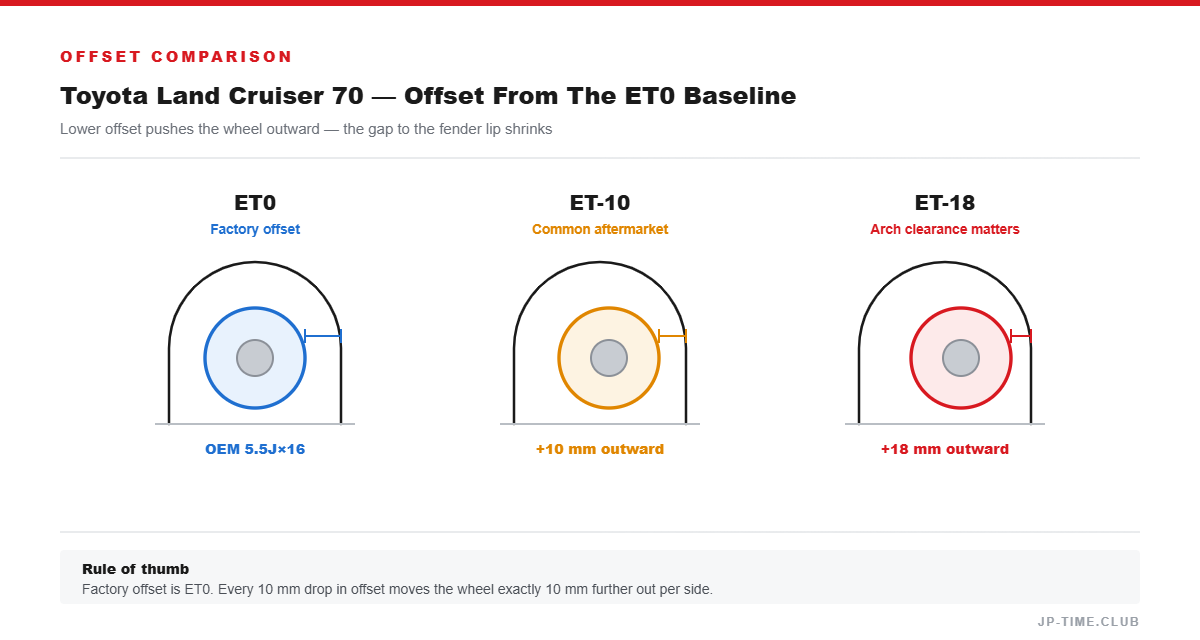
Worth its own note because the spread is large. The ZX wagon runs −25 on a 7J — deeply negative, which is why it looks the way it does. The LX runs zero on a narrow 5.5J. The 2014 reissue pickup runs +20, while the reissue van runs zero on a 7J.
So even within one bolt pattern, moving a wheel between a ZX wagon and an LX changes the track by 25 mm per side. These are working vehicles and the offsets were chosen for load and clearance rather than looks.
Importing
Everything up to August 2001 is eligible for US import now, which includes all of the pre-1999 trucks and the first two years of the 5×150 cars. The 2001–2004 trucks follow to 2029.
The 2014–2015 reissue is a 2039 proposition under the 25-year rule. Canada’s fifteen-year rule opens it from 2029.
What We Could Not Verify
- The HZJ75 troop carrier specifically. We infer from the chassis prefix that it sits with the pre-1999 group; we did not open a page badged HZJ75.
- Whether any transitional 1999 build carries the old pattern. The chassis prefix is the reliable tell.