The Short Version
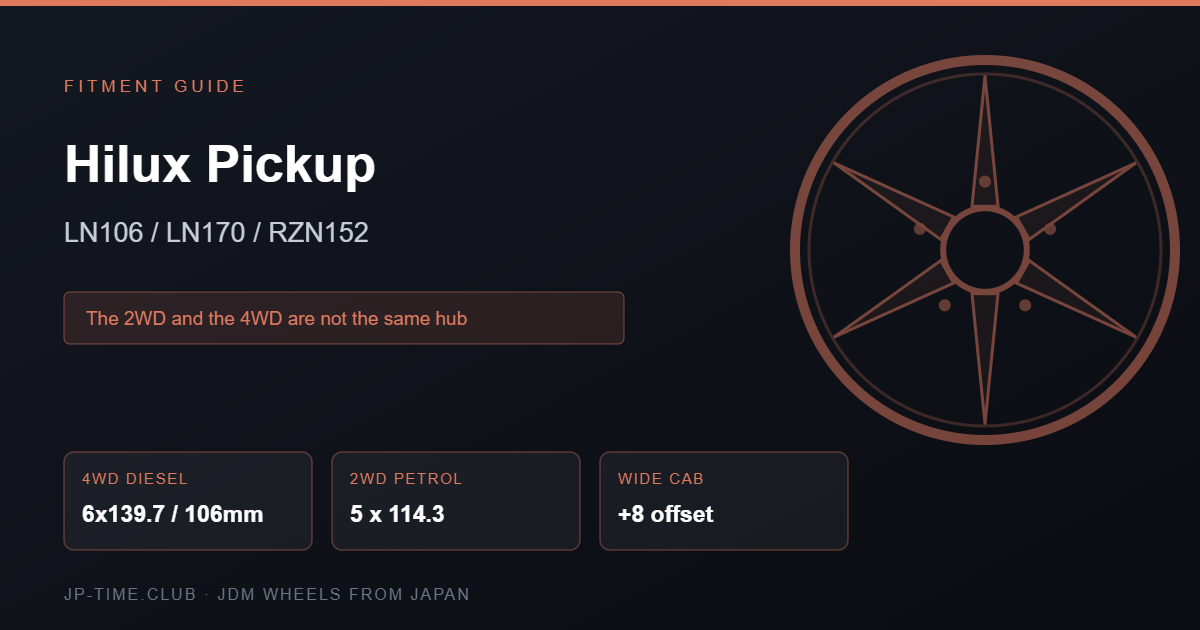
- The 4WD diesel Hilux is 6×139.7 with a 106 mm bore. The same as the Hilux Surf.
- The 2WD petrol Hilux is 5×114.3. A completely different hub, on the same model name.
- So a 4WD Hilux wheel will not bolt to a 2WD Hilux. This is the single most important fact on this page.
- Wide-body cabs run +8. Standard cabs run +29 or +30.
Drivetrain Decides the Bolt Pattern
Sellers and buyers treat “Hilux pickup” as one fitment. It is not.
Every 4WD LN-chassis grade we checked — the single-cab LN106 from 1990 and the extra-cab LN170H from 1997, spanning both the original Hilux Pickup and the post-1997 Hilux Sport Pickup rebrand — reads 6×139.7 with a 106 mm bore.
The 2WD petrol grades read something else entirely. We opened the GC-RZN152H page ourselves: PCD 114.3, 5 holes. Five studs on a passenger-car circle.
That is not a subtle difference. A wheel from a 4WD Hilux has six studs and a wheel from a 2WD Hilux has five, and no amount of the same model name changes it.
Factory Specification
| Drive | Chassis | Period | Body / grade | Wheel | Tyre | PCD / Holes / Bore |
|---|---|---|---|---|---|---|
| 4WD diesel | S-LN106 | 1990.08–1994.08 | 2.8D single cab long DLX | 15×6J +30 | 215SR15 | 139.7 / 6 / 106 |
| 4WD diesel | KB-LN107 | 1994.08–1997.08 | 2.8D double cab SR / SSR | 15×6J +30 | — | 139.7 / 6 / not re-confirmed |
| 4WD diesel | KB-LN170H | 1997.09–1999.09 | 2.4D extra cab, wide | 15×7J +8 | 255/70R15 | 139.7 / 6 / 106 |
| 4WD diesel | KF-LN172H | 1997.09–2004.04 | 3.0D extra cab, wide | 15×7J +8 | — | 139.7 / 6 / not re-confirmed |
| 2WD petrol | GC-RZN152H | 1999.08–2001.08 | 2.0 extra cab, standard | 15×6J +29 | 195SR15 | 114.3 / 5 / under investigation |
Two Names, One Truck
Worth knowing when searching. The database splits this vehicle in two: “Hilux Pickup” covers grades to August 1997, and “Hilux Sport Pickup” covers September 1997 onward.
That is a marketing rename at the 1997 facelift, not a new vehicle. But if you search one name you will not find the other, and it makes the model look like it ended in 1997 when it did not.
Standard Cab Versus Wide Cab
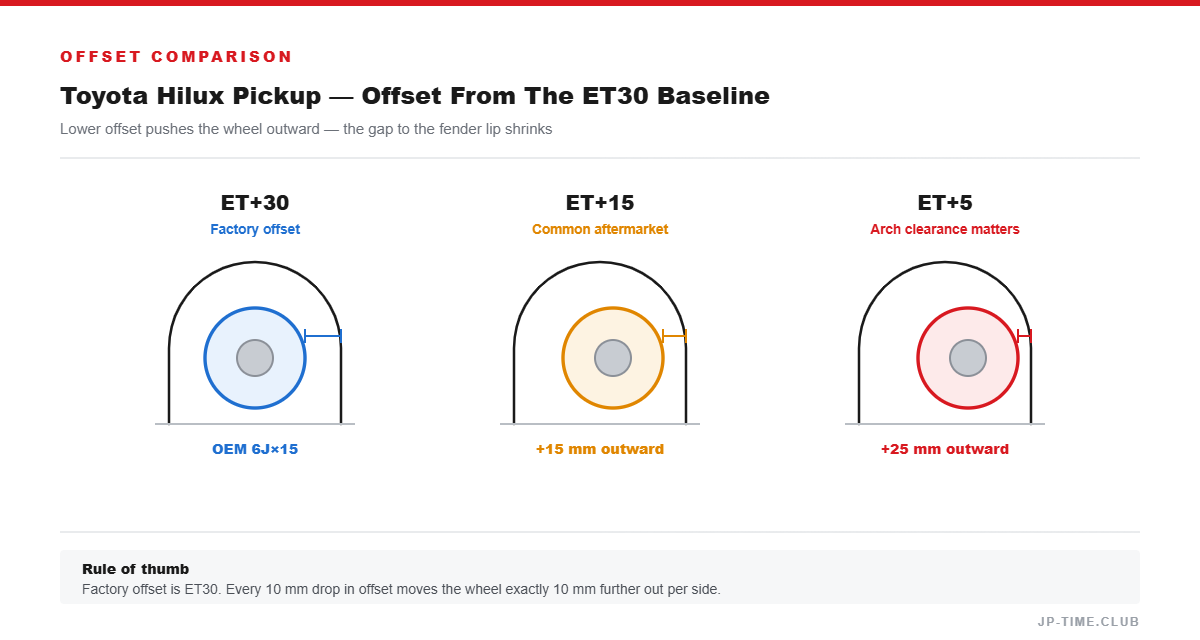
The second thing to establish after drivetrain. Standard-width cabs run +29 or +30 on a 6J. Wide-body double and extra cabs run +8 on a 7J.
That is 22 mm of offset and an inch of width, to clear the flared arches on the wide cars. Both are 6×139.7 and both will bolt on, so nothing stops you fitting the wrong one — it will simply sit 22 mm too far in or too far out.
Sizing
These are working trucks and most exported ones get used as such. From a +8 or +30 baseline the usual move is 16×7J to 16×8J in the −10 to +20 range with a taller all-terrain tyre.
Load rating matters more than weight here, and 6×139.7 wheels made for the Surf, the Prado or the 80-series Land Cruiser are the right family — they share the 106 mm register.
Importing
The LN106 and LN107 are fully past the US 25-year mark. The Sport Pickup era from September 1997 is eligible for cars built through August 2001, with the rest following to 2029.
The Hilux pickup was sold in North America until 1995 as the Toyota Pickup, so the shape is familiar there — but the diesel was never offered, which is why the JDM 2.8D and 3.0D trucks get imported.
What We Could Not Verify
- Hub bore for the 2WD petrol grades. The database explicitly marks it “under investigation”. The bolt pattern and hole count are confirmed.
- Hub bore for the LN107 double cab and the LN172H, whose wheel sizes we read from the index rather than opening the grade page.
- Anything before August 1990, which is where the database’s coverage starts.