The Short Version
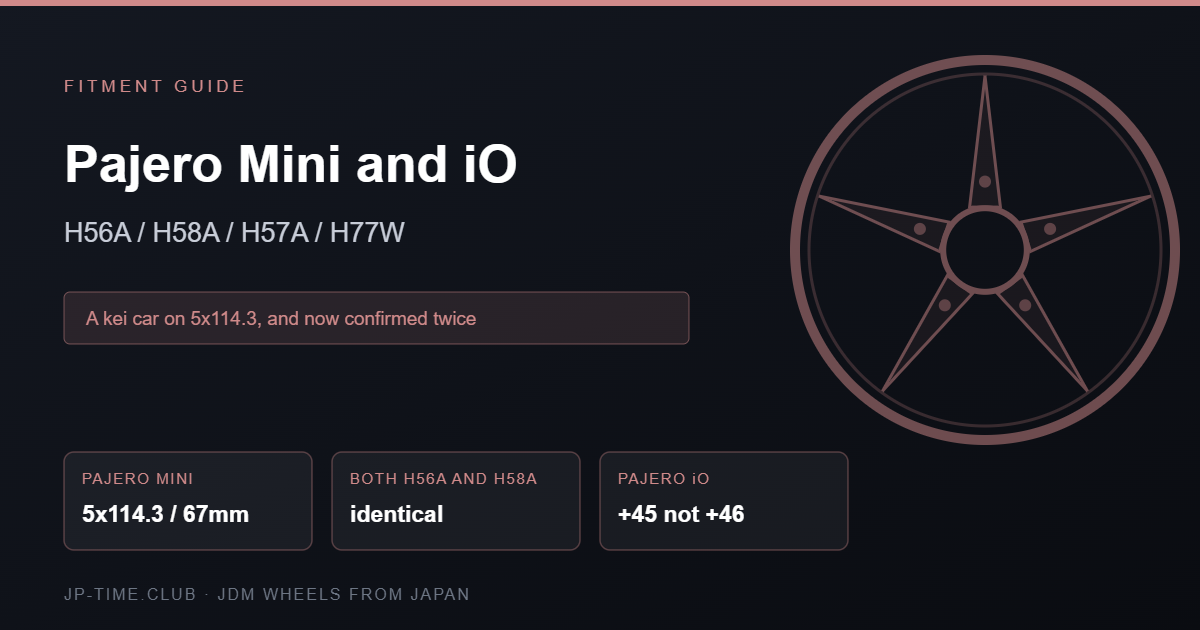
- 5×114.3 with a 67 mm hub bore on both Pajero Mini generations — the H56A and the H58A.
- That is a full-size car’s bolt pattern on a kei car, and it is now confirmed on four separate H56A grades.
- The Pajero iO matches the pattern and bore but runs +45 where the Mini runs +46.
- The Pajero Junior’s bore is marked “under investigation”, though its bolt pattern is confirmed.
The H56A Question, Settled
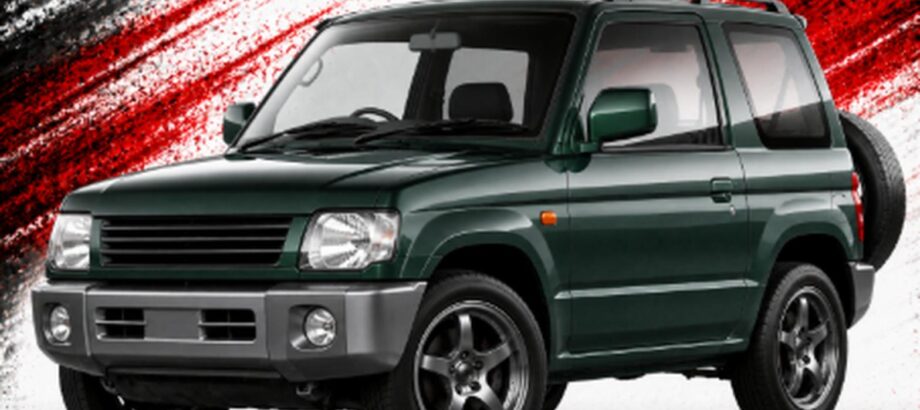
We confirmed the later H58A Pajero Mini at 5×114.3 on 67 mm some time ago, and flagged the earlier H56A (1994–1998) as unverified — explicitly warning readers not to assume it matched.
It does. Four separate H56A grade pages — VR-II, Desert Cruiser, Skipper V Turbo and Skipper X — all read PCD 114.3, 5 holes, 67 mm bore, at +46 on 175/80R15.
So both Pajero Mini generations share one fitment. The only difference we found is rim width: the H56A grades run a 5J rim and the later H58A VR runs 5.5J. Offset, pattern and bore are unchanged.
A Kei Car on Five Studs
This remains the striking thing about the car. Kei vehicles are almost universally 4×100, and the exceptions we have found — the Cappuccino and the AZ-1 at 4×114.3, the Honda Z at 5×114.3 — are genuinely unusual.
The Pajero Mini is in that last category, and unlike the Honda Z it is not a one-off: the pattern carries across the whole Mitsubishi mini-SUV family. The Pajero Junior and the Pajero iO are 5×114.3 too.
Practically that means your wheel pool is the large 5×114.3 one, not the kei one. Lancer, Galant and Diamante wheels are the right family; Wagon R and Move wheels are not.
Factory Specification
| Car | Chassis | Period | Grade | Wheel | Tyre | PCD / Holes / Bore |
|---|---|---|---|---|---|---|
| Pajero Mini | E-H56A | 1994–1998 | VR-II | 15×5J +46 | 175/80R15 | 114.3 / 5 / 67 |
| Pajero Mini | E-H56A | 1994–1998 | Desert Cruiser | 15×5J +46 | 175/80R15 | 114.3 / 5 / 67 |
| Pajero Mini | E-H56A | 1994–1998 | Skipper V Turbo | 15×5J +46 | 175/80R15 | 114.3 / 5 / 67 |
| Pajero Mini | E-H56A | 1994–1998 | Skipper X | 15×5J +46 | 175/80R15 | 114.3 / 5 / 67 |
| Pajero Mini | ABA-H58A | 1998– | VR | 15×5.5J +46 | 175/80R15 | 114.3 / 5 / 67 |
| Pajero Junior | E-H57A | 1995–1998 | ZR-II | 15×6J +46 | 205/70R15 | 114.3 / 5 / under investigation |
| Pajero iO | TA-H77W | 2002–2007 | ZR 2.0 4AT | 16×6J +45 | 215/70R16 | 114.3 / 5 / 67 |
The One Millimetre
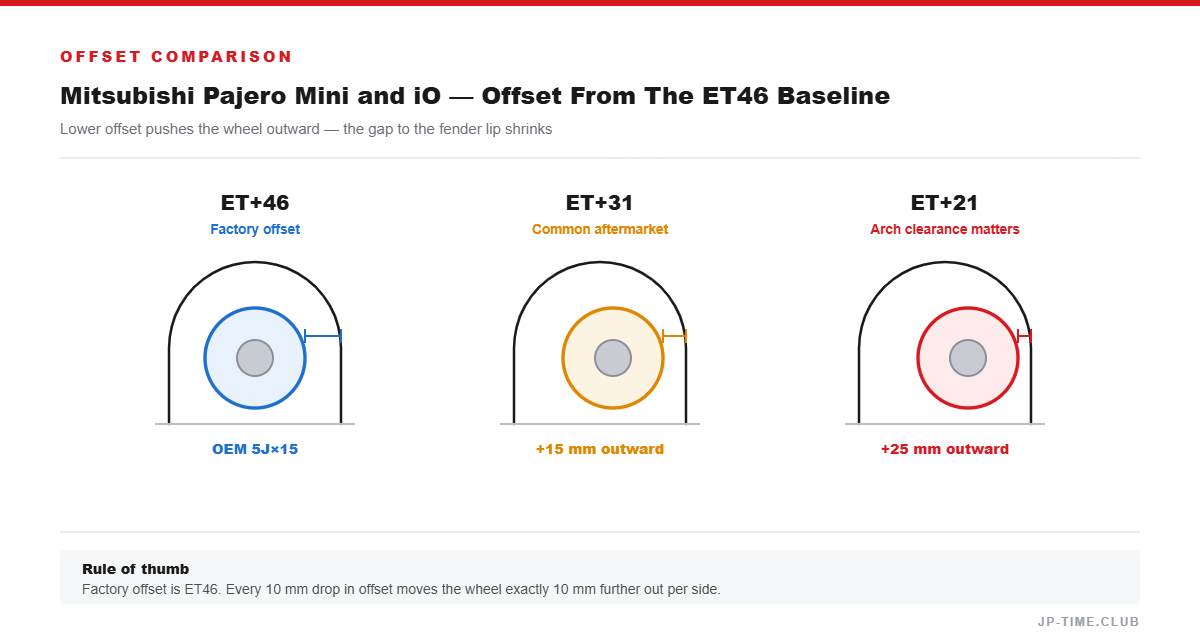
The Pajero Mini and Junior sit at +46. The Pajero iO sits at +45.
One millimetre is nothing to drive on. It matters only if you are doing precise fitment arithmetic — working out exactly where a wheel face will land relative to the arch — and it is the sort of thing that gets rounded away in secondary sources. We are reporting what the table says.
Sizing
The Pajero Mini’s 15×5J on a 175/80R15 is a tall, narrow, deliberately off-road-flavoured setup on a 660 cc vehicle. Most builds keep the diameter — the ride height depends on that tall sidewall — and go wider: 15×6J to 15×7J in the +20 to +45 range.
Because it is 5×114.3 rather than kei-standard, a wide 15-inch wheel is easy to find. That is a genuine advantage this car has over its kei rivals.
67 mm hub rings are needed with most aftermarket wheels.
Importing
The H56A Pajero Mini (1994–1998) is fully past the US 25-year mark, as is the Pajero Junior. The H58A ran from 1998 to 2013, so cars built through August 2001 are eligible now and the rest follow.
The Pajero iO from 2002 is a 2027-and-later proposition.
None was sold in North America. As always with kei vehicles, state road registration is a separate question from federal import eligibility.
What We Could Not Verify
- Hub bore for the Pajero Junior (H57A). Explicitly marked “under investigation”. Its bolt pattern is confirmed at 5×114.3. We are not carrying the Mini’s 67 mm across.