The Short Version
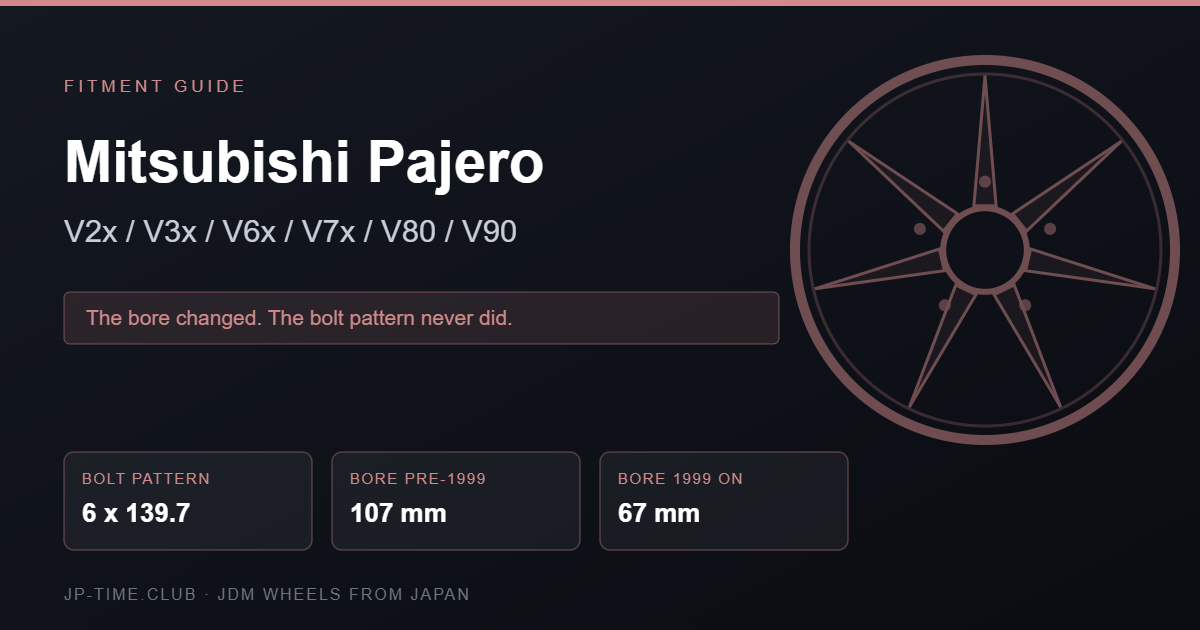
- The full-size Pajero never changed bolt pattern. 6×139.7 from the second generation right through to the last V90-series cars.
- The hub bore did change, and that is the real trap: 107 mm on the V2x / V3x, 67 mm from the third generation onward. Same PCD, completely different register.
- Pajero Mini and Pajero iO are 5×114.3 with a 67 mm bore. Not 6-lug, not 4-lug. Different vehicles entirely.
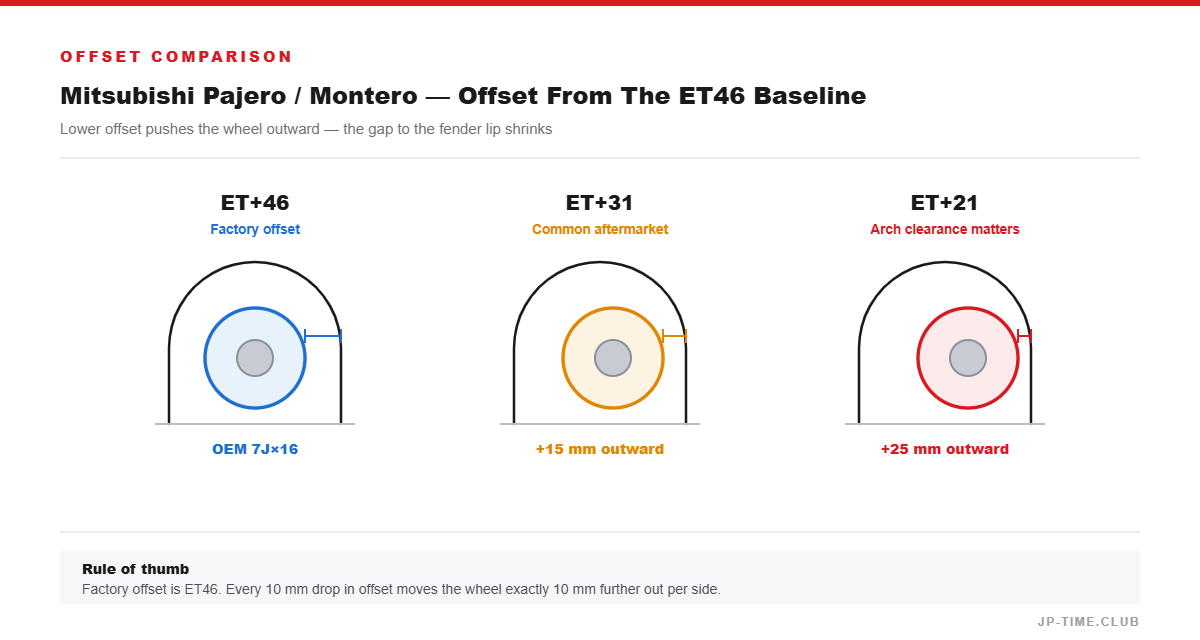
- Factory offsets moved too: +10 on the second generation, +46 from the third onward.
Everyone Looks for the Wrong Change
The question we get asked about the Pajero is when Mitsubishi moved it off 6×139.7. The answer is that they did not. We checked the second generation (V2x / V3x), the third (V6x / V7x) and the fourth (V80 / V90) in the Japanese factory database, gasoline and diesel, short and long wheelbase, right up to 2016 grades. Every one is 6×139.7.
What actually changed is the hub bore, and it changed by a lot. The second-generation cars have a 107 mm register. From the third-generation redesign onward the figure is 67 mm. That is not a rounding difference or a measurement convention — it is a fundamentally different hub.
The consequence is specific and expensive. A wheel that bolts perfectly to a 1995 Pajero, with the correct six studs at the correct spacing, will not sit hub-centric on a 2002 one, and vice versa. The lug nuts will pull it up and it will feel fine at first. It is not fine. On a two-tonne vehicle the hub register is doing real work.
Factory Specification
| Generation | Chassis | Period | Wheel | Bolt pattern | Bore |
|---|---|---|---|---|---|
| 2nd | E-V23W (3.0 Metaltop Wide VR) | 1994.08–1995.08 | 15×7J +10 | 6×139.7 | 107 |
| 2nd | E-V45W (3.5 Midroof Wide Exceed-Z) | 1994.08–1995.08 | 15×7J +10 | 6×139.7 | 107 |
| 2nd | V24W / V46WG and other XJ, XR, Exceed grades | 1994–1996 | 15×6J to 15×7J, +10 to +33 | 6×139.7 | 107 |
| 3rd | TA-V75W (Long Exceed-T 3.5) | 2001.08–2002.09 | 16×7J +46 | 6×139.7 | 67 |
| 4th | CBA-V93W (Exceed Long, gasoline) | 2007.10–2009.12 | 17×7.5J +46 | 6×139.7 | 67 |
| 4th | LDA-V88W (3.2D Short VR-U) | 2015.07–2016.10 | 18×7.5J +46 | 6×139.7 | 67 |
The Offset Moved With the Bore
It is worth noticing that the second generation sits at +10 and everything from the third generation onward sits at +46. Those two facts travel together: the third-generation redesign changed the front suspension and hub design, and the bore, the offset and the wheel diameter all moved at once.
So when you see a set of Pajero wheels advertised without a generation, the offset tells you almost as much as the bore does. A 15-inch 7J at +10 is a second-generation wheel. A 16, 17 or 18-inch at +46 is third generation or later. If a listing claims a 17-inch wheel at +10 fits a Pajero, something is wrong with the listing.
Pajero Mini and Pajero iO Are Not Small Pajeros
This is the second trap and it catches people who assume the family name implies shared hardware. It does not.
The Pajero Mini is a kei-class vehicle. We confirmed the H58A directly in the Japanese database: 5×114.3, 67 mm bore, 15×5.5J +46 on 175/80R15. Five lugs, not six, and not the four-lug pattern most people assume for a kei car.
The Pajero iO is the same story. Across roughly thirty grade and year combinations in the database, every one is 5×114.3 with a 67 mm bore, typically 16×6J at +45 or +46.
Note the coincidence that makes this genuinely confusing: the Mini, the iO and the post-1999 full-size Pajero all share a 67 mm bore. The same hub ring works on all three. The bolt pattern does not. If someone offers you “Pajero wheels” and the wheel has five studs, it came off a Mini or an iO, not off the truck.
Importing to the United States
Mitsubishi sold this vehicle in the United States as the Montero until 2006, so the second and third generations are familiar and already local there. For a JDM Pajero, the second and third generations are comfortably past the 25-year mark. The fourth-generation V80 / V90 launched in 2006 and becomes eligible on a rolling basis from 2031.
The JDM-only variants worth the effort are generally short-wheelbase second-generation cars and the diesel grades the US never received. All of those are eligible now.
What We Could Not Verify
- The exact month the bore changed from 107 mm to 67 mm. We have 1995 data at 107 and 2001 data at 67, which brackets it to the 1999 third-generation redesign, but we did not find a source dated at the changeover itself.
- First-generation Pajero Mini (H56A, 1994–1998) fitment. Do not assume it matches the H58A figures above.
- Pajero Junior (H57A, 1995–1998) fitment entirely. No source found.
- First-generation Pajero (1982–1991) fitment, which is outside the data we pulled.
Seen on the road
Which wheels are you looking for? Tell us the wheel, the size and the fitment — send us a request and we will go and find it.
Wheel identification is taken from the hashtags the owner applied to their own post.