The Short Version
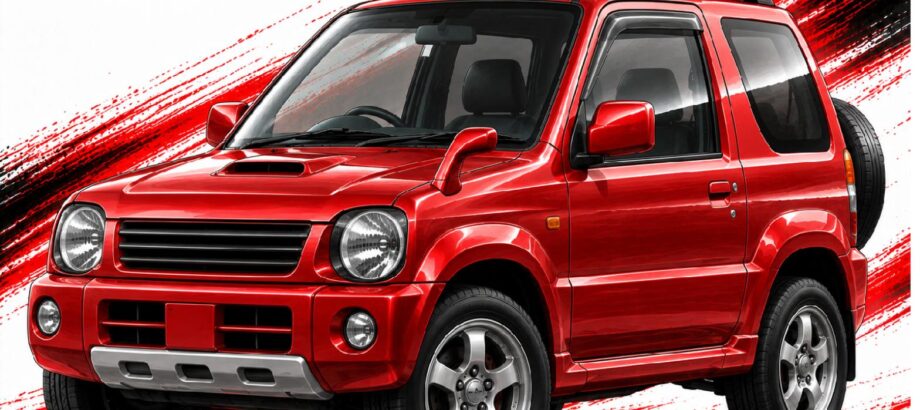
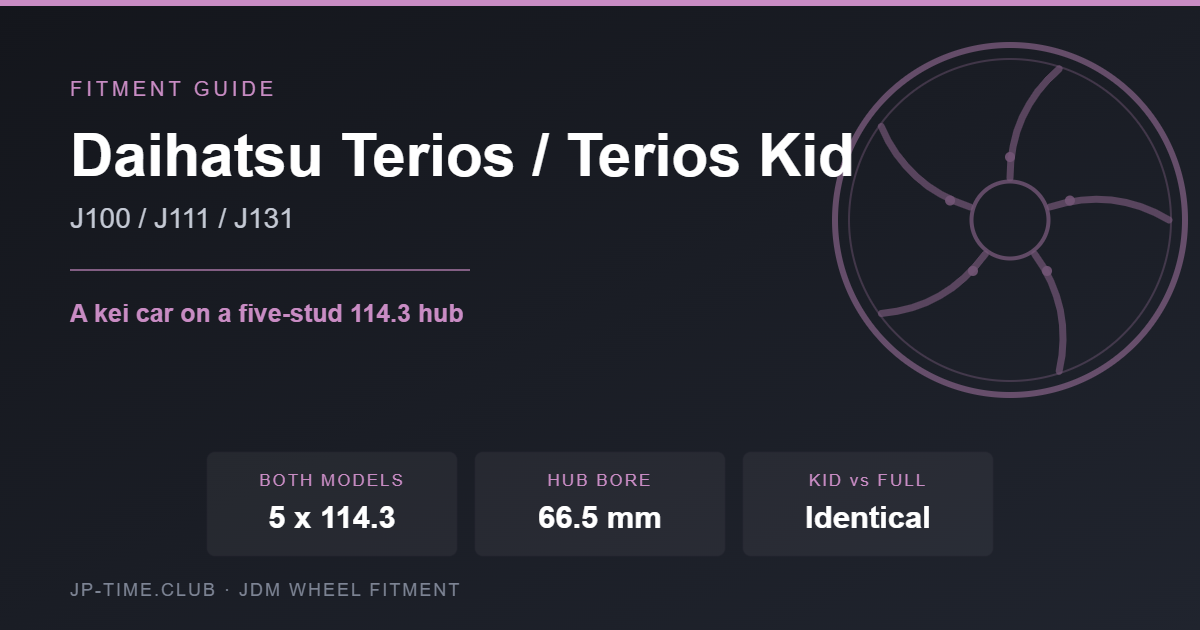
- The Terios Kid is a kei car on 5×114.3. Five studs, on the bolt circle of a Crown, under a 660 cc vehicle.
- The full-size Terios is identical: 5×114.3, 66.5 mm bore.
- 66.5 mm is its own figure. Not Toyota’s 60.1, not Mazda’s 67, not the 54.1 of every other Daihatsu kei car.
- The original F300 Rocky is not in either Japanese database. We could not verify it at all.
A Kei Car That Is Not on Kei Hardware
Daihatsu kei vehicles are 4×100 on a 54.1 mm bore. The Mira, the Move, the Hijet, the Copen — that is the family figure, and it is what anyone would assume for a 660 cc Terios Kid.
It is wrong. We read the factory database directly and every Terios Kid grade, 2WD and 4WD, returns:
| Model | Chassis | Grades | Wheel | PCD | Holes | Bore |
|---|---|---|---|---|---|---|
| Terios Kid 2WD | ABA-J131G | L, Custom L, Custom X | 5J×15 +50 | 114.3 | 5 | 66.5 mm |
| Terios Kid 4WD | ABA-J111G | L, Custom L, Custom X | 5J×15 +50 | 114.3 | 5 | 66.5 mm |
| Terios (full size) | TA-J122G, J100G, J102G | CL, CL Limited and others | 5.5J×15 +35 | 114.3 | 5 | 66.5 mm |
The reason is structural rather than clerical. The Terios Kid is a real body-on-frame four-wheel-drive vehicle that happens to fit inside kei dimensions — a shrunken Terios, not a stretched Mira. It inherited the Terios’s hub hardware, and Daihatsu did not design a smaller one for it.
What That Means Practically
This is good news, and it is the reason the Terios Kid has a following well beyond its size.
The whole 5×114.3 aftermarket is open to you. That is the largest wheel market in Japan. You are not restricted to the small, plain 4×100 kei selection. Fifteen-inch wheels intended for a Silvia, a Chaser or an Altezza will bolt to a 660 cc kei off-roader.
Two cautions. First, the bore. 66.5 mm is not a common aftermarket figure — most 5×114.3 wheels are bored to 73 mm and shipped with rings, which is fine, but a wheel bored specifically to Nissan’s 66 mm will not go on. Half a millimetre is enough. Check before buying.
Second, weight and load rating. A wheel designed for a 1,500 kg saloon is not automatically appropriate for a short-wheelbase 4WD that gets driven on rough surfaces, and kei regulations do not exempt you from needing an adequate load index. Our load rating guide covers the arithmetic.
Terios Versus Terios Kid
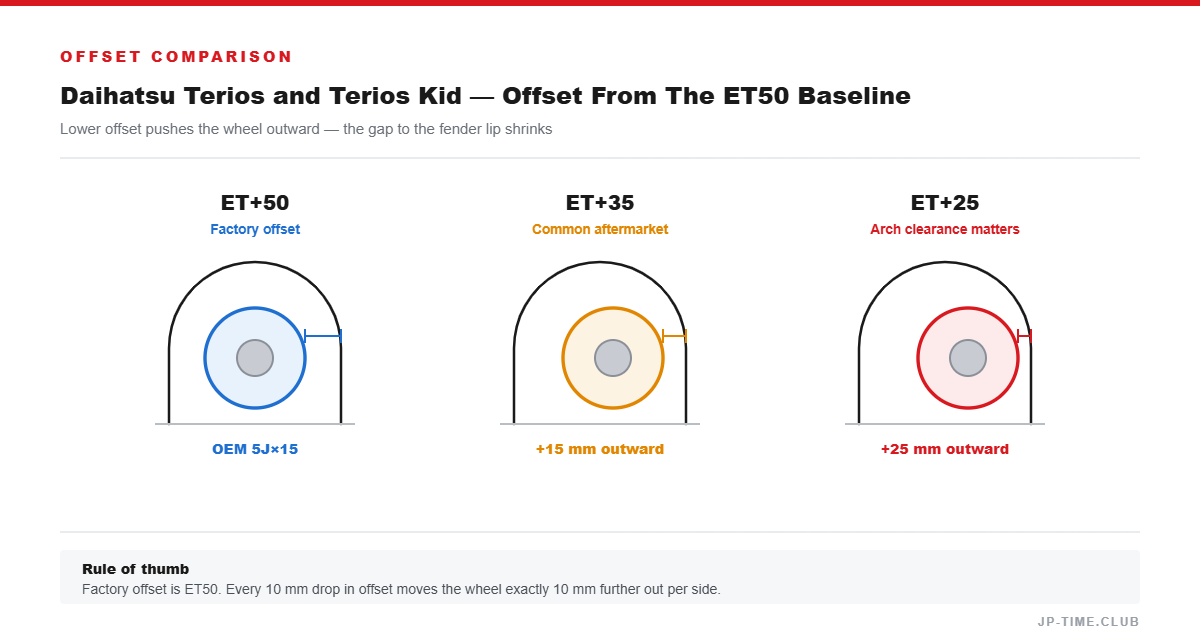
The only meaningful fitment difference is offset. The Kid runs 5J×15 at +50 and the full-size Terios runs 5.5J×15 at +35 — half an inch wider and 15 mm further out.
So full-size Terios wheels will bolt to a Kid and will sit noticeably proud, which is exactly the look many Kid owners want. Going the other way, Kid wheels on a Terios will tuck in. Both are mechanically fine at these offsets; it is a stance decision, not a safety one.
The Rocky We Could Not Find
You asked about the Rocky F300 — the 1990–1998 body-on-frame small 4×4, sold as the Rocky or Feroza in export markets. We could not verify it.
Both Japanese factory databases list “Rocky” only as the current A200S/A210S, the 2019-onward crossover that is a rebadged Toyota Raize, with data starting in 2019. The original F300 appears in neither site’s discontinued-model index. This is a genuine gap in the source data, not something we overlooked, and we are not going to fill it from a secondary site.
If you need F300 figures, measure the vehicle. We would rather tell you we do not know.
An Aside on the Current Rocky
Since we were in there: the modern A200S Rocky is 4×100 on a 54 mm bore — the ordinary Daihatsu figure — except the hybrid, chassis 5AA-A202S, which is 5-lug. A bolt-pattern change within a single generation, tied to the powertrain.
Completely unrelated to the vehicle you are reading about, but it is exactly the kind of thing that catches people, so it is worth having on the record.
Importing
The Terios launched in 1997 and the Terios Kid in 1998, so early cars of both are eligible for US import now and the rest follow on a rolling basis. Neither was sold in North America in this form, and the Kid in particular — a genuine locking-differential kei 4×4 — has no equivalent anywhere.
What We Could Not Verify
- The Rocky F300 entirely. Not indexed in either database, in any section.
- The second-generation J200 Terios (2006 onward), which we did not open.
- Whether any Terios or Terios Kid grade was offered with an optional wheel differing from the standard fitment.