

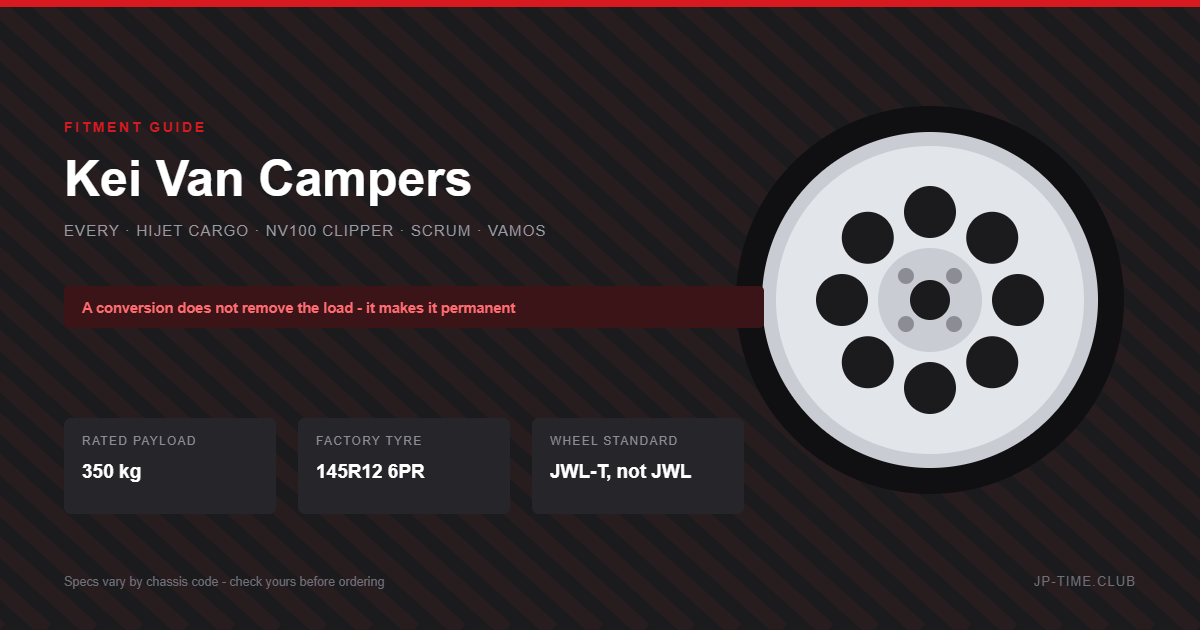
Kei vans have become camper vans. In Japan it is called 車中泊 — sleeping in the car — and it has been a mainstream hobby for a decade. In the United States and Australia the same vehicles are arriving as cheap, tiny, four-wheel-drive-capable camper platforms, and people are building beds, cabinets, water tanks and battery systems into them.
This is a good idea. It is also a load-rating question that almost nobody asks, because the weight you add to a camper conversion does not look like cargo.
The Short Version
- A kei van is rated for 350 kg of payload. The wheels, tyres and springs were designed around that number.
- A camper conversion does not remove the load. It makes it permanent, and usually raises its centre of gravity.
- These wheels are certified to
JWL-T— the truck and bus standard — not theJWLon a passenger car wheel. - Inch-up reduces load capacity at exactly the moment you are adding weight.
- The tyre and the wheel have separate ratings. Meeting one does not mean you have met the other.
What 350 kg Is Actually For
Japanese kei commercial vehicles are registered as 貨物 — cargo vehicles, the four-digit plate class. The standard rated payload is 350 kg, and that figure is not decoration. It is the number the suspension, the tyres and the wheels were engineered around.
The tyres tell you this plainly. A kei van leaves the factory on 145R12 6PR or, on the current Hijet Cargo, 145/80R12 80/78N LT. Both are commercial-vehicle designations. The LT and the ply rating are there because the vehicle is expected to be loaded.
There is a useful real-world illustration of what happens when you add weight to one of these. When Mitsubishi built the Minicab MiEV — the battery-electric version, roughly 200 kg heavier than the petrol van — it moved from 6PR to 8PR tyres. Mitsubishi did not simply hope the existing tyre would cope. It specified a heavier one.
Your camper conversion is doing to the van roughly what a battery pack did to the MiEV.
Add Up What You Are Actually Adding
The trap with a camper build is that no single item feels heavy. Together they are a permanent payload the vehicle now carries every day, in every corner, over every pothole.
| Item | Rough weight | Where it sits |
|---|---|---|
| Bed platform and framing | 25–50 kg | Low, over the rear axle |
| Cabinetry and storage | 20–60 kg | Mid height |
| Water, 20 L | 20 kg | Wherever you put it |
| Leisure battery, 100 Ah lithium | 10–15 kg | Low, ideally |
| Leisure battery, 100 Ah lead-acid | 25–30 kg | Low, necessarily |
| Roof rack and solar | 15–35 kg | Above the roofline |
| Fridge, cooking, bedding, gear | 30–60 kg | Mixed |
| Two adults | ~140 kg | Mid height, forward |
These are illustrative figures to make a point, not specifications — your build will differ and you should weigh it. But run a plausible middle case and you are at 300 kg or more of permanent and semi-permanent load on a vehicle rated for 350.
That is not automatically over the limit. It is, however, close enough that guessing is the wrong approach. Take the finished vehicle to a weighbridge, loaded as you actually travel, and get an axle-by-axle figure. Everything below depends on that number, and no article can give it to you.
Roof Load Is the One That Bites
Of everything in that table, the roof rack is the item that changes how the vehicle behaves rather than just how much it weighs.
A kei van is about 1.48 m wide — that is the legal limit for the class — and a high-roof version is close to 1.9 m tall. It is a tall, narrow box. Putting 25 kg of rack and panel on top of that raises the centre of gravity of a vehicle that did not have much margin to begin with.
The wheels do not care where the weight sits; the tyres and the way the vehicle corners very much do. If you are adding a roof load, that is the moment to be conservative about tyre choice rather than adventurous.
JWL-T, and Why It Is on Your Wheel
Japan operates two separate technical standards for light-alloy wheels, both issued under the same 1983 Ministry of Transport notification: one for passenger cars, behind the JWL mark, and one for trucks and buses, behind JWL-T.
Your kei van is a cargo vehicle. Aftermarket wheels sold for it in Japan are normally certified to the truck standard.
There is a detail here worth knowing, because it is checkable on the wheel itself. When a wheel is certified to both standards, the load figure is prefixed to say which certification it belongs to: VIA-P for the passenger-car figure, VIA-T for the truck figure. A dual-certified kei van wheel can read VIA-T 450KG.
If a wheel offered for a kei van carries only a bare VIA with no -T, and no JWL-T, it was certified as a passenger car wheel. That may still be a perfectly good wheel. It was not tested against the standard written for the job you are about to give it.
We have written this up in more detail in the kei truck and kei van overview, including the full list of markings a Japanese wheel is required to carry.
The Tyre and the Wheel Are Two Different Ratings
This trips up careful people, because they check one number and reasonably assume they are done.
The tyre carries a load index — the number before the speed letter. On the current Hijet Cargo’s 145/80R12 80/78N LT, the 80 is the load index for single fitment and the 78 is the figure for dual. On the standard load index scale those correspond to 450 kg and 425 kg per tyre. Older kei vans use the ply-rating convention instead: 145R12 6PR.
The wheel carries its own rating, stamped in kilograms next to the VIA mark. It is defined as half the axle weight at gross vehicle weight — what one wheel actually carries.
These are independent. A high-load-index tyre on a lightweight aftermarket wheel is limited by the wheel. A heavy-duty wheel with a passenger-car tyre on it is limited by the tyre. You need both numbers, and the smaller one is your answer.
Inch-Up, and the Awkward Timing
Thirteen, fourteen and fifteen-inch conversions on kei vans look good and there is a real Japanese aftermarket for them. The awkwardness is one of timing: a camper build is the point at which you are adding the most weight this vehicle has ever carried, and inch-up is the point at which you usually reduce its rated capacity.
Three things happen when you leave 12 inches:
- Load-rated tyre choice collapses. 145R12 and 145/80R12 are commercial sizes with plenty of LT and ply-rated options. At 14 or 15 inches you are largely choosing among passenger tyres.
- Wheel load ratings fall. Lightweight aftermarket wheels are designed around passenger cars. Look for the
JWL-Tmark, not just an attractive face. - Offset room is limited. Factory is around +40 to +45 on a body 1.48 m wide, and there is not much space to push the wheel outward.
None of this is an argument against inch-up on a van you use lightly. On a van carrying a permanent 300 kg build, it is an argument for staying on 12 or 13 inches with a load-rated tyre and a JWL-T wheel — and for treating that as the informed choice rather than the boring one.
A Short Checklist
- Weigh the finished vehicle, loaded as you travel, axle by axle.
- Divide the rear axle weight by two. That is what one rear wheel carries.
- Read the wheel. Find the kilogram figure next to the VIA mark. Is it above your number?
- Read the tyre. Find the load index or ply rating. Is it above your number?
- Check the mark.
JWL-Tor a bareJWL? - If you added a roof load, be conservative on everything above.
What We Could Not Verify
- Any single per-wheel load rating that applies to kei vans as a class. There is not one — it is a property of the individual wheel. The only reliable number is the one stamped on the wheel in front of you.
- Whether a 2014 rule change permits JWL-only wheels on light cargo vehicles in Japan. Several Japanese sites state this; we could not confirm it against a ministry document. If the van carries load, buy JWL-T.
- Conversion component weights. The table above is illustrative. Weigh yours.
- How overseas registration authorities treat a converted kei van. Entirely separate question — see our US guide for how varied that picture is.
Related Guides
- Kei trucks and kei vans: what wheels fit — bolt patterns, hub bores, JWL-T in full
- Suzuki Carry & Every — also sold as Clipper, Minicab and Scrum
- Daihatsu Hijet — also sold as Sambar since 2012
- Honda Acty & Vamos
- Kei trucks in the USA
Wheels for a Converted Kei Van
We source in Japan to order, which suits this problem: load-rated 12-inch and 13-inch wheels for kei commercial vehicles are a domestic Japanese product, and the sets worth having move locally.
Tell us the chassis code, and tell us your rear axle weight loaded — not the vehicle’s rated payload, the number off the weighbridge. With that we can tell you what actually carries it. The Request page is the place.