
The Short Version
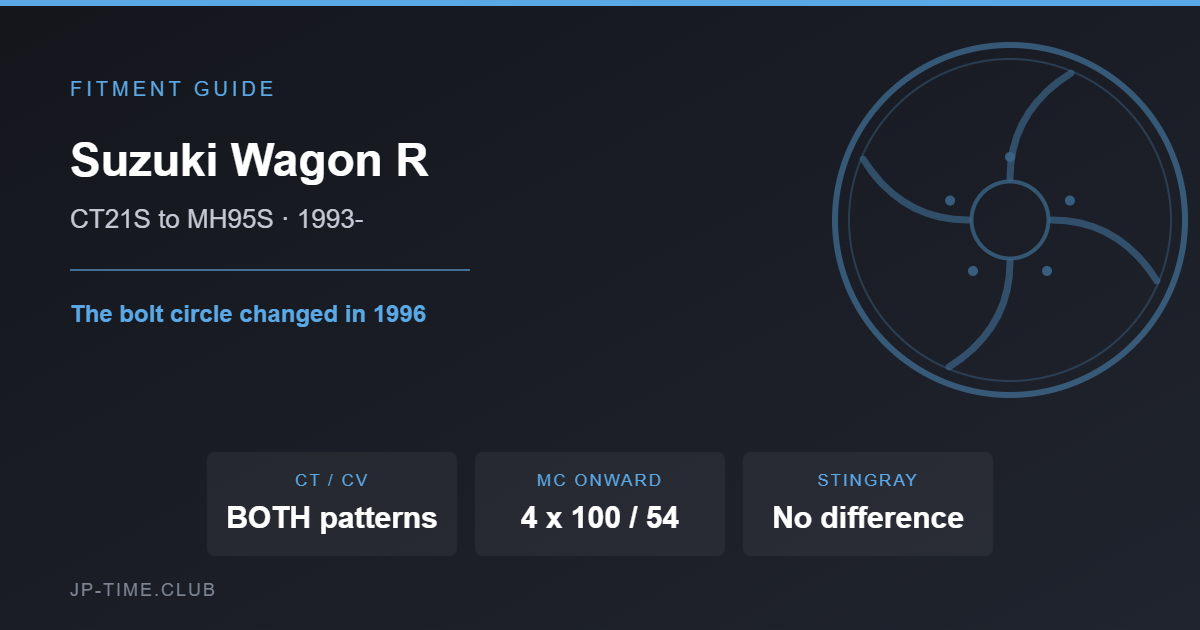
- The CT21S and CV21S carry both bolt patterns. 4×114.3 and 4×100, under the same chassis codes.
- Everything from the MC series onward is 4×100 on a 54 mm bore. Thirty years, no change.
- No CT/CV bore has ever been researched.
- Stingray and the RR turbo run the base car’s fitment.
The Ninth Case
We keep a running list of Japanese cars where one chassis code carries two bolt patterns. Until now it had eight entries. The Wagon R makes nine, and it is the highest-volume car on the list by a wide margin.
| Chassis | PCD | Holes | Bore | Rows | Example |
|---|---|---|---|---|---|
| CT21S | 114.3 | 4 | Not researched | 18 | 4-door 2WD RA 5MT, 4J×12 +45 |
| CT21S | 100 | 4 | Not researched | 30 | 2WD 5-door column FT 3AT, 4J×13 +45 |
| CV21S | 114.3 | 4 | Not researched | 11 | 4-door 4WD RG-4 5MT, 4J×13 +45 |
| CV21S | 100 | 4 | Not researched | 17 | 4WD 4-door RG-4 5MT, 4J×13 +45 |
| CT51S, CV51S | 100 | 4 | Not researched | 31 | 2WD RX 5MT, 4J×13 +45 |
The changeover falls in 1996. Cars built before it are 4×114.3; cars built after are 4×100. Same chassis code, same grade names, in several cases the same wheel size and the same offset.
This is the second time Suzuki has done this to us. The Cultus switched from 4×114.3 to 4×100 in February 1996 under chassis code E-AA44S — the same year, the same direction, the same silence about it.
So on a first-generation Wagon R, the chassis plate does not tell you the bolt pattern. Count the studs and measure the circle.
Everything After Is Simple
From the MC series in 1998 onward, the Wagon R is 4×100 with a 54 mm bore, and it stays there:
- MC11S / MC21S / MC12S / MC22S (1998–2003)
- MH21S / MH22S (2003–2009), including the RR turbo
- MH23S (2008–2010)
- MH34S / MH44S (2012–2017)
- MH35S / MH55S (2017–2020)
- MH85S / MH95S (2020–), including the hybrid grades
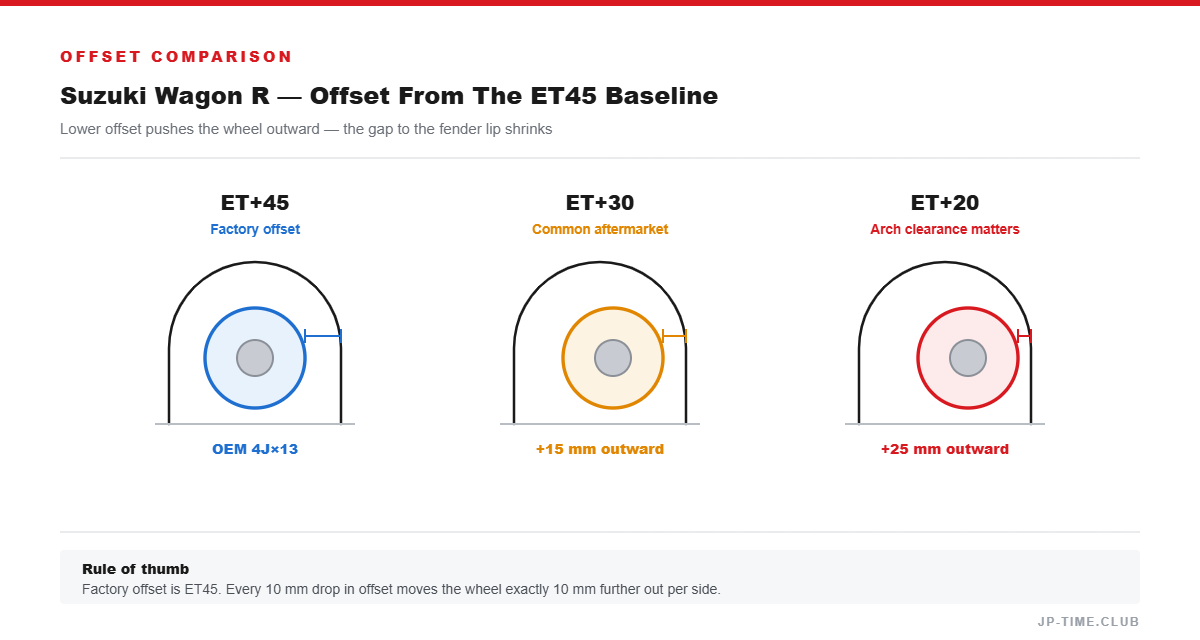
The offset is +45 throughout, and has been since 1993. Wheel size moves from 4J×13 to 4.5J×14, with 4.5J×15 on higher grades from around 2003.
That is remarkable consistency for a car that has been through six generations and thirty-two years.
Stingray and RR Are Not Different
We checked the Stingray on every generation where it exists — MH23S, MH34/44S, MH35/55S, MH95S — and the RR turbo across the MC and MH21/22 range. Both carry the same 4×100 / 54 mm at +45 as the base car. The Custom Z is the same again.
So there is no Stingray-specific or turbo-specific fitment to hunt for. What those grades get is a larger rim, usually 15-inch, and that is all.
The Bore Gap
Every CT and CV row leaves the bore blank, confirmed as 調査中 on the individual grade pages. The figure appears from the MC series in 1998 onward and reads 54 mm from there on.
So the first generation — the one with the bolt-pattern problem — is also the one with no bore. If you are working on a 1993 to 1998 Wagon R, you are measuring both numbers yourself. Our hub bore reference covers the method.
Buying
For anything MC-series or later, 4×100 with a 54 mm bore is the standard Suzuki and Daihatsu kei fitment and wheels are abundant and cheap.
The one thing to check: Honda and Mitsubishi kei cars use 56 mm, not 54 — we cover that in the N-BOX guide. A 56 mm-bored wheel is two millimetres loose on a Wagon R hub. It bolts up and it is not located.
For a first-generation car on 4×114.3, you are in genuinely awkward territory — that is a large bolt circle on a 12 or 13-inch wheel, and the choice is very thin.
Importing
The Wagon R launched in September 1993, so first and second-generation cars are eligible for US import now.
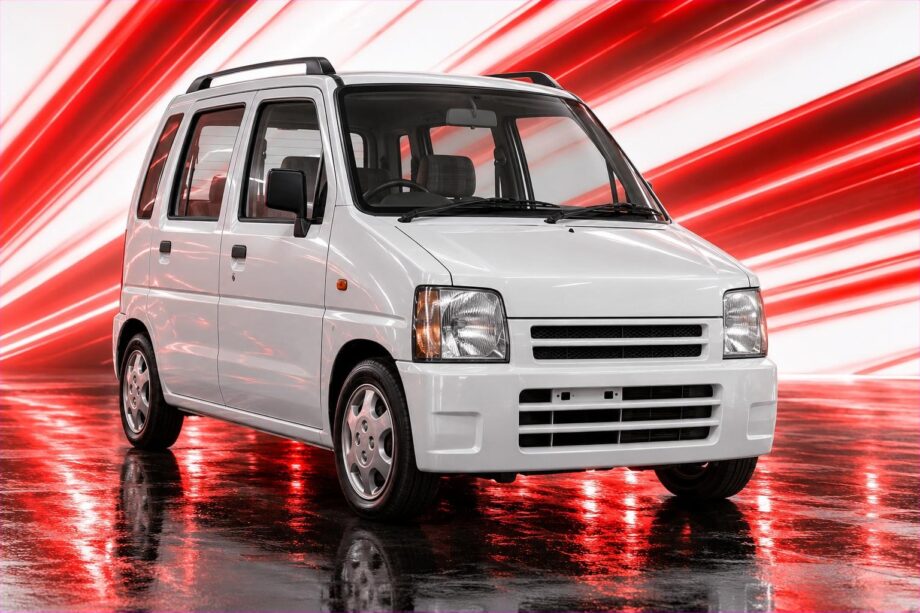
It has never been sold outside Japan under this name, and it more or less invented the tall kei wagon — the format that now dominates the Japanese market. The early CT21S is the interesting one historically, and it is also the one with the fitment trap.
What We Could Not Verify
- Hub bore for the entire 1993–1998 CT/CV generation. Confirmed unresearched.
- The exact month in 1996 of the bolt-pattern change. The dated blocks bracket it; we did not find a single row spanning the boundary.
- Whether the Wagon R Wide, Plus and Solio derivatives follow the same pattern — we did not open those pages.