The Short Version
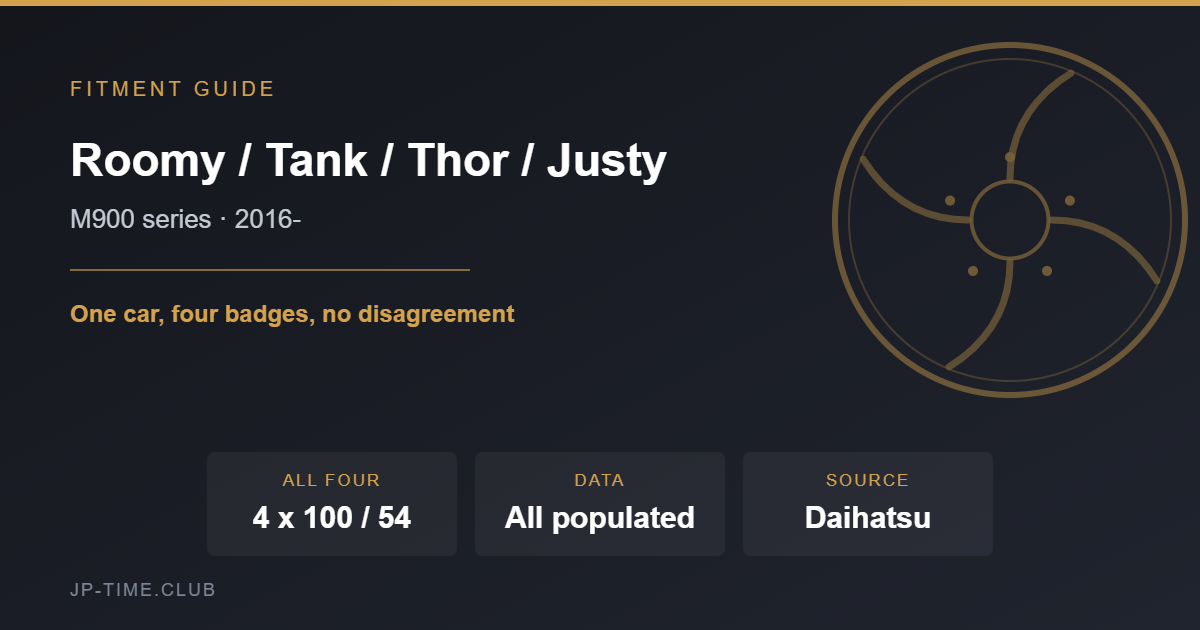
- One car, four badges, one specification. 4×100 on a 54 mm bore.
- All four pages exist and all four are fully populated.
- Daihatsu is the source. Toyota, Subaru and Daihatsu’s own badge all sit on it.
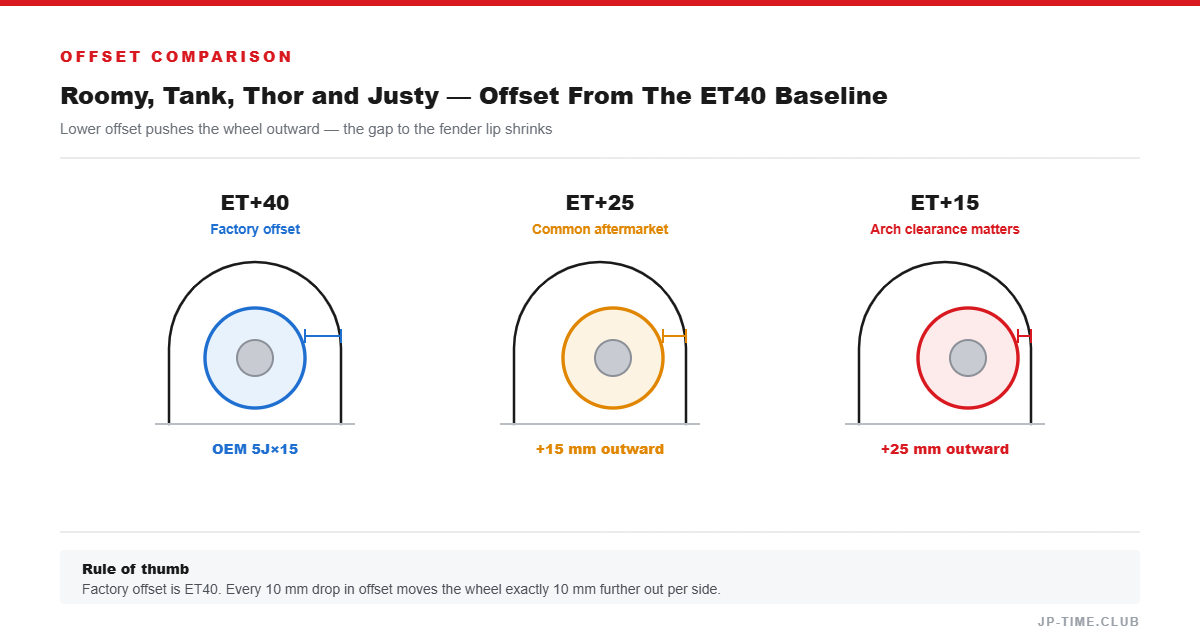
- Base grades run 5J×14 +35; Custom grades 5J×15 +40.
Four Badges, One Vehicle
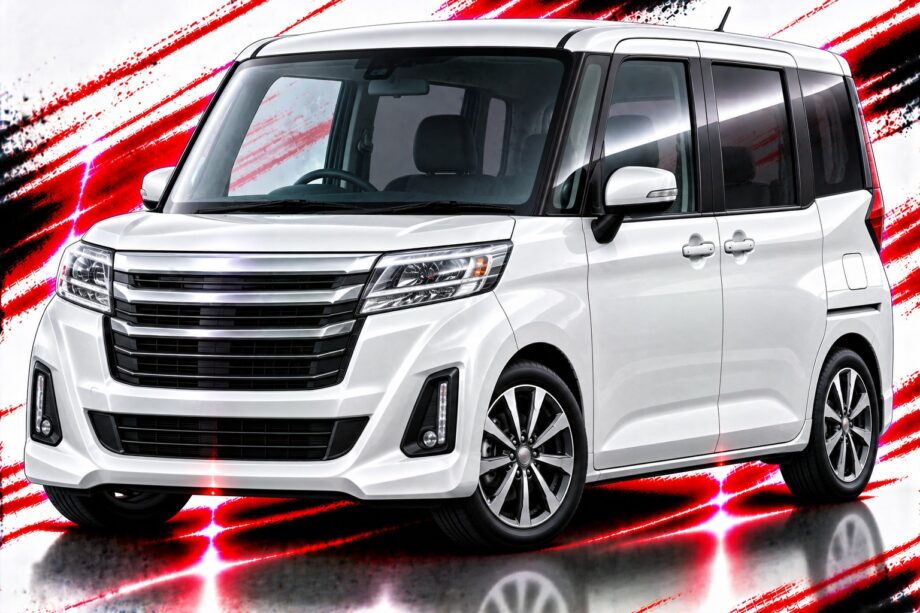
The M900 series is the most heavily rebadged car we have documented. Daihatsu builds it and it is sold as:
| Badge | Chassis | Period | Notes |
|---|---|---|---|
| Daihatsu Thor | M900S (2WD), M910S (4WD) | 2016– | The source vehicle. Most complete data set. |
| Toyota Roomy | M900A, M910A | 2016– | Toyota’s version, still current |
| Toyota Tank | M900A, M910A | 2016–2020 | A second Toyota badge, for a different dealer channel. Discontinued when Roomy absorbed the line. |
| Subaru Justy | M900F, M910F | 2016– | Subaru’s version |
Note the chassis-code convention, which is completely transparent once you see it: M900 plus a letter for the brand — S for Daihatsu, A for Toyota, F for Subaru. Same for the 4WD M910.
Toyota sold the same car under two of its own badges simultaneously, through different dealer networks. That is a very Japanese arrangement and it means “Roomy” and “Tank” are not even different trim levels — they are the same vehicle with different grilles.
The Fitment
All four badges: 4×100, 4 holes, 54 mm bore.
- Base grades — 5J×14 at +35
- Custom grades — 5J×15 at +40
No badge diverges. No grade splits. Every page is populated with a real bore figure.
Why We Checked So Carefully
Because badge twins are exactly where the data usually falls apart. We have documented five pairs where one page carries a hub bore and its twin does not — and one, the Ipsum and Gaia, where the same chassis code reads differently on two pages.
A four-badge vehicle is four chances for that to happen. It did not happen here. All four agree, which makes this the cleanest rebadge set we have looked at.
Compare the Passo and Boon, also Daihatsu-built and also in complete agreement. Daihatsu’s rebadges appear to be better documented than most.
The Justy Naming Trap
Worth flagging, because it will catch someone.
The Subaru Justy page carries two completely unrelated cars. Alongside the M900F above, there is an E-KA7 and E-KA8 Justy from the early 1990s — a Subaru-built supermini, with the bore unresearched.
Both are 4×100 by coincidence. One has a published 54 mm and one has nothing. Read the chassis code, not the model name — we cover the older car in our Domingo and Justy guide.
Buying
4×100 on 54 mm is the most abundant fitment in Japan, shared with the Tanto, the Vitz, the Corolla and most Suzuki and Daihatsu kei cars.
The offset is the thing to note: +35 on base grades is low for a small Toyota-badged car. A wheel at +45 will tuck the track in by a centimetre per side, which on a narrow, tall body is visible.
Check the bore, as always on 4×100: Honda and Mitsubishi use 56 mm and those wheels sit loose here.
Importing
All four badges launched in 2016, so they become eligible for US import from 2041.
None was sold outside Japan. The interest is the packaging — a sliding-door, tall-roofed five-seater on a sub-3.7-metre footprint, which is a format that simply does not exist elsewhere.
What We Could Not Verify
- Tyre sizes by grade.
- Whether the Tank and Roomy differ in any factory wheel option, as opposed to grille and trim.