
The Short Version
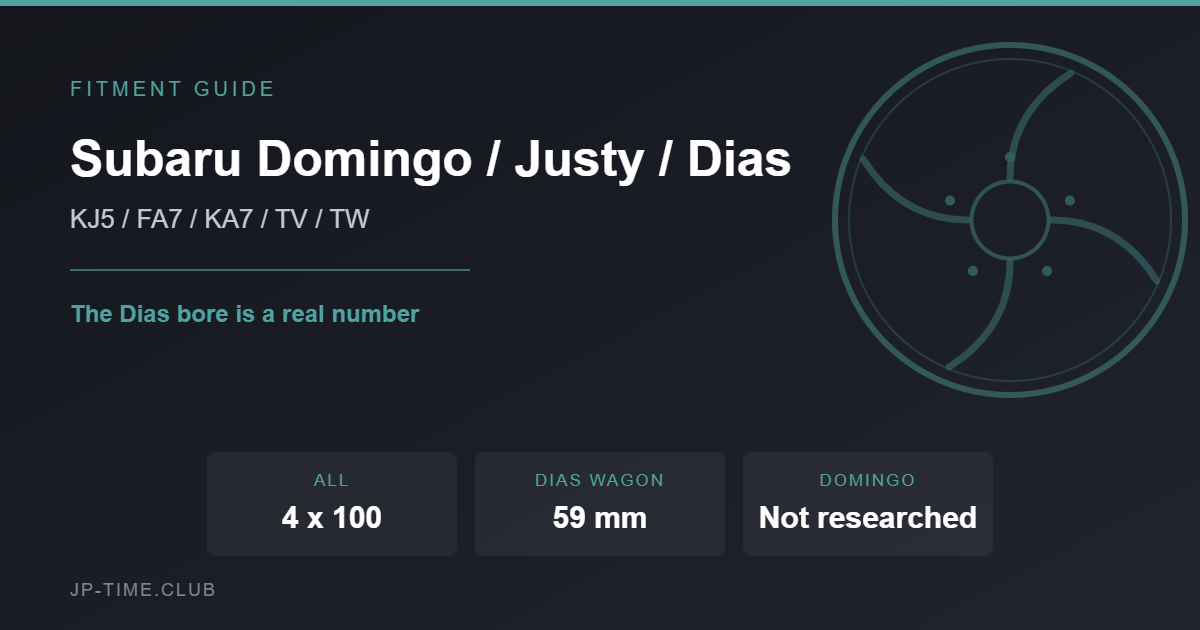
- Everything is 4×100. No 4×140, which is the old Subaru pattern people expect.
- The Dias Wagon bore is a genuine 59 mm, confirmed on pages eleven years apart.
- The Domingo and the 1990s Justy have never been researched.
- Two of these nameplates cover two completely unrelated cars each. Read the date before the name.
Not 4×140
The first question people ask about old Subarus is whether they are on the 4×140 pattern — the wide four-stud circle Subaru used on the Leone and others, which is genuinely awkward to buy for.
None of these are. The Domingo, the Justy and the Dias Wagon lineage are all 4×100. We searched every row on every page and found no 140 anywhere.
Factory Specification
| Model | Chassis | Period | Wheel | Tyre | PCD / Holes / Bore |
|---|---|---|---|---|---|
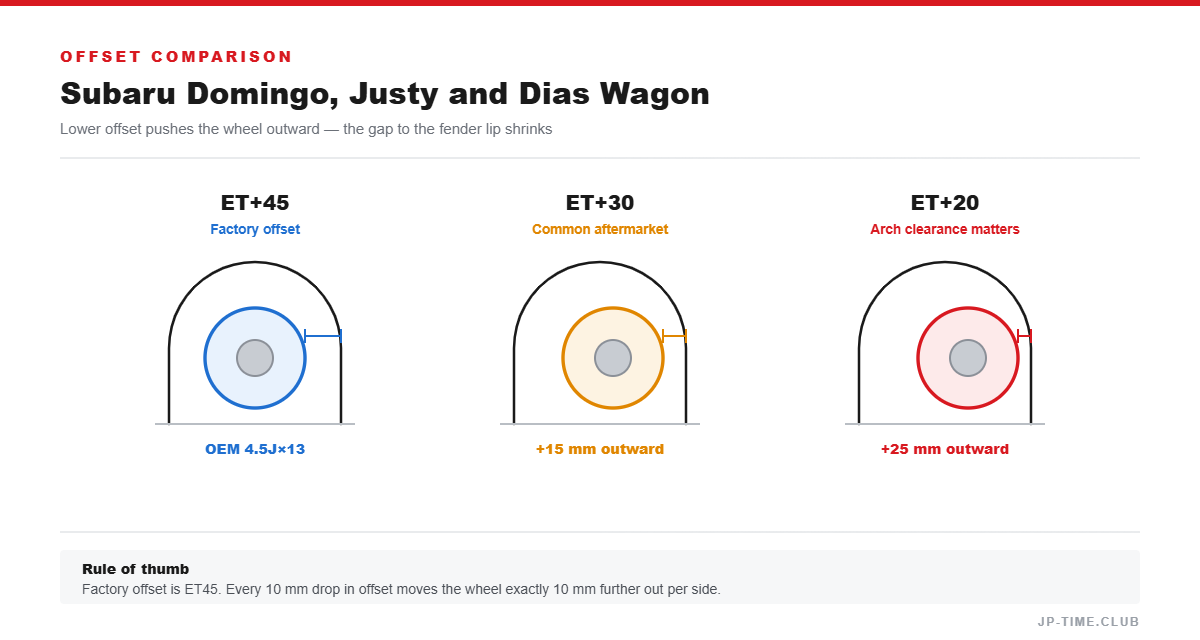
| Domingo | E-KJ5 (2WD), E-KJ8 (4WD) | 1992.09–1994.06 | 12×4J +45 | 155R12 | 100 / 4 / Not researched |
| Domingo | E-FA7 (2WD), E-FA8 (4WD) | 1996.09–1999.01 | 13×4J +45 | 155R13 | 100 / 4 / Not researched |
| Justy (original) | E-KA7 (2WD), E-KA8 (4WD) | 1992.09–1994.12 | 13×4.5J +45 | 165/65R13 | 100 / 4 / Not researched |
| Dias Wagon / Libero | V-KV3, KV4 | 1998.02–1999.02 | 13×4.5J +45 | 165/70R13 | 100 / 4 / 59 |
| Dias Wagon | LE/GD-TV1, TV2 | to 2002.09 | 13×4.5J +45 | — | 100 / 4 / 59 |
| Dias Wagon | TA/GF/ABA-TW1, TW2 | to 2009.09 | 13×4.5J +45 | 165/70R13 | 100 / 4 / 59 |
59 mm Is Its Own Number
Worth pausing on, because it is not a figure that turns up often. The Dias Wagon’s 59 mm is confirmed twice, on grade pages eleven years apart, so it is a stable and trustworthy reading.
It is not Toyota’s 54, not Honda’s 56.1, and not the 64.1 that gets invented for everything. If you are buying 4×100 wheels for a Dias Wagon, a 54 mm-bored wheel will not go on and a 60 mm one will be marginally loose. Check the figure.
The Domingo, and Why the Missing Bore Matters More Here
The Domingo is a mid-engined micro-van and one of the most popular camper-conversion bases in Japan. That is exactly the application where hub-centric fitting stops being a detail.
A conversion adds a bed, a sink, water, and often a pop-top — permanent weight, carried for years, on a vehicle whose factory tyres were 155R12 on a 4J rim. That is a very small wheel carrying a very changed vehicle.
And the bore is unresearched. So: measure your hub before you buy anything, and check the tyre load index rather than just the size. Our load rating guide covers the arithmetic, and it applies to the Domingo as directly as it does to a kei van.
The factory pages carry no load-index or reinforced-tyre specification, so that information has to come from the tyre, not from us.
Two Nameplates, Four Cars
A warning that will save someone money.
“Justy” in this database covers two completely unrelated vehicles: the 1992–1994 supermini above, and a 2019–2020 Daihatsu-based rebadge (M900F / M910F). Both happen to be 4×100 — and the modern one has a published 54 mm bore while the original is unresearched. Do not carry 54 back to the old car. The coincidence of pattern is exactly the trap.
The “Dias Wagon” page has the same problem in reverse: mixed in among the genuine Dias lineage is ABA-S321N / S331N, dated 2019–2020 — a modern Daihatsu-based kei vehicle with a 54 mm bore, not 59. If you pull that page wholesale without checking chassis codes and dates, you will merge two unrelated vehicles.
The general rule: read the date range, not the model name. Japanese manufacturers reuse nameplates freely, and these databases file by name.
Importing
The Domingo ran to 1998 and the original Justy to 1994, so both are entirely eligible for US import. The Dias Wagon lineage is eligible through the early 2000s cars now.
None was sold in North America in this form. The Domingo is the one people want — a four-wheel-drive, mid-engined, seven-seat micro-van with a sunroof, which is a specification that has never existed anywhere else.
What We Could Not Verify
- Hub bore for any Domingo, of either generation. Confirmed unresearched on an individual grade page.
- Hub bore for the original 1992–1994 Justy. Same.
- Anything before 1992 for either the Domingo or the Justy. The database’s earliest rows start there, so the 1983 and 1984 launch cars are not covered.
- Load index or reinforced-tyre specifications for camper use — not present on these pages.