

The Short Version
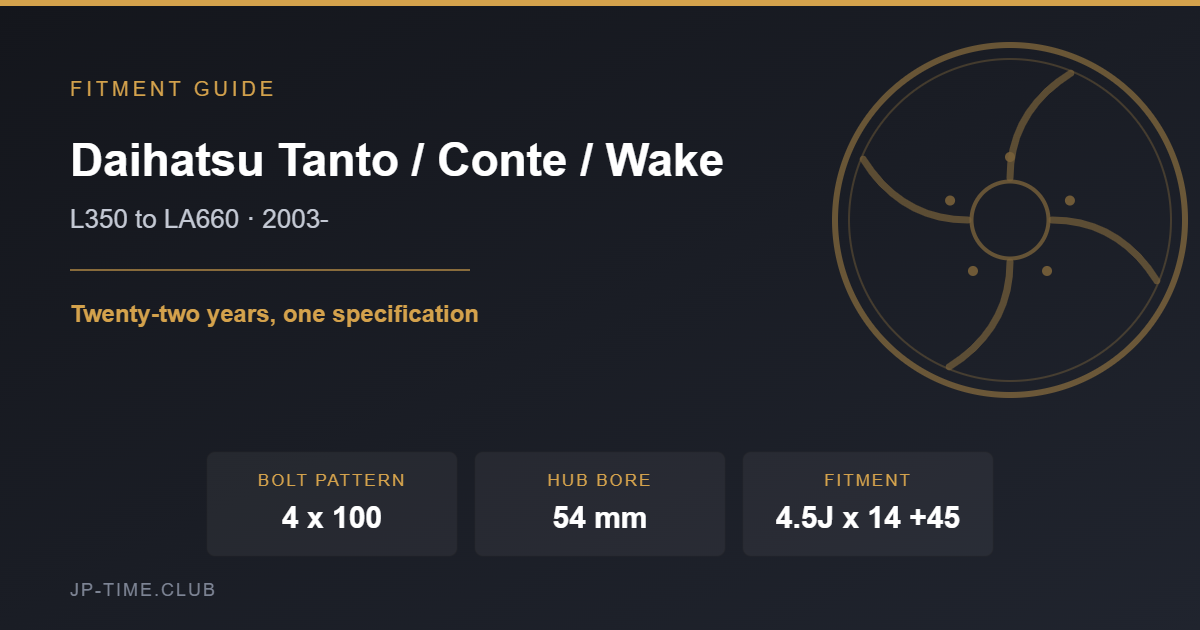
- 4×100 on a 54 mm bore, at +45 on 4.5J×14. Every model, every generation, every trim.
- Twenty-two years without a change.
- The bore is published on the oldest cars too, unlike the Wagon R.
- Custom and Funcross trims are identical to base.
Nothing to Report, Usefully
After the Wagon R, which changes bolt pattern within a chassis code, and the Honda kei range, which uses a different bore from everyone else, the Daihatsu tall-wagon family is refreshingly boring.
| Model | Chassis | Period | Wheel | PCD / Holes / Bore |
|---|---|---|---|---|
| Tanto | L350S, L360S | 2003.11–2007.12 | 4.5J×14 +45 | 100 / 4 / 54 |
| Tanto | L375S, L385S | 2007.12–2009.12 | 4.5J×14 +45 | 100 / 4 / 54 |
| Tanto | LA600S, LA610S | 2013.10–2019.07 | 4.5J×14 +45 | 100 / 4 / 54 |
| Tanto | LA650S, LA660S, incl. Funcross | 2019.07– | 4.5J×14 +45 | 100 / 4 / 54 |
| Move Conte | L575S, L585S | 2008.08– | 4.5J×14 +45 | 100 / 4 / 54 |
| Wake | LA700S, LA710S | 2014.11– | 4.5J×14 +45 | 100 / 4 / 54 |
One fitment. Twenty-two years. Three model lines. No splits, no unresearched cells, no generation changes.
Why That Is Actually Worth Publishing
Two reasons.
It gives you a reliable baseline. When you have a Daihatsu tall wagon of any age, you know the answer without checking, and that is not true of most of the vehicles we cover.
It makes the exceptions visible. Daihatsu’s own Terios Kid is 5×114.3 on 66.5 mm — a full-size four-wheel-drive hub under a 660 cc vehicle. That looks like an anomaly precisely because the rest of the Daihatsu kei range is so uniform. It is not sloppiness; it is a genuinely different vehicle underneath.
The Bore Is There From 2003
Worth noting against the Suzuki comparison. The Wagon R’s bore is unresearched for its entire first generation, 1993 to 1998, and only appears from the MC series onward.
The Tanto has a published 54 mm on its 2003 launch chassis. Whoever compiled this data went back further on Daihatsu than on Suzuki.
Buying
4×100 with a 54 mm bore is the most abundant fitment in Japan. Wheels are plentiful and cheap, including a lot of 14 and 15-inch aftermarket stock made specifically for kei cars.
The one check that matters: Honda and Mitsubishi kei cars use 56 mm. A Honda kei wheel will bolt to a Tanto and sit two millimetres loose on the hub. It is the single most likely mistake in the kei wheel market and nothing about fitting it will warn you.
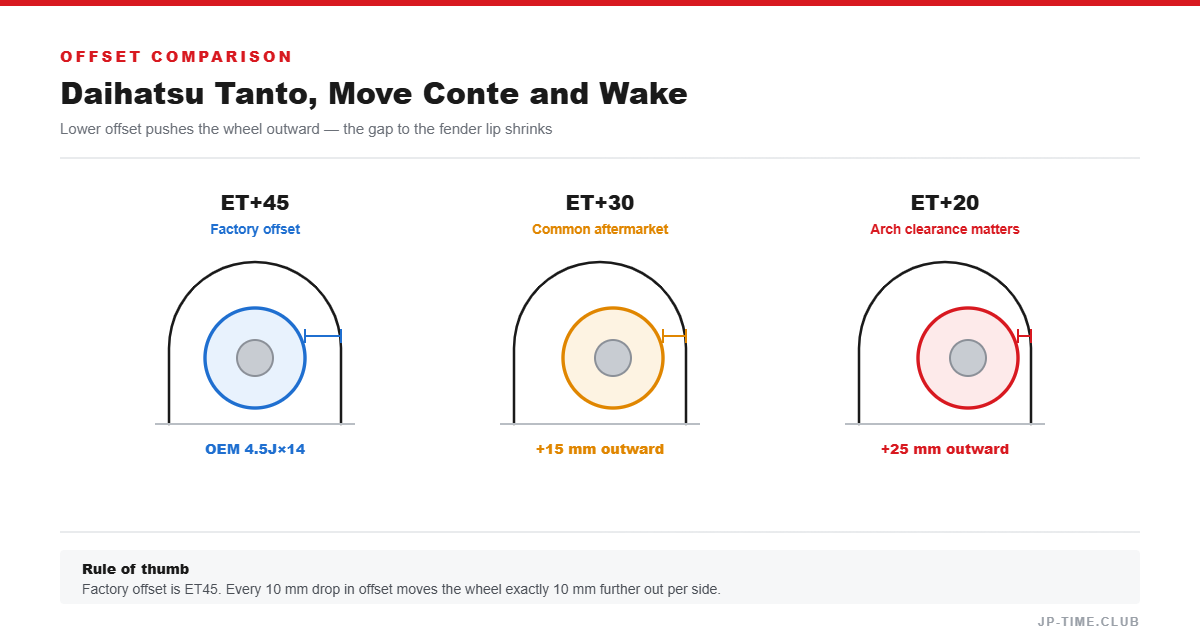
Going up in size, remember the kei width limit is a registration-class limit, not just a fender rule — exceeding 1,475 mm overall reclassifies the vehicle. That constrains how far out you can go far more tightly than on a passenger car.
The Tanto Is Worth a Word
Since the fitment story is short. The Tanto’s contribution was the Miracle Open Door — no B-pillar on the passenger side, so the front and rear doors open into a single aperture nearly 1.5 metres wide, on a car under 3.4 metres long.
That is a genuinely clever piece of packaging and it is why the tall kei wagon took over the Japanese market. The Wake took the same idea taller still.
Importing
The Tanto launched in November 2003, so first-generation cars become eligible for US import from 2028. The Move Conte follows from 2033 and the Wake from 2039.
None was sold outside Japan. These are the cars that will be arriving as the current wave of 1990s kei imports ages out.
What We Could Not Verify
- Nothing outstanding. Every row we read carries a full specification.
- Tyre sizes, which the aggregate pages mostly leave blank.