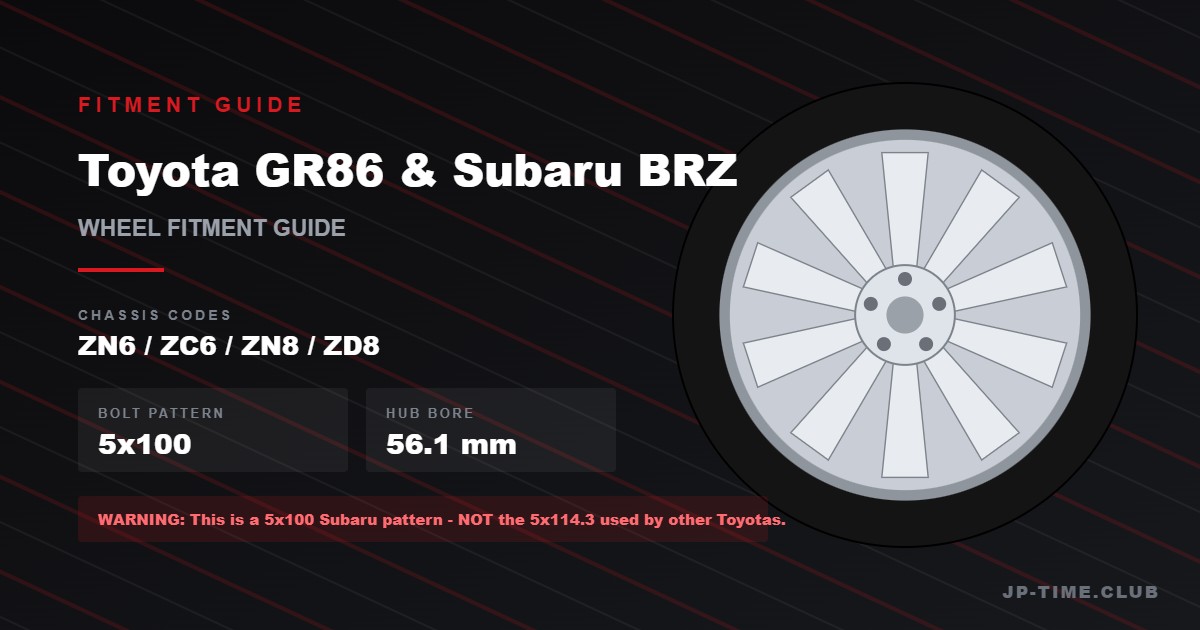
Start here, because this is where most GR86 wheel purchases go wrong: the 86 is not a 5×114.3 Toyota.
It is a Subaru underneath, and it carries Subaru’s fitment — 5×100 bolt pattern, 56.1 mm hub bore, M12x1.25 studs, 120 Nm torque. None of that matches the Supra, the MR2, the Chaser or any other Toyota you might be cross-shopping wheels from. It matches a WRX.
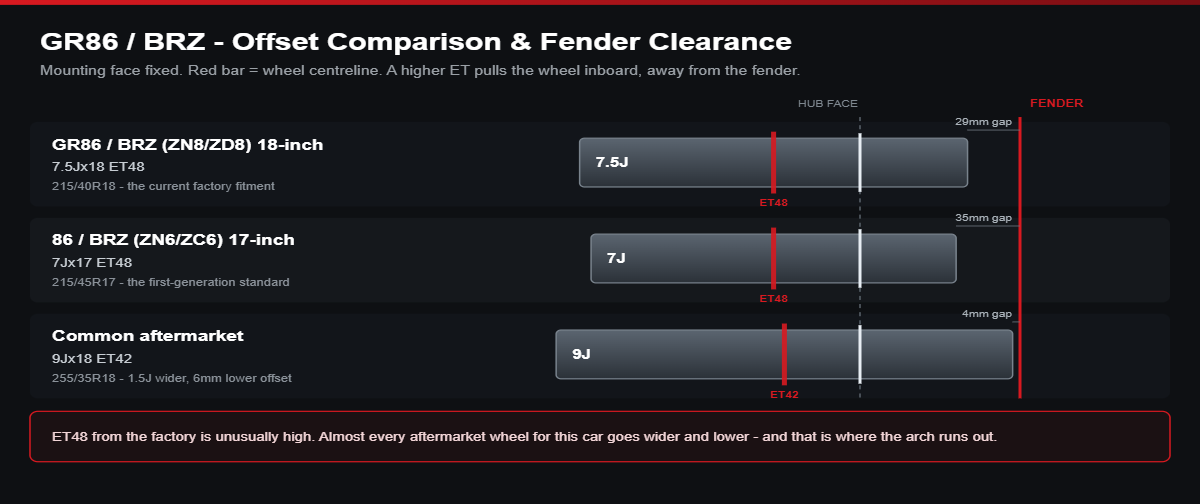
The second thing to know is the offset: ET48 from the factory, on every generation and every wheel size. That is unusually high, and it is the number that governs everything you do next.
Section 1: OEM Wheel Specifications by Generation
| Model | Chassis Code | Years | Bolt Pattern | Hub Bore | OEM Wheel | OEM Tyre |
|---|---|---|---|---|---|---|
| Toyota 86 / GT86 / FR-S | ZN6 | 2012-2020 | 5×100 | 56.1 mm | 6.5Jx16 ET48 7Jx17 ET48 |
205/55R16 215/45R17 |
| Subaru BRZ | ZC6 | 2012-2020 | 5×100 | 56.1 mm | 6.5Jx16 ET48 7Jx17 ET48 |
205/55R16 215/45R17 |
| Subaru BRZ tS | ZC6 | 2015-2020 | 5×100 | 56.1 mm | 7.5Jx18 ET48 | 225/40R18 |
| Toyota GR86 | ZN8 | 2021- | 5×100 | 56.1 mm | 7.5Jx17 ET48 7.5Jx18 ET48 |
215/45R17 215/40R18 |
| Subaru BRZ | ZD8 | 2021- | 5×100 | 56.1 mm | 7Jx17 ET48 7.5Jx18 ET48 |
215/45R17 215/40R18 |
Thread size is M12x1.25 and wheel torque is 120 Nm across all generations. Toyota 86, GT86, Scion FR-S and Subaru BRZ of the same generation are mechanically identical for fitment purposes.
Section 2: Offset Comparison & Fender Clearance Visualization
Section 3: Why ET48 Matters So Much
A stock GR86 has a visible gap between the tyre and the fender lip. That is deliberate — it gives suspension travel and it gives tyre clearance for a car that Toyota expected people to drive hard on standard springs.
It also means the aftermarket has an unusually large window to work with. Going from 7.5J ET48 to 9J ET42 adds roughly 25 mm of outboard movement per side: 19 mm from the extra rim width and 6 mm from the offset change. That is a dramatic visual change from what sounds like a modest specification step.
Practical guidance:
- ET45–ET48 at 8J — effectively a stock replacement. No rubbing at any ride height.
- ET40–ET45 at 8.5–9J — the popular street fitment. Sits flush with the arch on a car at or near stock height. Usually needs no bodywork.
- ET35–ET40 at 9.5J — aggressive. Expect a fender roll and some negative camber on a lowered car.
- Below ET35 — over-fenders or a stretched tyre. Not a bolt-on.
A real-world example of the most popular upgrade path — 9 inches of rim at ET42, sitting flush without body work. — via @@miyanikiniki
Section 4: The 56.1 mm Hub Bore
The 86 shares Subaru’s 56.1 mm hub bore, which is one of the smallest in common use. Two consequences:
- Almost every aftermarket wheel needs hub-centric rings. A 5×100 wheel made for a Volkswagen or Audi will have a 57.1 mm bore — one millimetre too large. It will bolt on, but it will not be hub-centric without a ring, and a 1 mm gap is enough to produce a vibration you will chase for months.
- Wheels from 5×100 Subarus fit directly. Impreza, Forester and the pre-2005 WRX all share 5×100 / 56.1 mm. See our WRX STI guide — note that the STI moved to 5×114.3 in 2005, so an STI wheel from 2005 onwards will not fit an 86.
Section 5: What Does Not Fit
This is a short list of the wheels people most often try to make work, and why they cannot:
- Any 5×114.3 wheel — Supra, Silvia, Skyline, Evo, RX-7, 350Z. Wrong pattern entirely. There is no adapter solution worth using on a car this light and this responsive.
- 5×100 VW / Audi wheels — right pattern, 57.1 mm bore. Fit with hub rings only.
- 2005+ WRX STI wheels — 5×114.3. Wrong pattern.
- Toyota 60.1 mm wheels — wrong pattern and wrong bore.
If you take one thing from this guide: when a listing says “fits Toyota”, it almost certainly does not mean this Toyota.
Section 6: Weight, Not Width
The 86 is a light car — roughly 1,270 kg for a GR86 — with modest power and a chassis built around responsiveness rather than grip. That makes unsprung weight the specification that actually changes how the car drives.
A forged 17-inch wheel at around 7–8 kg will transform turn-in in a way that a wider, heavier 19-inch wheel will not. This is one of the few modern platforms where going smaller and lighter is a genuine performance decision rather than a compromise.
Look for the JWL and VIA stamps on any used Japanese wheel. Both marks together indicate a wheel built and independently verified to the Japanese light-alloy standard.
Related Fitment Guides
- Subaru WRX STI — where Subaru’s 5×100 came from
- Toyota Celica — 5×100 with a different hub bore
- Mazda MX-5 / Miata — the closest comparison in this series
- Mitsubishi Lancer Evolution X — the AWD alternative
Every guide in this series is built the same way: verified factory specifications, an offset diagram, and an honest account of what fits and what does not.
Seen on the road
Which wheels are you looking for? Tell us the wheel, the size and the fitment — send us a request and we will go and find it.
Wheel identification is taken from the hashtags the owner applied to their own post.
Buying Wheels for Your GR86 or BRZ
Four numbers, in this order: 5×100, 56.1 mm, then width and offset. Get the first two right and the rest is a matter of taste and ride height.
Looking for a specific set? We specialise in genuine Japanese wheels — RAYS, Volk, Enkei, SSR, WORK, BBS Japan and the rare discontinued sets that never left the country. Tell us the wheel, the fitment, the year — our team searches our networks until we find it.
Specifications in this guide reflect factory equipment for Japanese-market vehicles. Trim levels, optional wheel packages and market-specific variants can differ. Always confirm the fitment against your own car before purchase.