

The Short Version
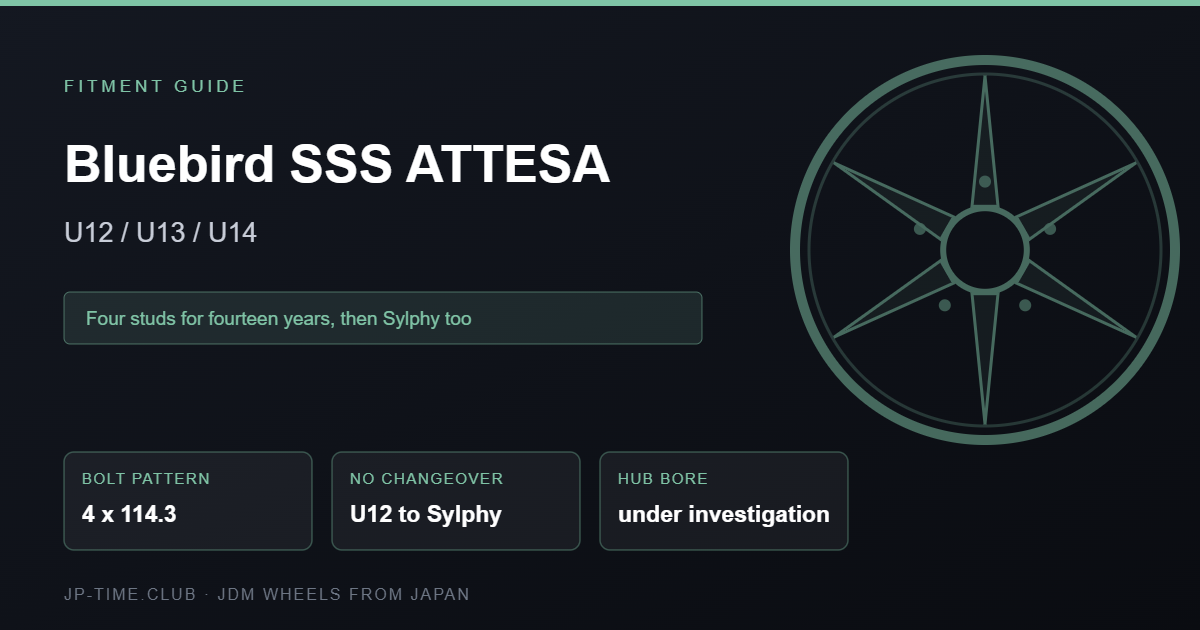
- 4×114.3 on every Bluebird generation we checked — U12, U13 and U14, including the SSS ATTESA four-wheel-drive cars.
- There is no changeover. The five-lug switch people expect never happens.
- It carries into the Bluebird Sylphy too, which reads 4×114.3 with a 66 mm bore.
- The classic Bluebirds’ bore is marked “under investigation” while the Sylphy’s is published.
Fourteen Years, One Pattern
We went in expecting to find a four-to-five-lug changeover somewhere in the Bluebird’s run, because that is what happened to most Nissan saloons of the period as they grew.
It does not. The U12 (1987–1991), the U13 (1991–1996) including the four-wheel-drive ATTESA grades, and the U14 (1996–2001) all read 4×114.3.
So does the Bluebird Sylphy that replaced it in 2000, which reads 4×114.3 with a 66 mm bore.
That is a long run on a four-stud pattern for a car that eventually reached 2.0 litres and four-wheel drive. If you have been told a late Bluebird is five-lug, it is not.
Factory Specification
| Generation | Chassis | Period | Grade | Wheel | Tyre | PCD / Holes / Bore |
|---|---|---|---|---|---|---|
| U12 | E-U12 | 1987–1991 | 2WD 1600 SE Saloon 3AT | 13×5J +40 | 165SR13 | 114.3 / 4 / under investigation |
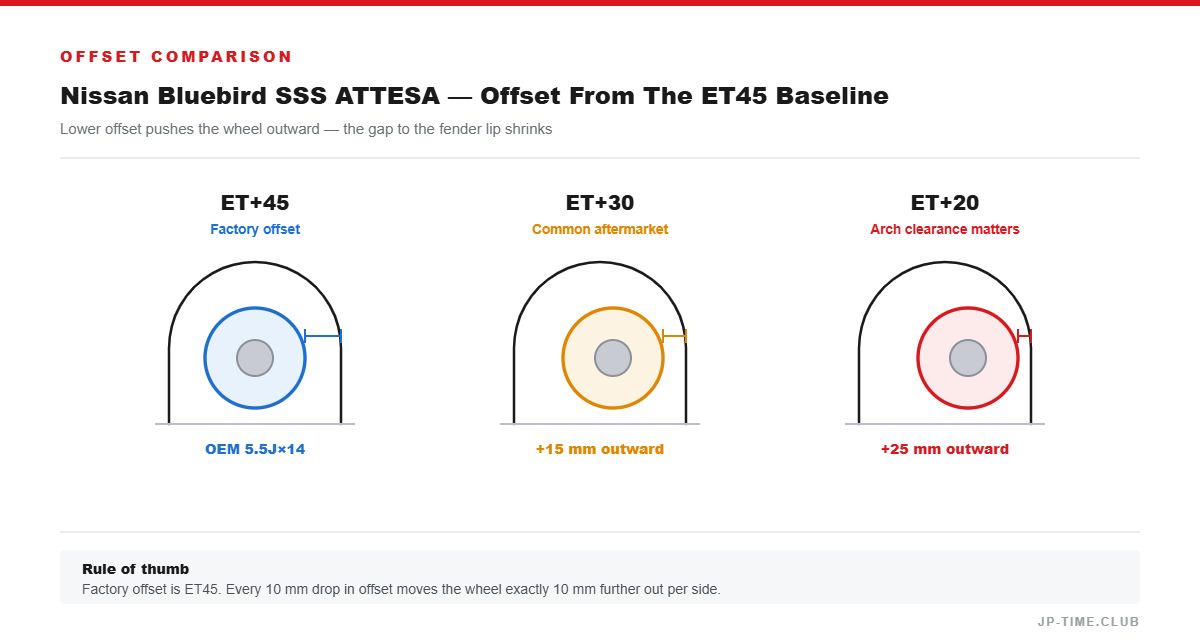
| U13 | E-HNU13 | 1991–1996 | 4WD ATTESA 2000 ARX-G 4AT | 14×6J +45 | 195/65R14 | 114.3 / 4 / under investigation |
| U14 | E-HU14 | 1996–1998 | 2WD SSS 2.0 5MT | 14×5.5J +45 | 185/65R14 | 114.3 / 4 / under investigation |
| U14 | GF-QU14 | 1998–2001 | 2WD SSS 1.8 4AT | 14×5.5J +45 | 185/65R14 | 114.3 / 4 / under investigation |
| Bluebird Sylphy | UA-QG10 | 2000–2005 | 18Vi 4AT | 15×6J +40 | 185/65R15 | 114.3 / 4 / 66 |
The Bore Pattern Is Odd
Every classic Bluebird grade we opened has its hub bore marked 調査中 — under investigation. The Sylphy successor reads a clean 66 mm.
66 mm is the Nissan standard, confirmed on the S13, the 180SX, the Laurel and the V35 and V36. So the U12 to U14 almost certainly are 66 mm too.
Almost certainly is not published, and we do not print it. Our hub bore guide explains how to settle it on your own car in five minutes.
A Note on Search Results
Worth saying because it affected this very car. While researching the Sylphy, a search summary confidently reported 4×100 with a 60 mm bore. The rendered factory page reads 4×114.3 with 66 mm.
That is a wrong bolt pattern and a wrong bore, delivered fluently. It is why every number in these guides comes from a page we opened rather than from a summary of one, and why we would encourage you to apply the same standard to anything you read about fitment — including here.
SSS-R
The SSS-R is a U12 grade from October 1989 that comes up in enthusiast sources and is the one people want. It does not appear as a distinct line in the factory database’s U12 grade table.
It may correspond to a differently-labelled grade there — there is an E-RU12 chassis code in the range — but we could not confirm the mapping, so the SSS-R’s own figures are unverified against the factory data. The rest of the U12 range is uniformly 4×114.3, so the bolt pattern is not in doubt; the wheel and offset are.
Sizing
13×5J and 14×5.5J at +40 to +45 is modest, and these are narrow cars. The practical window is 15×6.5J to 16×7J in the +35 to +45 range.
4×114.3 is a period pattern rather than a modern one, so the wheel pool is largely 1980s and 1990s Japanese product — which suits the car and limits you if you want something contemporary.
Importing
The U12 ran 1987–1991 and the U13 to 1996 — both fully past the US 25-year mark. The U14 ran to 2001, so cars built through August 2001 are eligible, which is effectively the whole run.
North America got the U12 and U13 as the Nissan Stanza and Altima respectively, but never the SSS ATTESA four-wheel-drive grades, which are the ones worth importing.
What We Could Not Verify
- Hub bore for the U12, U13 and U14. Explicitly marked “under investigation” on every grade we opened.
- The SSS-R grade, which does not appear under that name in the factory grade table.