
The Short Version
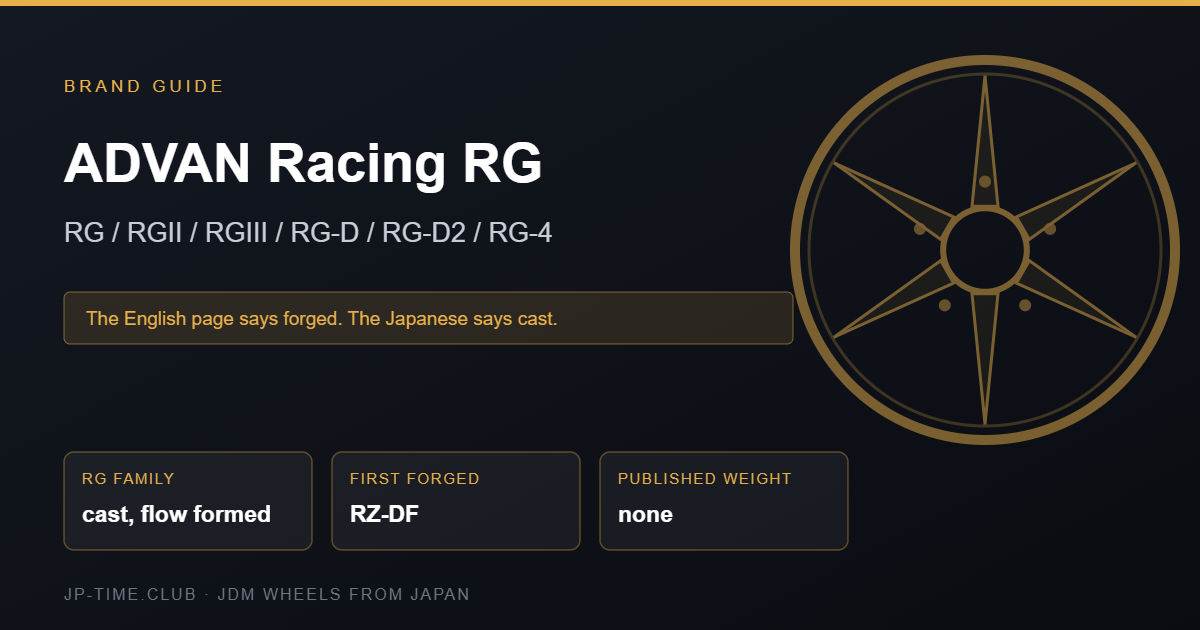
- Every wheel in the RG family is cast, not forged. Cast, then flow-formed at the inner rim.
- ADVAN’s own English page calls the RGIII “form-forged”. The Japanese original says 錳造 — cast. The English text is a mistranslation, and English-language sites repeat it.
- The first forged ADVAN Racing wheel is the RZ-DF, which ADVAN says so about in its own copy. It is not in the RG family.
- The D in RG-D means deep rim, not disc and not a different construction.
- ADVAN publishes neither a weight nor a load rating for any RG-family size. Not one, not the other.
The Mistranslation
Start here, because it changes what you think you are buying.
ADVAN Racing’s English-language product page for the RGIII describes the wheel as form-forged, using the word forging. The Japanese page for the same wheel, describing the same process, says 錳造 — casting. High-density casting, followed by flow forming of the inner rim, which produces a metal grain structure ADVAN says approaches that of forging.
Approaching forging and being forged are different claims, and only one of them is on the Japanese page. Our reading is that this is a translation error rather than two different specifications, because every other wheel in the RG family — RG, RGII, RG-D, RG-D2, RG-4 — is described in Japanese with the same cast-plus-flow-formed language.
The practical consequence: if you are paying a forged premium for an RGIII, you are paying it for a cast wheel. That is not a criticism of the wheel, which is a good one. It is a criticism of the price you may be quoted.
ADVAN’s actual first forged wheel is the RZ-DF, which the Japanese copy calls ADVAN Racingブランド初の鍛造ホイールモデル — the brand’s first forged wheel model. The RS, RZ, GT and TC-4 lines are the forged and higher-end side of the catalogue. The RG family is not.
The Lineage
| Model | Status | What changed | Sizes | PCD |
|---|---|---|---|---|
| RG | discontinued | the origin. Slim six-spoke; the name comes from Racing & Gymkhana | 14–17 in | 100 (4H), 114.3 (5H) |
| RGII | discontinued | over-flange six-spoke; optional GTR deep-concave face | 15–18 in | 100, 114.3 |
| RGIII | sold while stocks last | longer, more concave spokes; first RG with a side cut | 17–19 in | 100, 114.3 |
| RG-D | discontinued | 2010. RG’s face fused with a deep rim; standard-deep and extra-deep tooling per size | 17–19 in | 100, 114.3 |
| RG-D2 | current | 2016. Step rim, three concave levels by size, continuous advanced side cut | 15–18 in | 100, 114.3, 120 |
| RG-4 | current, the flagship | the most linear six-spoke yet; three faces — S-TD, GTR, S-GTR | 17–18 in | 100, 112, 114.3, 120 |
Two things worth knowing. RG-D2 replaced RG-D in 2016, six years after RG-D launched — ADVAN says exactly that on the RG-D2 page, which is how we dated RG-D to 2010. And several RG-family sizes are offered in 4×100, which makes this one of the better-served lines for kei and compact cars.
Do not confuse the RG family with RJ-D2, a Jimny-specific model that borrows RG-D2’s styling but is catalogued separately. There is no RG-F, despite what you may read.
Authenticating an ADVAN Racing Wheel
The most consistent signature runs across every generation: the cast “ADVAN Racing” logotype between the spokes, raised about a millimetre, with the faces machined flat after painting so the lettering contrasts. ADVAN describes this identically on the RG-D, RGII, RGIII and RG-4 pages. On counterfeits seized in China, that machining step is one of the things left undone — the lettering sits there unfinished on top.
RG-D2 adds a checkable extra: a thermal-transfer text on the rim step reading ADVAN Racing FLOW FORMING JAPAN MADE. If you are looking at an RG-D2, look for it.
Watch the model-name badge, because it varies by generation and this catches people. On the RG-D, RGIII and RG-4 the spoke badge is a sticker supplied in the box for the owner to apply. On the RGII it is a factory heat transfer. A missing sticker on an RG-4 means nothing at all; a missing factory mark on an RGII means something.
Centre caps prove nothing. Every RG-family size list describes the wheel as capless with the ADVAN Racing centre cap sold separately, in φ73 for PCD 114.3 and φ63 for PCD 100. Genuine caps can be bought and fitted to anything.
On Counterfeit Notices
Here is where we differ from most write-ups. We could not find a standalone consumer-facing “beware of imitations” page from ADVAN or Yokohama. We are not going to say one exists.
What does exist is a repeated pattern of corporate enforcement announcements about counterfeiters in China — reported in 2017 and 2018, then December 2021 in Foshan, Guangdong, then May 2023 again in Foshan, then May 2025 in Anlu, Hubei. These are press releases about raids and shutdowns, not buyer’s guides.
The visual tells that circulate — an orange colourway that is not in ADVAN’s palette, unmachined logo faces, visibly thicker and cruder spokes — come from a Japanese blog’s reading of the photographs in the 2023 release, not from an ADVAN checklist. They are useful. They are also general to the brand rather than specific to the RG-D, and we found nothing calling out RG-D counterfeits by name.
Our general cross-brand method is in Spotting a Fake JDM Wheel.
What ADVAN Does Not Tell You
ADVAN’s Japanese size tables publish rim size, PCD, hole count, inset, bore, colour and a tax-inclusive price. They publish no weight and no load rating.
That is worth stating for anyone arriving from RAYS, which prints a load rating on every size line — a figure frequently misread as the wheel’s weight. ADVAN gives you neither number, so any weight you see quoted for an RG-family wheel is a third party’s measurement, not a manufacturer figure.
What We Could Not Verify
- The launch year of the original RG, and of the RG-4.
- Whether any ADVAN Racing model has ever been made outside Japan. The site has a dedicated Japan Made section, which implies segmentation exists somewhere, but no source identifies a non-Japanese ADVAN Racing model.
- Whether ADVAN Racing barrels carry a VIA mark in addition to JWL.
- Any counterfeit tell specific to the RG-D.
- The existence of a consumer-facing counterfeit notice page. We looked and found only enforcement releases.
- Barrel stamp format. We saw one owner’s photograph of an original RG stamped
ADRG 17-1; that is an example, not a documented scheme. - Manufacturer weight or load figures for any RG-family wheel. Not published.