
The Short Version
- 4×100, from RS Watanabe’s matching data. That is the only source that covers this car.
- Neither Japanese factory database has an EXA entry at all. Their Pulsar coverage starts at the N14 in 1990 — three years after the EXA ended.
- No hub bore figure exists anywhere.
- RS Watanabe does not separate N12 from N13, so we cannot confirm generation by generation.
A Car That Falls Between the Databases
The EXA is the coupe derivative of the Pulsar, sold in Japan and Australia as the EXA and in North America as the Pulsar NX. The N12 ran 1982–1986 and the N13 from 1986 to 1990.
Both Japanese factory wheel databases begin their Pulsar coverage with the N14 in 1990. We opened both sites’ full Nissan model indexes and there is no EXA entry — not under that name, and not folded into the Pulsar pages.
So the only source that covers this car is RS Watanabe’s matching data, which has an explicit EXA row showing 4×100. That confirms the bolt pattern. It gives nothing else.
What the One Source Says
| Car | Chassis | Years | PCD | Hub note |
|---|---|---|---|---|
| EXA | N12 and N13 combined into one row | 1982–1990 | 4×100 | none |
The absence of a hub note is worth reading carefully. On the same page, RS Watanabe carries explicit machining notes for plenty of other cars — the Sunny at φ73 front, the 510 Bluebird at φ67, the CSP311 Silvia at φ74. The EXA has none.
As with the Hakosuka and the Kenmeri, our reading is that they flag the bore when their wheel needs machining to clear the hub, and stay silent when it does not. That is suggestive that no special hub work is needed. It is not a bore figure, and we are not going to present it as one.
The Canopy and the Roof Panels
The N13 EXA is the one with the party trick: a removable targa roof and, on some markets, an interchangeable rear canopy that turned the coupe into a small wagon. It is the reason the car has the following it does.
We found no evidence in any source that these body variants change the bolt pattern or the hub. They are body panels rather than chassis changes, and we would expect the fitment to be identical — but absence of evidence is not confirmation, and we are flagging it as such rather than asserting it.
What to Do
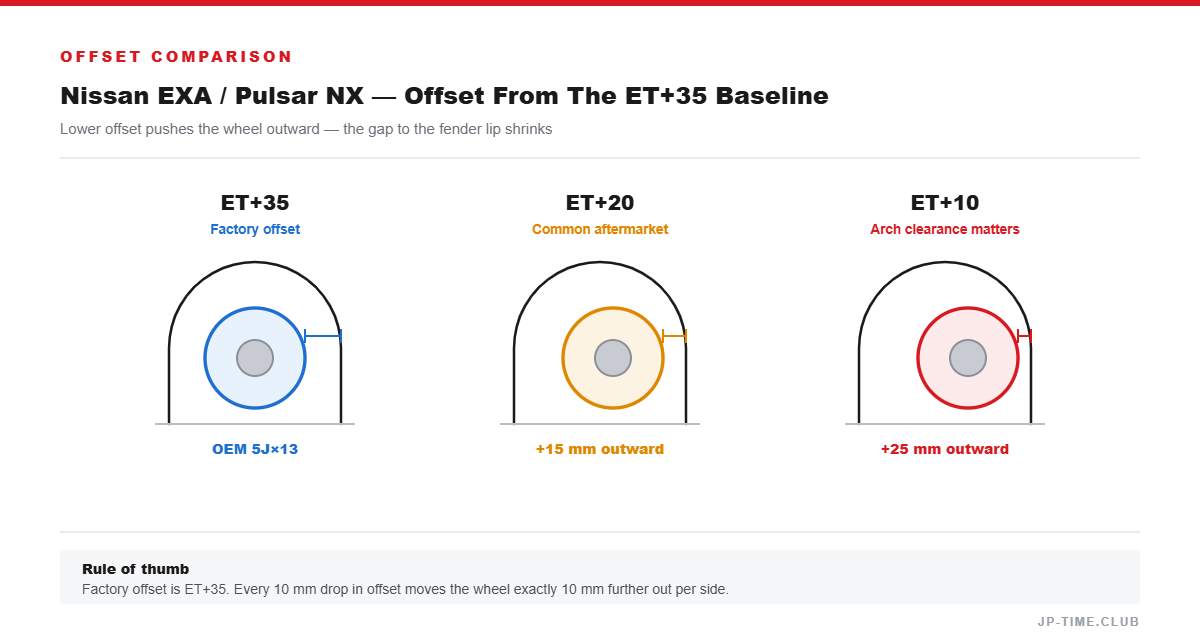
4×100 is a very common Japanese pattern, so the wheel pool is large. The constraint is that you do not have a published bore or a published factory offset, which means you cannot order rings or judge stance from a spec sheet.
Measure the register on your own hub, and read the offset off the back of a factory wheel if the car still has one. Send us both and we will publish them here with credit. This is a guide that would genuinely benefit from one owner with a tape measure.
Market Notes
Japan and Australia got the EXA. North America got the Pulsar NX, which is the same car. We did not verify whether the US-market cars carry the identical wheel specification, because they are not in the Japanese databases either.
For an Australian owner that matters less — the cars are local, and measuring one is easy.
Importing
The N12 ran 1982–1986 and the N13 1986–1990. Both are decades past the US 25-year mark, and North America had the Pulsar NX locally in any case.
What We Could Not Verify
- Hub bore. No source states a number.
- Factory wheel size and offset from a primary table. Neither Japanese database covers the car.
- Whether the N12 and N13 genuinely share a bolt pattern, as RS Watanabe’s combined row implies.
- Whether the roof and canopy variants affect anything. We found no evidence either way.