The Short Version
- RE-Amemiya is a Chiba-based Mazda tuning shop, legally 有限会社RE雨宮自動車 (RE Amemiya Jidosha), founded by Isami Amemiya (雨宮勇美, b. 1946) in Koto Ward, Tokyo, in 1976 as a bodywork and paint shop.
- The name comes from the founder’s surname plus “RE” — Rotary Engine. The shop has built almost nothing but Mazda rotary-powered cars for its entire history.
- In January 1985, an RE-Amemiya-built SA22C RX-7 hit 307.42 km/h on the Yatabe test track — the first rotary-engined car in Japan confirmed over 300 km/h.
- The shop campaigned RX-7s in the GT300 class of the All-Japan GT Championship / SUPER GT from 1995 to 2010, winning the championship in 2006 and earning the nickname “Sepang Meister” for five wins in nine races at that circuit.
- Since 2004 the team has competed in D1 Grand Prix drifting, finishing 2nd overall in 2005, 3rd in both 2007 and 2008, and 2nd again in 2014 and 2019.
- RE-Amemiya remains an active Tokyo Auto Salon exhibitor; its “Kizami” concept won the Grand Prix at the 2025 Tokyo International Custom Car Contest.
From Bodywork Shop to Rotary Specialist
Isami Amemiya’s own account, published by GAZOO, is straightforward: he trained as a panel beater, went independent at 21, and in 1976 — in his early thirties — opened 雨宮自動車 (Amemiya Jidosha) in Koto Ward, Tokyo. The original business was bodywork and paint. Tuning and customization came later, as the shop’s own performance work grew alongside it.
The company is registered today as 有限会社RE雨宮自動車, based in Tomisato, Chiba Prefecture. Its stated specialty, in the founder’s own words, is rotary engines — “because that’s all I know.” Every car the shop is known for, from the earliest SA22C builds to the current FD3S time-attack machines, runs a Mazda rotary.
January 1985: Breaking the 300 km/h Barrier
The shop’s defining early moment came after a failed attempt in December 1984. The following month, on the Yatabe high-speed test straight, an RE-Amemiya SA22C RX-7 running a 13B rotary with an original low-compression rotor (8.5:1) and twin KKK K26 turbochargers recorded 307.42 km/h — the first time a rotary-powered car in Japan had been verified over 300 km/h. The build combined the engine work with detailed aerodynamic refinement, and the record is widely credited as the moment that proved the rotary engine’s high-speed potential in Japan.
GT300 and the “Sepang Meister”
RE-Amemiya ran RX-7s in the GT300 class of the All-Japan GT Championship, later SUPER GT, from 1995 through 2010 — a fifteen-year program. The team took the GT300 championship in 2006. Its results at Malaysia’s Sepang circuit were unusually strong even by the team’s own standard: five wins in nine races there, which earned the nickname “Sepang Meister” (セパンマイスター) in Japanese motorsport media.
A Second Career in Drifting
RE-Amemiya moved into All-Japan Professional Drift Championship (D1 Grand Prix) competition in 2004, running rotary-powered RX-7s in a discipline built almost entirely around V8-powered chassis. The team’s results there have been consistent rather than dominant: 2nd overall in the 2005 season, 3rd overall in both 2007 and 2008, and 2nd overall again in 2014 and 2019.
RE-Super G: The Name on This Car’s Wing
The rear wing on the car photographed for this article carries “RE-Super G” lettering. This is not a generic livery — it is a genuine RE-Amemiya product and program name tied to the shop’s 1995 JGTC (the All-Japan GT Championship, SUPER GT’s predecessor) campaign, and the name has since been applied to specific RE-Amemiya parts, including peripheral-port rotary housings sold under the same designation. Seeing it on a wing is a reasonably direct sign of a genuine RE-Amemiya-associated build, though we have not been able to confirm from our own sources whether every “RE-Super G” wing sold was fitted only to cars with a matching engine package.
Spotted in the Wild: A Widebody FD3S Wearing the Full Kit
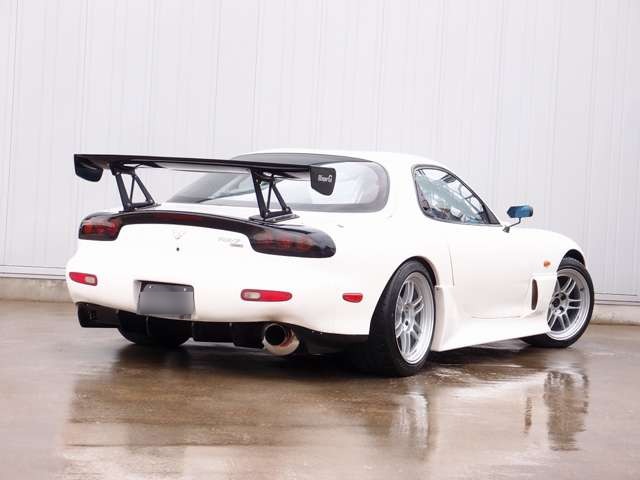
This FD3S — an Anfini RX-7 Type RB in Chaste White — is a real, currently-running example of an RE-Amemiya-aero widebody build, photographed on the street rather than staged for this article. It combines RE-Amemiya’s wide front and rear fender flares and the RE-Super G rear wing with Mazdaspeed side skirts (covered in our companion Mazdaspeed article) and a set of ENKEI RPF1 wheels in 17 inches.
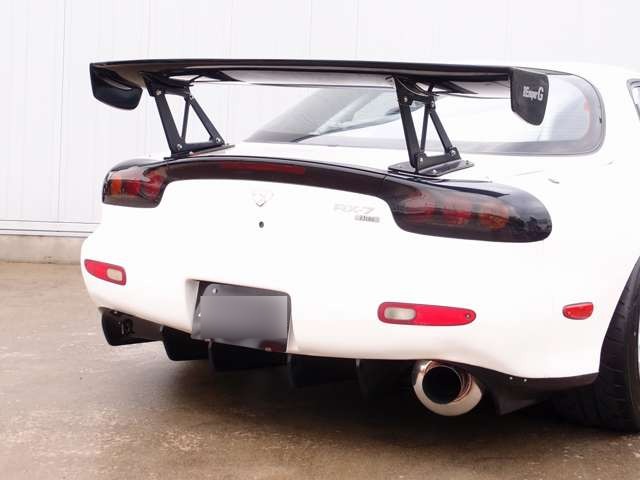
It is a useful illustration of a point buyers often miss: an RE-Amemiya-aero car is frequently a mix of parts from several tuning houses rather than a single-brand build, because the aero, the driveline work, and the wheels are usually bought from whichever specialist does that one thing best. Judge each part on its own, not on the assumption that “widebody RX-7” means one manufacturer built the whole car.
What We Could Not Verify
- The exact founding year of the “RE-Amemiya” brand as distinct from the 1976 founding of 雨宮自動車. GAZOO’s profile of the founder gives 1976 for the original bodywork shop; at least one English-language source states 1974 for “RE Amemiya Car Co., Ltd.” specifically. We could not find a Japanese primary source that reconciles these two dates, so we are not presenting either as the single confirmed founding year of the RE-Amemiya brand name.
- Whether “RE” is officially defined by the company as standing for “Rotary Engine.” This is the near-universal explanation repeated across enthusiast and press sources, but we could not locate a company statement using those exact words.
- The exact number of consecutive years RE-Amemiya has exhibited at Tokyo Auto Salon. The show’s own exhibitor records confirm recent appearances (2023, 2025, and a listing for 2026), but we could not find a published start date for an unbroken streak.
- Whether every product sold under the “RE-Super G” name shares identical specifications across the years it has been offered.
FAQ
Is RE-Amemiya still in business?
Yes. The company continues to operate from Tomisato, Chiba, continues to exhibit at Tokyo Auto Salon, and won the Grand Prix at the 2025 Tokyo International Custom Car Contest with its “Kizami” concept.
What does “RE” stand for?
It is generally understood to reference “Rotary Engine,” reflecting the shop’s exclusive focus on Mazda’s rotary-powered cars. We could not confirm an official company statement using that exact phrase.
Did RE-Amemiya only build race cars?
No. Alongside its GT300 and D1 Grand Prix programs, RE-Amemiya has sold street aero kits, exhaust systems, and rotary engine parts for road-going RX-7s and other Mazda rotary models for decades.
Are RE-Amemiya wheels a thing?
RE-Amemiya is primarily known for aero, engine, and exhaust products rather than wheels. The wheels on the car in this article are ENKEI RPF1 — see our Enkei brand guide and our Mazda RX-7 FD3S fitment guide.
Sources
Founder biography and 1976 founding date: GAZOO.com profile of Isami Amemiya (published January 2026). Company registration and current specialty: Japanese Wikipedia entry for RE雨宮. The January 1985 300 km/h record, vehicle, location and figures: Motor-Fan.jp retrospective article. GT300 and D1 Grand Prix results: Japanese Wikipedia entry for RE雨宮. Tokyo Auto Salon exhibitor history and 2025 award: Tokyo Auto Salon’s official exhibitor pages and GAZOO.com event coverage. The RE-Super G name and its tie to RE-Amemiya’s 1995 JGTC program: cross-referenced JDM parts retailer listings for RE-Amemiya peripheral-port housings and GT wings carrying the same name. Where sources conflicted or a claim could not be independently confirmed, we have said so above rather than filling the gap.
Related Guides
- Mazda RX-7 FD3S Wheel Fitment Guide — OEM specs for the chassis RE-Amemiya is best known for
- Enkei Brand Profile — the wheel brand fitted to the car in this article
Looking for genuine JDM wheels to pair with a rotary build? Submit a Request and we will search our networks in Japan for the size and offset you need.