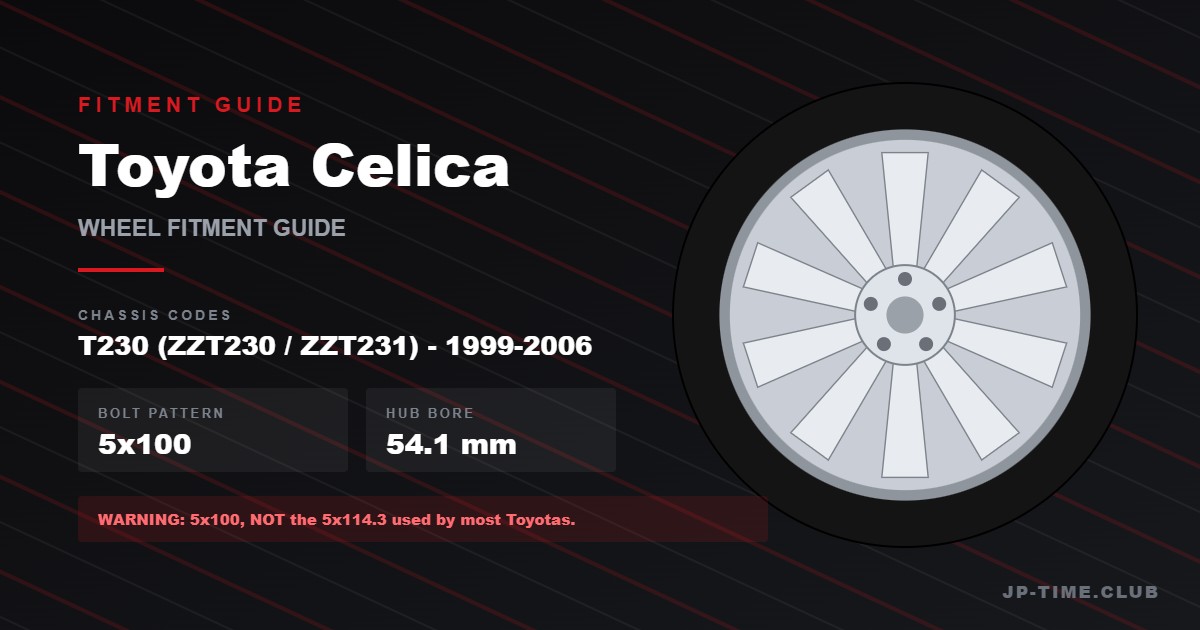
The last Celica is a 5×100 car. Not 5×114.3 — which means nothing from the Supra, the Chaser, the MR2, the Lexus IS or any of the Toyotas we have covered so far will fit it.
Its full specification is 5×100, 54.1 mm hub bore, M12x1.5, ET39 — a small, front-wheel-drive fitment on a car that looks considerably more exotic than that suggests.
Section 1: OEM Wheel Specifications
| Model | Chassis Code | Bolt Pattern | Hub Bore | Thread | Wheel (front & rear) | Tyre |
|---|---|---|---|---|---|---|
| 1.8 VVT-i | ZZT230 | 5×100 | 54.1 mm | M12x1.5 | 6.5Jx15 ET39 | 195/60R15 |
| 1.8 VVTL-i / TS / GT-S | ZZT231 | 5×100 | 54.1 mm | M12x1.5 | 6.5Jx15 ET39 6.5Jx16 ET39 |
205/55R15 205/50R16 |
Front and rear wheels are identical. Offset is ET39 on every factory wheel size.
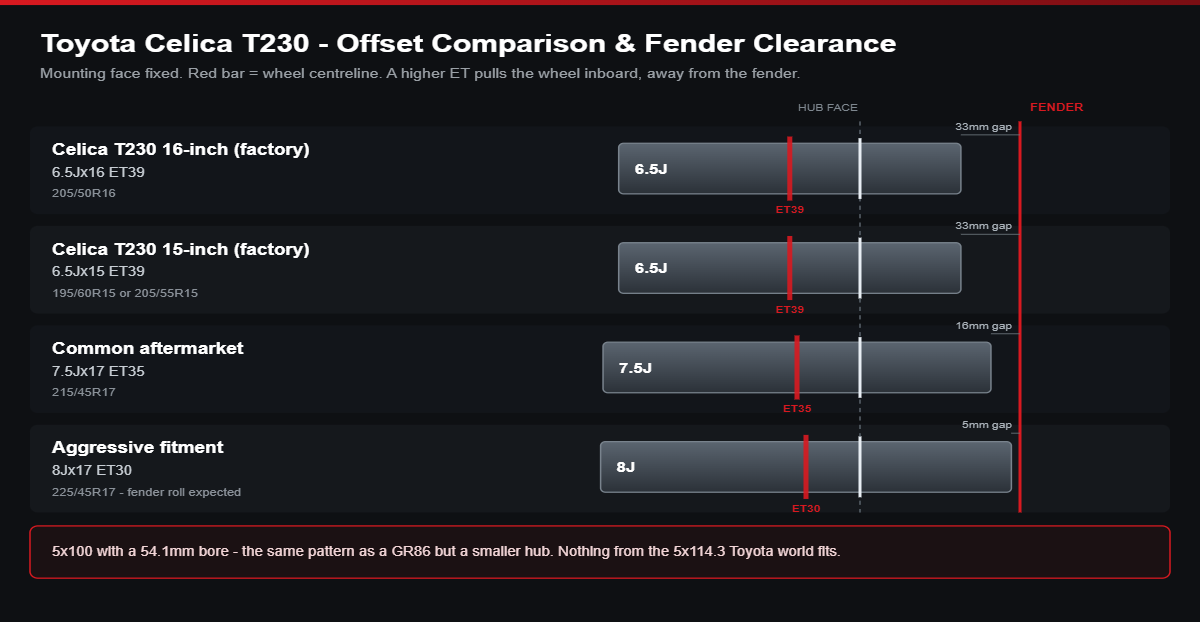
Section 2: Offset Comparison & Fender Clearance Visualization
Section 3: 5×100 and a 54.1 mm Bore
This combination is worth being precise about, because 5×100 is used by several manufacturers with different hub bores:
- Toyota Celica T230 and Toyota Prius: 54.1 mm.
- Subaru, and therefore the Toyota GR86 / Subaru BRZ: 56.1 mm. See our GR86 / BRZ guide.
- Volkswagen and Audi 5×100: 57.1 mm.
The rule that runs through this entire series applies: a larger bore can be reduced with a hub-centric ring; a smaller one cannot be enlarged. So:
- GR86 / BRZ wheels (56.1 mm) fit a Celica with a 56.1–54.1 ring.
- Volkswagen 5×100 wheels (57.1 mm) fit a Celica with a 57.1–54.1 ring.
- Celica wheels will NOT fit a GR86 or a BRZ. The bore is 2 mm too small for the Subaru hub.
That asymmetry is genuinely useful. The Celica accepts the entire 5×100 world; almost nothing accepts the Celica’s wheels.
A Japanese-market Celica on deep-dish WORK wheels — a long way from the factory 6.5J ET39. — via @@waku_16
Section 4: Realistic Fitments
- 17×7 ET40–ET45 — a clean upgrade with 215/45R17. No arch work at factory ride height. Keeps the rolling diameter close.
- 17×7.5 ET35 — the standard enthusiast fitment. Roughly 10 mm more poke per side than stock. Fine on standard arches; mild roll on a lowered car.
- 17×8 ET30 — noticeably aggressive. Fender roll and some camber.
- 16×7 ET38 — the track and budget choice. More sidewall, cheaper tyres, and the Celica’s brakes clear 16 inches comfortably.
The Celica weighs around 1,100 kg with 190 hp in ZZT231 form. Like the Integra Type R and the CR-X, it is light enough that wheel weight is a real handling variable rather than a footnote. A forged 17 is worth more than a cast 18.
Section 5: Tyre Diameter and Gearing
The 2ZZ-GE in the ZZT231 makes its power above 6,000 rpm and the car is geared accordingly. Increasing rolling diameter blunts that noticeably.
Rough diameter-matched sizes against the factory 205/50R16:
- 17-inch: 215/45R17
- 18-inch: 215/40R18 — workable, but the ride deteriorates and unsprung mass rises. Not recommended on this car.
Related Fitment Guides
- Toyota GR86 & Subaru BRZ — 5×100 with a 2 mm larger bore
- Toyota Vitz / Yaris & GR Yaris — the same 54.1 mm Toyota bore
- Toyota MR2 SW20 — the Toyota that IS 5×114.3
- Toyota AE86 — the Celica’s ancestor in spirit
Every guide in this series is built the same way: verified factory specifications, an offset diagram, and an honest account of what fits and what does not.
Seen on the road
Which wheels are you looking for? Tell us the wheel, the size and the fitment — send us a request and we will go and find it.
Wheel identification is taken from the hashtags the owner applied to their own post.
Buying Wheels for Your Celica
5×100, 54.1 mm, ET39 as the reference. Check the bore before anything else — it is the one number that will stop a wheel going on, and it is 2 mm away from the far more common Subaru figure.
Looking for a specific set? We specialise in genuine Japanese wheels — RAYS, Volk, Enkei, SSR, WORK, BBS Japan and the rare discontinued sets that never left the country. Tell us the wheel, the fitment, the year — our team searches our networks until we find it.
Specifications in this guide reflect factory equipment for Japanese-market vehicles. Trim levels, optional wheel packages and market-specific variants can differ. Always confirm the fitment against your own car before purchase.