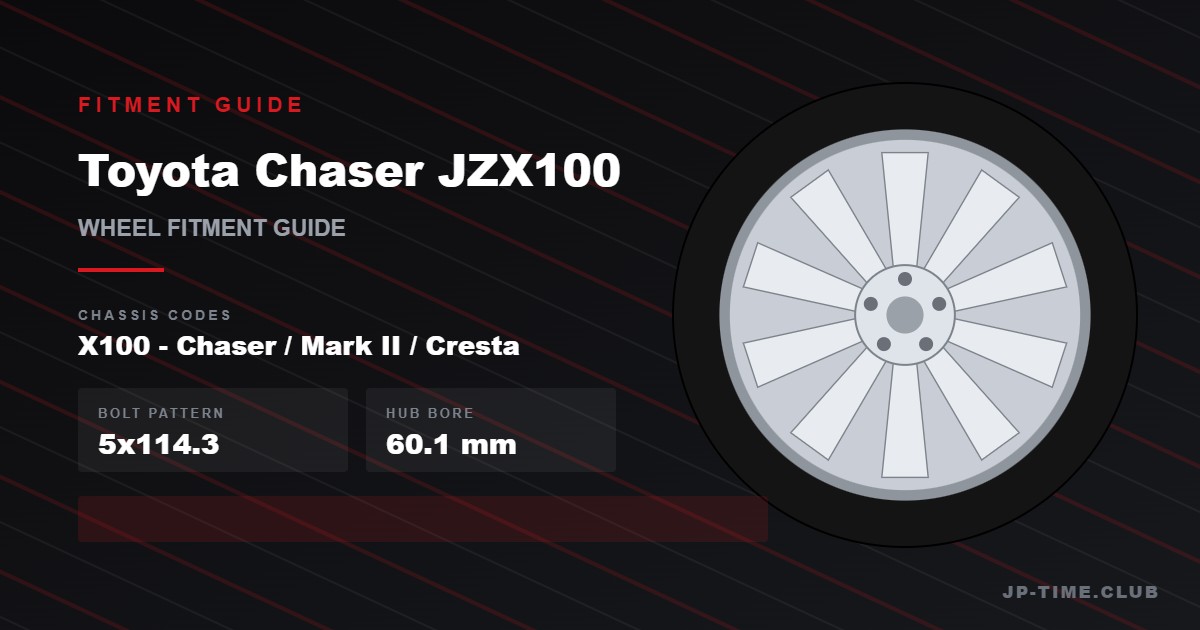
Almost every JZX100 you have seen in a drift video is wearing wheels that are nothing like what Toyota fitted. The factory Chaser Tourer V ran 6.5Jx16 ET50 at the front and 7.5Jx16 ET55 at the rear — narrow rims, very high offsets, and a wheel that tucks well inside the arch.
The gap between that and a typical modified Chaser is enormous, and understanding it is the whole point of this guide.
Section 1: OEM Wheel Specifications
| Model | Chassis Code | Bolt Pattern | Hub Bore | Thread | Front Wheel | Rear Wheel |
|---|---|---|---|---|---|---|
| 2.5 Turbo (Tourer V) | JZX100 | 5×114.3 | 60.1 mm | M12x1.5 | 6.5Jx16 ET50 | 7.5Jx16 ET55 |
| 2.5 VVT-i (NA) | JZX100 / JZX105 | 5×114.3 | 60.1 mm | M12x1.5 | 6.5Jx16 ET50 6Jx15 ET50 |
same as front |
| 2.0 VVT-i | GX100 / GX105 | 5×114.3 | 60.1 mm | M12x1.5 | 6Jx15 ET50 | same as front |
| 1.8 VVT-i | SX100 | 5×114.3 | 60.1 mm | M12x1.5 | 5.5Jx14 ET50 6Jx15 ET50 |
same as front |
| 2.4 Diesel | LX100 | 5×114.3 | 60.1 mm | M12x1.5 | 5.5Jx14 ET50 6Jx15 ET50 |
same as front |
The X100 platform covers the Chaser, Mark II and Cresta. All three share bolt pattern, hub bore, thread and offset. Only the 2.5 Turbo received a staggered rear wheel.
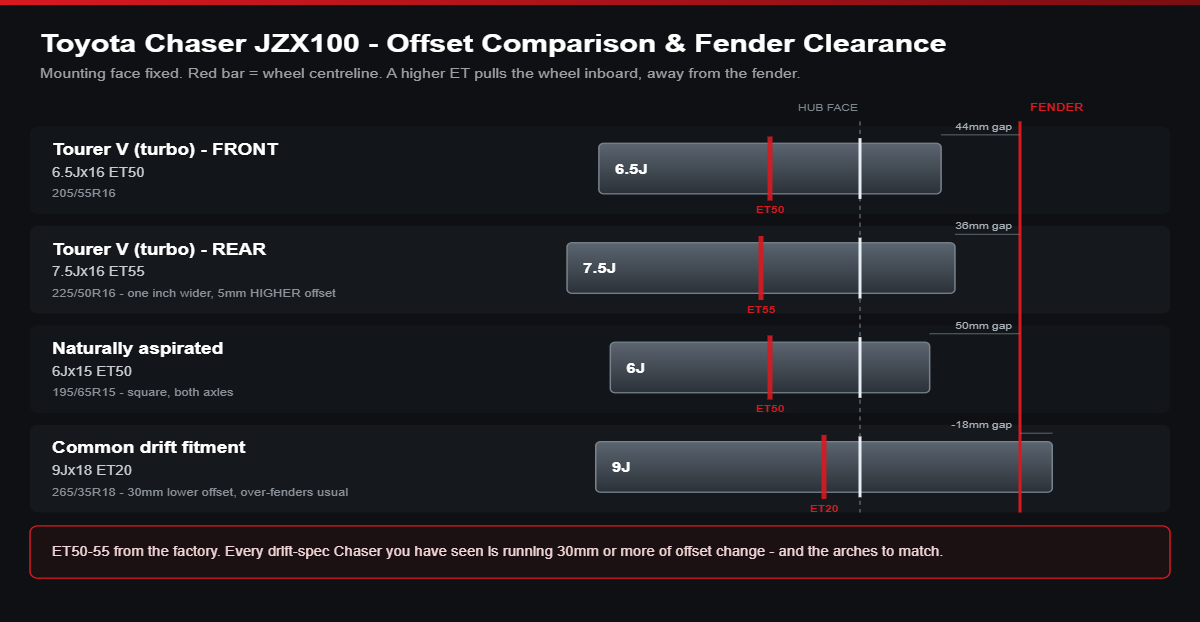
Section 2: Offset Comparison & Fender Clearance Visualization
Section 3: The Turbo’s Rear-In Stagger
The Tourer V is the only X100 with a staggered setup, and it goes in the direction people least expect: the rear rim is one inch wider but sits at ET55 against the front’s ET50 — five millimetres further inboard.
This is the same philosophy Toyota used on the MR2 SW20 and that Honda used on the S2000 and NSX: widen the rim, keep the wheel tucked. It is the opposite of the 370Z, which pushes the rear out by 28 mm.
Practically, it means you cannot swap a Tourer V front wheel to the rear — but the difference is small enough that most owners never notice until they measure.
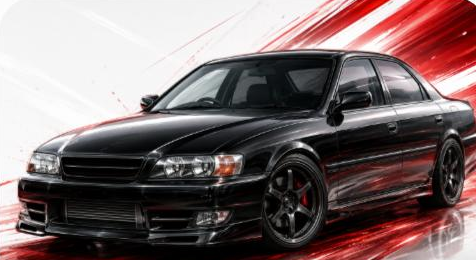
A Japanese-market X100 — the platform that defines the modern drift aesthetic. — via @@yu_uki100
Section 4: What Modified Chasers Actually Run
The X100 has generous arches for a saloon of its era, but the factory ET50 leaves a very large gap. Common fitments, in order of aggression:
- 17×8 ET35 / 17×9 ET30 — the mild street setup. Fits standard arches at a moderate ride height. No body work.
- 18×9 ET20 / 18×9.5 ET15 — the common modern fitment. Fender roll required, and camber at the rear.
- 18×9.5 ET0 / 18×10.5 ET0 with over-fenders — the full drift-spec look. Body work, not a bolt-on.
Because the factory offset is so high, the Chaser has an unusually large amount of usable room before the wheel hits the arch. That is exactly why the platform became a drift favourite: it tolerates enormous fitment changes before it needs cutting.
Section 5: The 60.1 mm Toyota Bore
The X100 uses Toyota’s standard 5×114.3 / 60.1 mm / M12x1.5 combination, shared with the Supra, MR2, Celica and Soarer.
- Supra and MR2 wheels fit. See our Supra guide.
- Nissan wheels (66.1 mm) fit with hub-centric rings — the bore is larger than the Toyota hub, so a 66.1–60.1 ring is all that is needed. This is why so many JZX100s wear Silvia and Skyline wheels.
- Toyota wheels do NOT fit Nissan hubs — the error only works in one direction.
- Evo and RX-7 FD wheels (67.1 mm) fit with rings.
This one-way compatibility is a genuine advantage for the Chaser: it can wear almost the entire 5×114.3 Japanese catalogue with a set of rings.
Section 6: Brake Clearance
The factory 16-inch wheel clears the Tourer V’s brakes comfortably, and 15-inch wheels fit the naturally aspirated cars. However, a large proportion of surviving JZX100s have been fitted with larger brake packages — commonly Supra or aftermarket four-pot setups — which push the minimum diameter to 17 inches.
Check what is behind the wheel before buying a 16-inch set. On a platform this heavily modified, the factory specification is often the least reliable guide to what the car actually needs.
Related Fitment Guides
- Toyota Supra — the same 60.1 mm bore and engine family
- Lexus SC / Toyota Soarer — the closely related coupe
- Lexus IS — the modern equivalent
- Lexus GS350 / GS F — Toyota’s rear-in tradition
Every guide in this series is built the same way: verified factory specifications, an offset diagram, and an honest account of what fits and what does not.
Seen on the road
Which wheels are you looking for? Tell us the wheel, the size and the fitment — send us a request and we will go and find it.
Wheel identification is taken from the hashtags the owner applied to their own post.
Buying Wheels for Your JZX100
The Chaser is one of the easiest cars in this series to fit wheels to, precisely because it starts so conservatively. Diameter, width, offset, bore, brakes — and then decide how far past ET30 you are willing to go.
Looking for a specific set? We specialise in genuine Japanese wheels — RAYS, Volk, Enkei, SSR, WORK, BBS Japan and the rare discontinued sets that never left the country. Tell us the wheel, the fitment, the year — our team searches our networks until we find it.
Specifications in this guide reflect factory equipment for Japanese-market vehicles. Trim levels, optional wheel packages and market-specific variants can differ. Always confirm the fitment against your own car before purchase.