

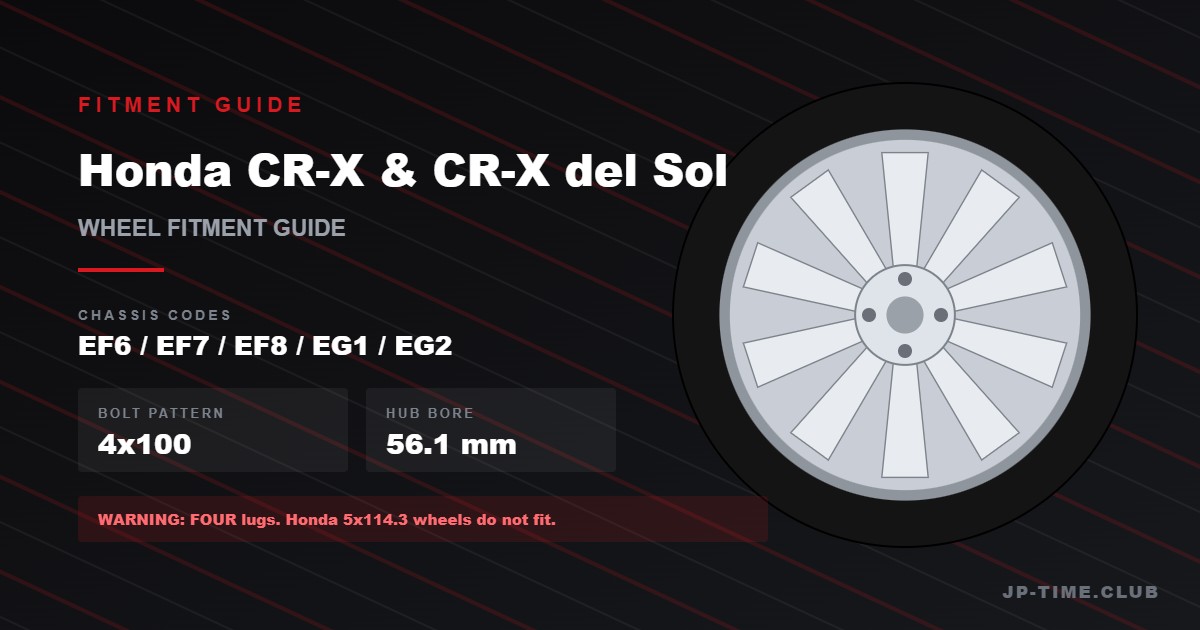
The CR-X is a four-lug car. Everything Honda built after it that people cross-shop wheels from — the Integra Type R, the S2000, the NSX, the EK9 Civic Type R — is five-lug 5×114.3.
The CR-X and del Sol run 4×100 with a 56.1 mm hub bore and M12x1.5 studs, at ET45 across every model and every year. That combination is what defines the platform’s aftermarket, and it is not the one most Honda buyers assume.
Section 1: OEM Wheel Specifications
| Model | Chassis Code | Years | Bolt Pattern | Hub Bore | Thread | OEM Wheel / Tyre |
|---|---|---|---|---|---|---|
| CR-X 1.5 | EF6 / EF7 | 1987-1992 | 4×100 | 56.1 mm | M12x1.5 | 5Jx13 ET45 / 175/70R13 5Jx14 ET45 / 175/65R14 |
| CR-X 1.6 SiR | EF8 | 1987-1992 | 4×100 | 56.1 mm | M12x1.5 | 5.5Jx14 ET45 / 195/60R14 |
| CR-X del Sol 1.6 | EG1 / EJ4 | 1992-1998 | 4×100 | 56.1 mm | M12x1.5 | 5Jx14 ET45 / 175/65R14 |
| CR-X del Sol SiR | EG2 | 1992-1998 | 4×100 | 56.1 mm | M12x1.5 | 6Jx15 ET45 / 195/55R15 |
Bolt pattern, hub bore, thread and offset are identical across both generations. Only rim width and diameter change.
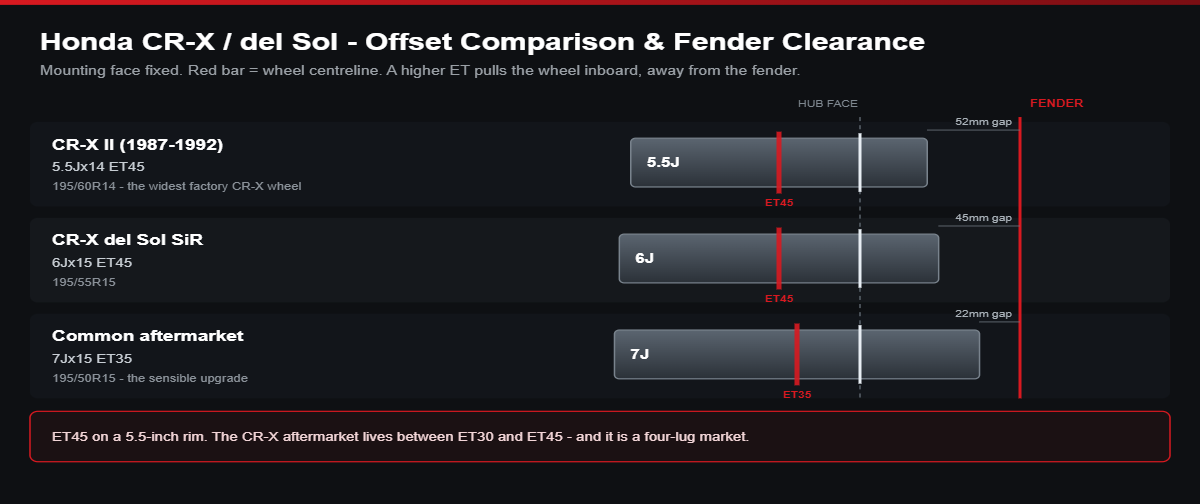
Section 2: Offset Comparison & Fender Clearance Visualization
Section 3: The 4×100 / 56.1 mm Combination
4×100 is a very common pattern, but the 56.1 mm bore is Honda-specific, and it sits between two other common sizes:
- Toyota 4×100 (Vitz, Aqua, Passo) is 54.1 mm. A Toyota wheel will not fit a Honda hub — the bore is 2 mm too small. See our Vitz / Yaris guide.
- European 4×100 (VW, Mini, Renault) is 57.1 mm. These will fit with a 57.1–56.1 hub-centric ring.
- Other Honda 4×100 cars fit directly — EF/EG/EK Civic (non-Type R), Integra DA/DC2 in four-lug form, Fit/Jazz.
The rule is the same one that runs through this entire series: a larger bore can be reduced with a ring; a smaller bore cannot be enlarged.
A Japanese CR-X SiR on forged 4×100 wheels — a specialist corner of the market that Japan still serves. — via @@crx_club_turkey
Section 4: What the Aftermarket Offers
4×100 in a genuine performance wheel is a shrinking market globally, but Japan remains the exception. RAYS (Volk TE37 in 4×100), WORK, SSR, Enkei, Watanabe and Mugen have all produced 4×100 wheels for this generation of Honda, and secondhand sets in Japan are the realistic source.
Realistic fitments
- 15×6.5 ET38–ET45 — a clean upgrade with 195/50R15. No arch work, keeps the rolling diameter honest.
- 15×7 ET35 — the sensible enthusiast fitment. Fits standard arches at a mild drop. Roughly 19 mm more track per side than the factory 5.5J ET45.
- 15×8 ET25 — aggressive on a car this narrow. Fender roll and camber expected.
- 14×6.5 ET38 — for a car being kept period-correct. Tyre choice at 14 inches is limited but still viable.
Do not go large. The CR-X weighs around 950 kg with roughly 130 hp in SiR form. A 17-inch wheel adds unsprung mass the car cannot afford and removes sidewall it genuinely uses. 15 inches is the sweet spot, and 16 is the sensible maximum.
Section 5: The Five-Lug Conversion Question
Converting a CR-X to 5×114.3 using Integra Type R or later Civic hubs is a well-documented path, and it is usually done for the brakes rather than the wheels. If you are doing it, do it for that reason — the four-lug wheel market is smaller but far from empty, and a conversion changes the car’s front-end geometry and parts availability in ways worth thinking through first.
For context on the five-lug Honda world, see our Civic guide, S2000 guide and NSX guide — all 5×114.3 with a 64.1 mm bore.
Related Fitment Guides
- Honda Civic — the same Honda 4×100 fitment
- Honda Integra Type R — where Honda splits four and five lugs
- MINI Cooper — identical pattern and bore
- Toyota AE86 — the contemporary four-lug alternative
Every guide in this series is built the same way: verified factory specifications, an offset diagram, and an honest account of what fits and what does not.
Seen on the road
Which wheels are you looking for? Tell us the wheel, the size and the fitment — send us a request and we will go and find it.
Wheel identification is taken from the hashtags the owner applied to their own post.
Buying Wheels for Your CR-X
Four lugs, 100 mm, 56.1 mm bore, ET45 as the reference. Then keep it small and keep it light — this car rewards that more than almost anything else in this series.
Looking for a specific set? We specialise in genuine Japanese wheels — RAYS, Volk, Enkei, SSR, WORK, BBS Japan and the rare discontinued sets that never left the country. Tell us the wheel, the fitment, the year — our team searches our networks until we find it.
Specifications in this guide reflect factory equipment for Japanese-market vehicles. Trim levels, optional wheel packages and market-specific variants can differ. Always confirm the fitment against your own car before purchase.