
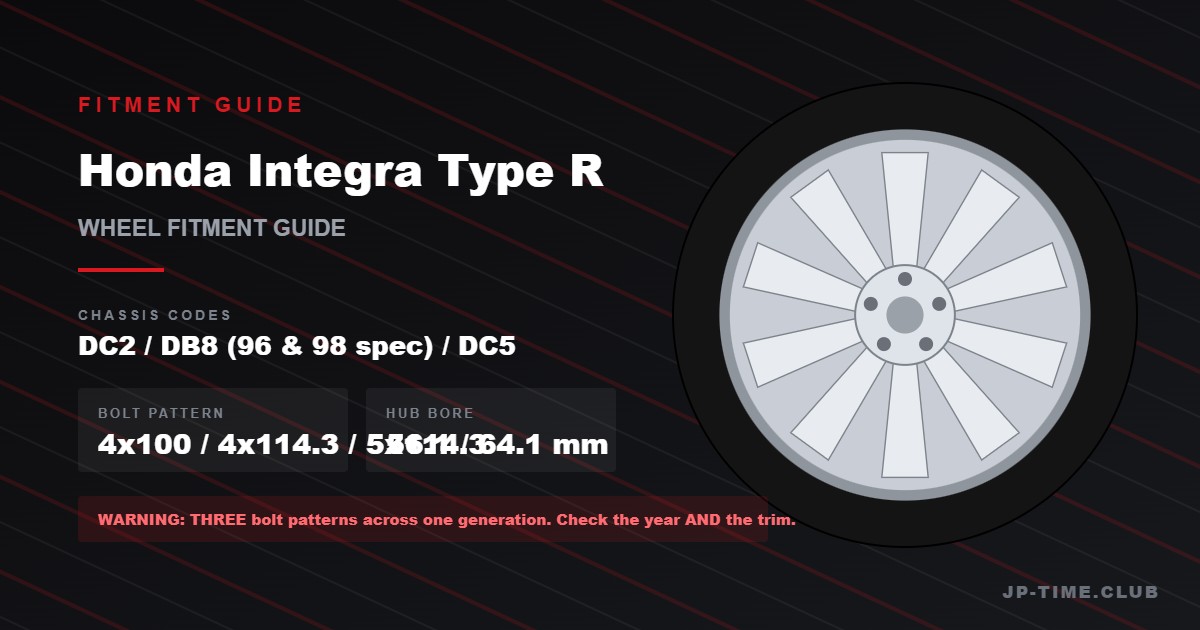
Three bolt patterns. One bodyshell. Six model years.
The third-generation Integra is the most fitment-confusing car in this entire series, and it is confusing in a way that no other manufacturer manages:
- An ordinary DC2 or DB8 Integra is 4×100 with a 56.1 mm bore.
- A 96-spec Type R (1995-1997) is 4×114.3 — four lugs, but a completely different circle.
- A 98-spec Type R (1998-2001) is 5×114.3 with a 64.1 mm bore.
Three cars that look identical from ten metres, and no wheel from any of them fits either of the others.
Section 1: OEM Wheel Specifications
| Model | Chassis Code | Years | Bolt Pattern | Hub Bore | Thread | OEM Wheel / Tyre |
|---|---|---|---|---|---|---|
| Integra 1.6 / 1.8 (base) | DB6 / DB9 / DC1 / DC2 | 1995-2001 | 4×100 | 56.1 mm | M12x1.5 | 5.5Jx14 ET45 / 185/65R14 6Jx15 ET45 / 195/55R15 |
| Integra Type R (96-spec) | DC2 / DB8 | 1995-1997 | 4×114.3 | see note | M12x1.5 | 6Jx15 ET50 / 195/55R15 |
| Integra Type R (98-spec) | DC2 / DB8 | 1998-2001 | 5×114.3 | 64.1 mm | M12x1.5 | 6Jx15 ET50 / 195/55R15 7Jx16 ET50 / 215/45R16 |
| Integra Type R | DC5 | 2001-2006 | 5×114.3 | 64.1 mm | M12x1.5 | 7Jx17 ET60 / 215/45R17 |
| Integra 2.0 (base) | DC5 | 2001-2006 | 5×114.3 | 64.1 mm | M12x1.5 | 6Jx15 ET45 / 195/65R15 7Jx17 ET45 / 215/45R17 |
Note on the 96-spec Type R: the 4×114.3 hub is well documented but the published bore figure varies by source. Measure the hub or confirm against a known-good wheel before purchase.
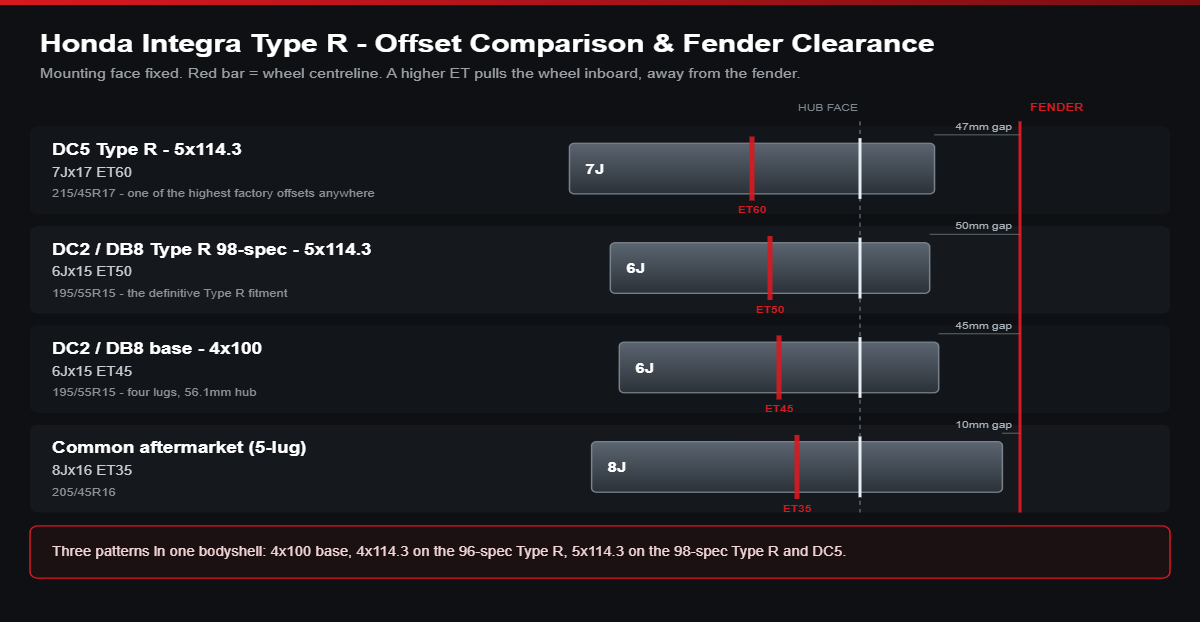
Section 2: Offset Comparison & Fender Clearance Visualization
Section 3: How to Identify What You Have
In order of reliability:
- Count the studs. Five means 98-spec Type R or DC5. Four means base car or 96-spec Type R.
- If four, measure across the studs. On a four-lug pattern, measure centre-to-centre between two studs directly opposite each other — that measurement is the PCD. 100 mm means a base Integra; 114.3 mm means a 96-spec Type R.
- Check the chassis plate. DC2 and DB8 cover both Type R and non-Type R, so the code alone is not enough — but combined with the year it resolves the question.
This matters because 96-spec Type R wheels are a genuinely rare item. 4×114.3 in a 15-inch performance wheel is a small market even in Japan, and the factory Type R wheel in that pattern commands a premium accordingly.
A Japanese-market DC2 Type R on forged 5×114.3 wheels — the 98-spec fitment. — via @@eriel_f.co.jp
Section 4: The DC5 and Its ET60
The DC5 Type R runs 7Jx17 ET60. That is an extraordinary number for a front-wheel-drive performance car, and it sits alongside the S2000’s ET55/ET65 and the NSX’s ET55/ET60 as evidence of a consistent Honda philosophy in this period: tuck the wheel, set the track with the suspension.
The practical consequence is the same as on those cars. A typical aftermarket 17×8 comes in ET35–ET45. Fitted to a DC5, an ET40 wheel sits 20 mm further outboard than factory — which on the DC5’s arches means rubbing at full lock and under compression.
Realistic DC5 fitments:
- 17×7.5 ET48–ET55 — effectively factory-equivalent. Japanese wheels made for this platform live here.
- 17×8 ET45 — common, and it will need a mild fender roll on a lowered car.
- 17×8.5 ET40 and lower — rolled arches and camber, and expect rubbing on standard suspension.
Section 5: The DC2 Type R Fitment
The 98-spec DC2 Type R’s 6Jx15 ET50 on a 195/55R15 is one of the definitive JDM fitments — small, light, and chosen for lap time rather than appearance. The car weighs around 1,090 kg.
- 15×7 ET40–ET45 — the classic upgrade with a 195/50R15. Keeps the car’s character intact.
- 16×7 ET42 — the practical modern choice for tyre availability.
- 17×8 ET35 — visually popular, but adds meaningful unsprung mass to a very light car. Consider carefully.
The DC2 Type R is one of the few cars where going smaller and lighter is the performance choice — the same argument that applies to the AE86 and the CR-X.
Section 6: The 64.1 mm Honda Bore
Five-lug Integras share Honda’s 64.1 mm bore with the NSX, S2000, Civic Type R and Accord.
- S2000, NSX and Civic Type R wheels fit — though their offsets are also very high.
- Nissan wheels (66.1 mm) fit with a 66.1–64.1 ring.
- Toyota wheels (60.1 mm) will not fit at all.
- Evo and RX-7 FD wheels (67.1 mm) fit with rings.
Related Fitment Guides
- Honda Civic — Honda’s other four-and-five-lug story
- Honda CR-X & del Sol — the four-lug side
- Honda S2000 — the five-lug side at ET65
- Honda / Acura NSX — the same 64.1 mm bore
Every guide in this series is built the same way: verified factory specifications, an offset diagram, and an honest account of what fits and what does not.
Seen on the road
Which wheels are you looking for? Tell us the wheel, the size and the fitment — send us a request and we will go and find it.
Wheel identification is taken from the hashtags the owner applied to their own post.
Buying Wheels for Your Integra
Count the studs, then measure the pattern, then check the bore. On this car, all three steps are necessary — and skipping any one of them is how people end up with a set of wheels that will not go on.
Looking for a specific set? We specialise in genuine Japanese wheels — RAYS, Volk, Enkei, SSR, WORK, BBS Japan and the rare discontinued sets that never left the country. Tell us the wheel, the fitment, the year — our team searches our networks until we find it.
Specifications in this guide reflect factory equipment for Japanese-market vehicles. Trim levels, optional wheel packages and market-specific variants can differ. Always confirm the fitment against your own car before purchase.