
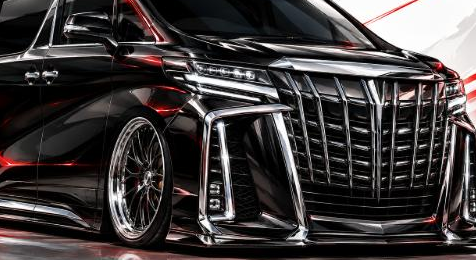
The Alphard and Vellfire are the most heavily wheeled vehicles in Japan. Not sports cars, not saloons — luxury minivans, and an entire branch of the Japanese aftermarket exists to serve them.
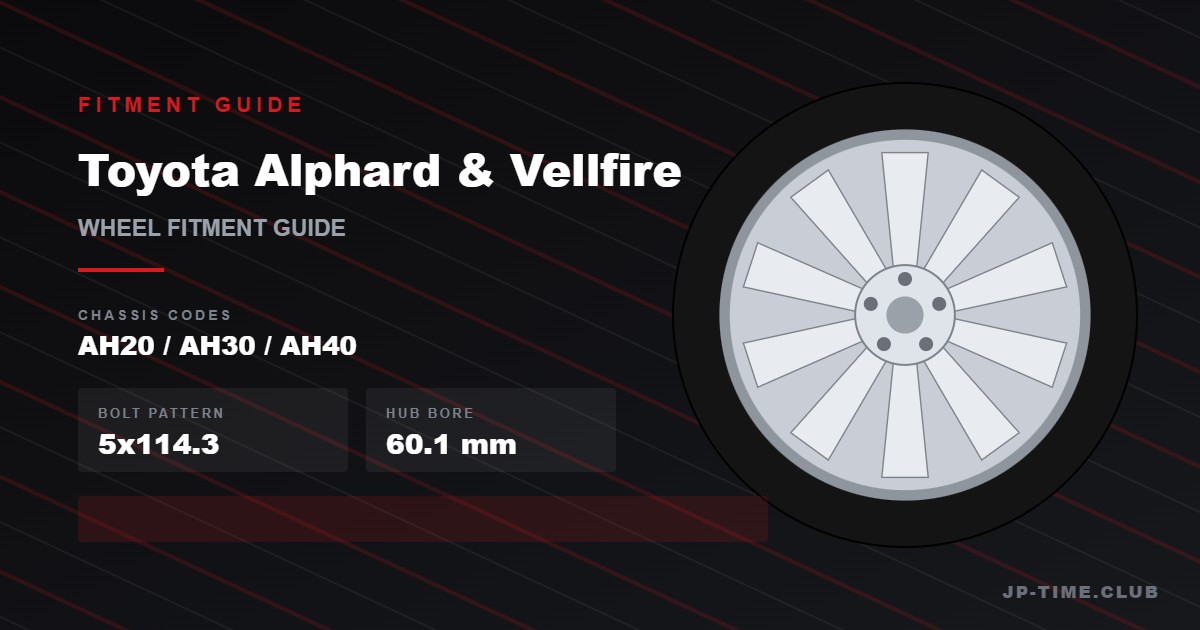
The fitment itself is ordinary: 5×114.3, 60.1 mm bore, M12x1.5, 103 Nm. The same combination as a Supra, a Chaser or a Lexus IS. What is unusual is a factory quirk most owners never notice.
Section 1: OEM Wheel Specifications
| Package | Bolt Pattern | Hub Bore | Thread | Torque | Wheel (front & rear) | Tyre |
|---|---|---|---|---|---|---|
| 16-inch | 5×114.3 | 60.1 mm | M12x1.5 | 103 Nm | 6.5Jx16 ET33 | 215/65R16 |
| 17-inch | 5×114.3 | 60.1 mm | M12x1.5 | 103 Nm | 6.5Jx17 ET33 | 225/60R17 |
| 18-inch | 5×114.3 | 60.1 mm | M12x1.5 | 103 Nm | 7.5Jx18 ET45 | 235/50R18 |
The Alphard and Vellfire are the same vehicle with different bodywork and share fitment exactly. AH20 (2008-2015) uses the same bolt pattern and bore.
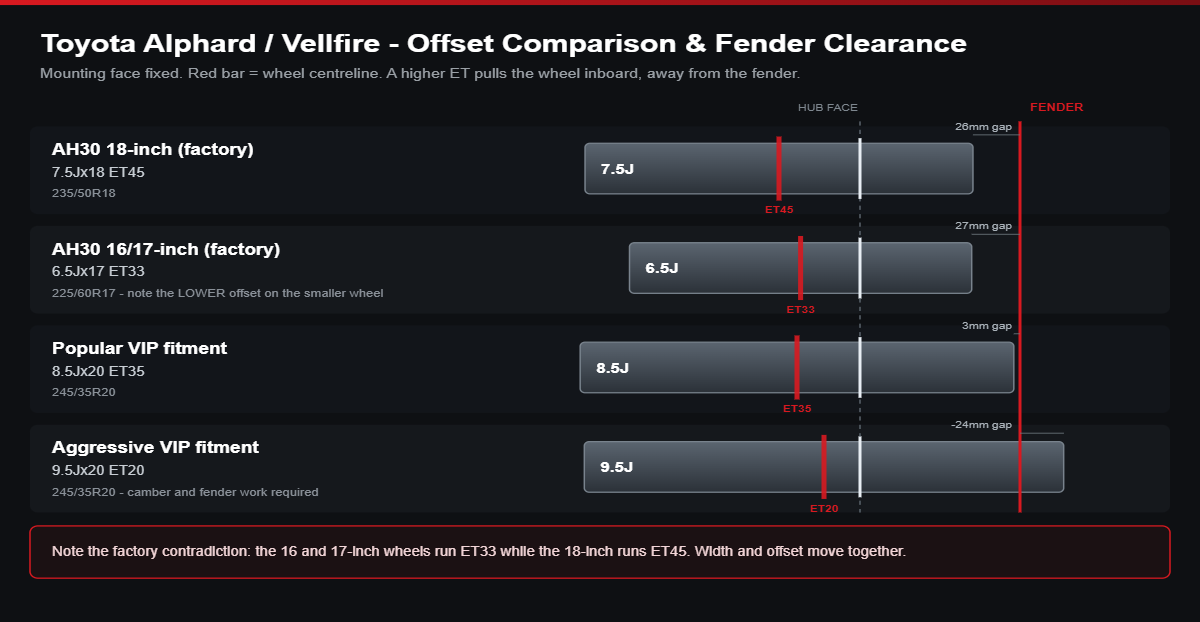
Section 2: Offset Comparison & Fender Clearance Visualization
Section 3: The Factory Offset Split
This catches people out. The Alphard’s smaller wheels run ET33 and the 18-inch runs ET45 — a twelve-millimetre difference on the same vehicle.
It is not arbitrary. The 18-inch wheel is one inch wider (7.5J against 6.5J), so half an inch of extra rim sits on each side of the centreline. Raising the offset by 12 mm keeps the outer edge of the tyre in almost exactly the same place while pulling the inner edge away from the suspension.
Practical consequence: if you are moving between factory wheel sizes, the offsets are not interchangeable. An ET33 16-inch wheel and an ET45 18-inch wheel are designed to produce the same stance by different means.
A 20-inch fitment on an Alphard — the size the aftermarket built this whole category around. — via @@bocilsashimi
Section 4: What the Aftermarket Actually Runs
The Alphard and Vellfire aftermarket is enormous in Japan, and it is almost entirely about 20 and 21-inch wheels with deep faces and low-profile tyres.
- 20×8.5 ET35 with 245/35R20 — the mainstream fitment. Fits standard arches at factory ride height on most cars. Keeps the rolling diameter close to the factory 18-inch.
- 20×8.5 ET45 — the conservative version. Sits closer to where Toyota put the 18-inch wheel.
- 20×9.5 ET20 / 21×9 ET30 — the full VIP look. Lowered on coilovers or air, with camber and usually some arch work.
- 19×8 ET38 — the practical choice. More sidewall, better ride, far cheaper tyres.
Rolling diameter matters more here than on a sports car. The Alphard is heavy and geared for it; a significant increase in overall diameter dulls the response and affects the speedometer. Match the diameter, not just the wheel size.
Section 5: Load Rating — The Section That Matters
An Alphard weighs around 2,000 kg empty, and it is a vehicle designed to be full: seven or eight people plus luggage takes it well beyond that. Gross vehicle weight is what the wheel has to carry, not kerb weight.
On any used Japanese wheel for this vehicle:
- Look for JWL and VIA stamps on the inside of the spoke face.
- Check the published load rating per wheel. Japanese manufacturers state it per model and size. For an Alphard, you want a figure comfortably above the front axle load divided by two.
- Be sceptical of wheels designed for sports cars. A 20-inch wheel built for a 1,400 kg coupe may look perfect and be rated well below what this vehicle needs.
The same caution applies to the Land Cruiser, where the JWL-T truck standard becomes relevant.
Section 6: What Fits From Elsewhere
The 60.1 mm Toyota bore gives the Alphard access to the widest fitment pool in Japan:
- Any Toyota or Lexus 5×114.3 wheel — Supra, Chaser, IS, LS400, SC430, Century. See our LS400 guide.
- Nissan wheels (66.1 mm) and Evo / RX-7 wheels (67.1 mm) — fit with hub-centric rings.
- Honda wheels (64.1 mm) — fit with rings.
Offsets are the limiting factor rather than fitment. Most sports-car wheels are made in ET30–ET45, which suits the Alphard well — but check the load rating before the offset.
Related Fitment Guides
- Toyota Sienna — the North American equivalent
- Toyota Land Cruiser — load rating on a heavy Toyota
- Toyota Century — the VIP predecessor
- Lexus LS400 / Celsior — where VIP style began
- Suzuki Jimny — the other Japanese vehicle where load rating comes first
Every guide in this series is built the same way: verified factory specifications, an offset diagram, and an honest account of what fits and what does not.
Seen on the road
Which wheels are you looking for? Tell us the wheel, the size and the fitment — send us a request and we will go and find it.
Wheel identification is taken from the hashtags the owner applied to their own post.
Buying Wheels for Your Alphard or Vellfire
5×114.3, 60.1 mm, and a load rating that respects a full car. The Alphard is mechanically one of the easiest vehicles in this series to fit wheels to, and one of the easiest to fit the wrong wheels to.
Looking for a specific set? We specialise in genuine Japanese wheels — RAYS, Volk, Enkei, SSR, WORK, BBS Japan and the rare discontinued sets that never left the country. Tell us the wheel, the fitment, the year — our team searches our networks until we find it.
Specifications in this guide reflect factory equipment for Japanese-market vehicles. Trim levels, optional wheel packages and market-specific variants can differ. Always confirm the fitment and load rating against your own vehicle before purchase.