Ask an American enthusiast to picture the company that makes WORK wheels and you usually get something large. A famous name, a global presence, decades of drift and time-attack cars — it feels like a corporation.
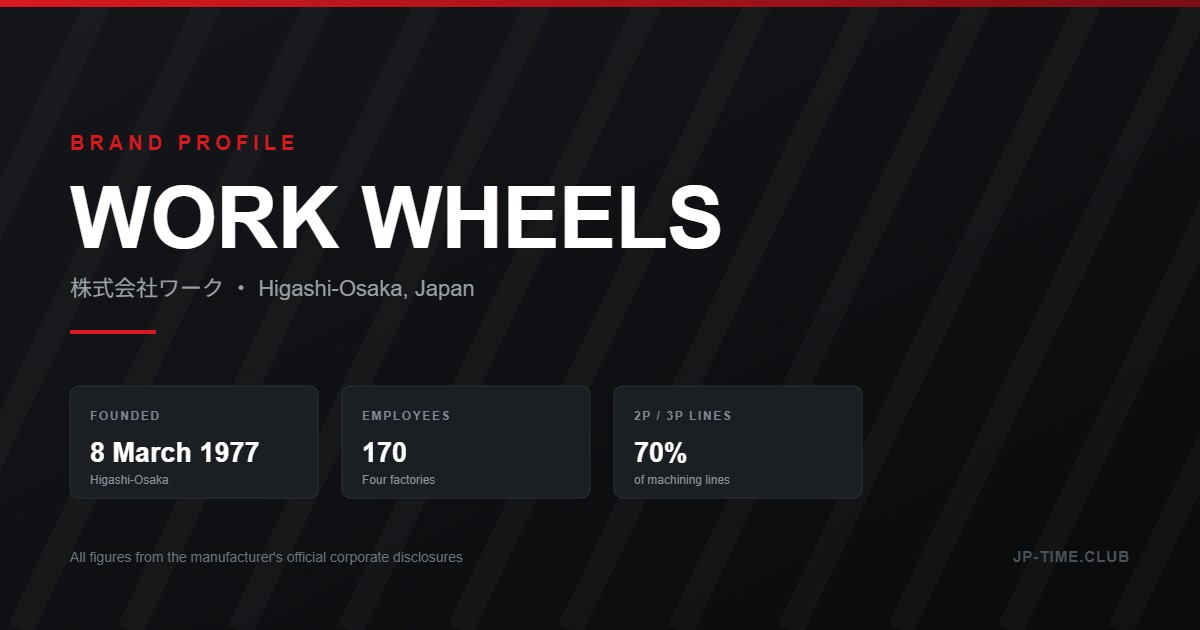
It is a 170-person company in Higashi-Osaka.
That is not a criticism. It is the most interesting thing about WORK, and it explains almost everything about how the wheels are made and why they cost what they cost. This profile is built from WORK’s own published corporate records, read in Japanese, rather than from other people’s articles — and those records tell a far more specific story than the usual brand write-up.
The Short Version
- Founded 8 March 1977 by Takeshi Tanaka, with 4 million yen of capital, in Takaida-Hondori, Higashi-Osaka.
- A dedicated three-piece wheel factory opened in December 1979 — two years and nine months after the company existed at all.
- Today: 170 employees, four factories, 23,430 m² of total site area, capital of 95 million yen.
- Around 70% of WORK’s machining lines are given over to two-piece and three-piece rim production.
- President since August 2015: Chika Tanaka.
If you remember one thing: WORK decided what it was going to be in 1979 and has not moved since.
What the Official Record Actually Says
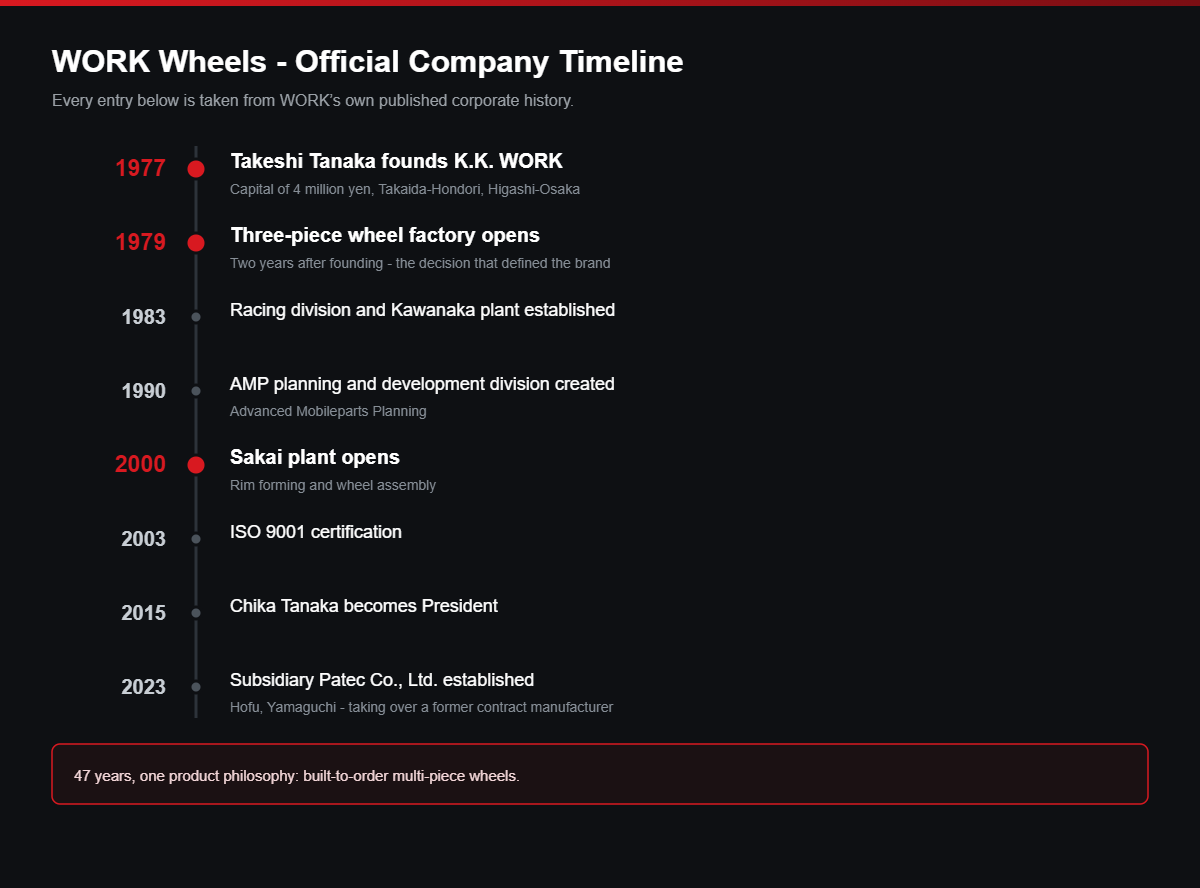
Two entries matter more than the rest.
1979. A company founded in March 1977 with four million yen — a genuinely small sum, even then — opened a factory dedicated to three-piece wheels in December 1979. Multi-piece construction was not a differentiator bolted on once the business was established. It was the business, almost from the start.
2000. The Sakai plant opened for rim forming and wheel assembly. Twenty-three years in, WORK was still putting capital specifically into the multi-piece process rather than drifting toward the cheaper, higher-volume one-piece cast wheels that dominate the market.
Between those dates sit the things you would expect: a racing division in 1983, a planning and development arm called AMP (Advanced Mobileparts Planning) in 1990, ISO 9001 certification in 2003. Steady, unglamorous, consistent.
Why WORK Is a Multi-Piece Company
WORK publishes its factory breakdown, and one number in it is the clearest statement of intent on the entire website:
Of the machining lines, 70% are used to produce two-piece and three-piece rims in wrought aluminium, covering the full range of WORK’s size variations.
Most wheel manufacturers treat multi-piece as a premium sub-line. WORK treats one-piece as the sub-line.
The consequence for a buyer is the thing WORK is actually famous for: you can order the same design in an enormous range of widths and offsets, because the rim and the disc are separate components assembled to order rather than a single casting that exists in four fixed sizes.
WORK calls this its “on-demand system”. In its own description, rim forming, disc casting, machining, painting, assembly and sales are deliberately separated across different plants and lines, with a production control department merging those lines as required. The stated purpose is high-mix, low-volume production — the manufacturing term for “many different specifications, small quantities of each.”
This is why a WORK wheel in an unusual offset is normal. It is not a marketing difference. It is a different factory layout.
Where the wheels are actually made
| Plant | Location | Site area |
|---|---|---|
| Okayama No.1 | Mimasaka, Okayama | 6,489 m² |
| Okayama No.2 | Mimasaka, Okayama | 9,772 m² |
| Sakai | Sakai, Osaka | 4,130 m² |
| Shiki | Yao, Osaka | 3,039 m² |
Two prefectures, four sites, 23,430 m² in total — and one of the most recognisable wheel catalogues in the world.
The Current Model Families
- MEISTER — S1, M1, L1, CR01, in one-piece, two-piece and three-piece forms. The deep-lip line most associated with the brand.
- EMOTION — CR Shigoku, T5R and related models. The sport and track family.
- GNOSIS — RXM, RXS, CVS. Luxury and large-diameter fitments.
- SCHWERT — QUELL2, BRUNNEN LX. Executive saloon territory.
- EQUIP — E05 and the classic Equip lineage.
- CRAG, XTRAP, LS VAJRA — SUV, van and truck applications.
Note how many families exist in both one-piece and three-piece versions. That is the on-demand system showing up in the catalogue: same design language, different construction, same factory.
What This Means When You Are Buying
1. Offset and width are not fixed. On a multi-piece WORK the specification is assembled, not selected from stock. Used WORK wheels therefore turn up in offsets that appear in no catalogue table, because someone ordered them that way. Read the actual stamping rather than assuming a catalogue figure.
2. Multi-piece wheels can be rebuilt. A damaged rim half on a two- or three-piece wheel is a component, not a write-off. That is a real part of the value of a used set and one reason well-kept WORK wheels hold their price.
3. Small company, finite output. 170 people and four modest plants running high-mix, low-volume production is not a configuration that floods a market. Discontinued WORK designs do not come back, which is why particular older models command what they do.
What We Could Not Verify
Two things are widely repeated about WORK that we could not confirm from any official source, so we are not stating them as fact.
- The origin of the name. English-language articles frequently say “WORK” comes from artwork. WORK uses the phrase “art of wheel” in its own showroom, which is suggestive — but the company does not publish an explanation of the name anywhere we could find. Treat the artwork story as folklore until WORK says otherwise.
- The relationship between the founder and the current president. Takeshi Tanaka founded the company; Chika Tanaka has led it since 2015. The shared surname is obvious. The company does not state the connection, so neither will we.
We would rather leave a gap than fill it with something that merely sounds right.
FAQ
Is WORK a Japanese-made wheel?
WORK operates four factories in Osaka and Okayama prefectures and describes an integrated process covering rim forming, disc casting, machining, painting and assembly. In 2023 it also established a subsidiary, Patec Co., Ltd., in Hofu, Yamaguchi, taking over the business of a former contract manufacturer.
How big is WORK?
170 employees, capital of 95 million yen, four plants totalling 23,430 m². Its published customer list includes Yellow Hat, Autobacs Seven, Fuji Corporation, Sumitomo Rubber, TOYO TIRE and Toyota Customizing & Development, among roughly 3,500 accounts.
Why are WORK wheels available in so many offsets?
Because most are assembled from separate rim and disc components rather than cast in one piece. Around 70% of WORK’s machining line capacity is dedicated to two- and three-piece rim production.
Are WORK wheels JWL and VIA certified?
Japanese-market wheels sold for road use carry JWL marking, and VIA registration is the standard third-party verification. Check the stamping on the specific wheel in front of you rather than relying on the model name.
Can a bent WORK wheel be repaired?
On two- and three-piece models the rim is a separate component and can in principle be replaced. On one-piece models it cannot. Confirm which construction you have before assuming either.
Is WORK the same company as WedsSport?
No. WedsSport is a different manufacturer entirely. The maker of WORK wheels is K.K. WORK of Higashi-Osaka, Osaka.
Sources
Every figure in this article comes from WORK’s own corporate disclosures — the company profile, company history and factory overview pages of work-wheels.co.jp — read in the original Japanese. Where those documents are silent, we have said so rather than filling the gap from secondary sources.
Related Fitment Guides
- Nissan Silvia S15 — 5×114.3 / 66.1 mm, one of the most common WORK applications
- Toyota Chaser JZX100 — the platform that made deep-lip multi-piece fitment mainstream
- Toyota AE86 — 4×114.3, where the classic Equip lineage lives
- Mazda RX-7 FD3S — 5×114.3 / 67.1 mm
- Honda Civic — 4×100 and 5×114.3, and why the difference matters
Looking for a specific set? We specialise in genuine Japanese wheels — RAYS, Volk, Enkei, SSR, WORK, BBS Japan and the rare discontinued sets that never left the country. Tell us the wheel, the fitment, the year — our team searches our networks until we find it.