
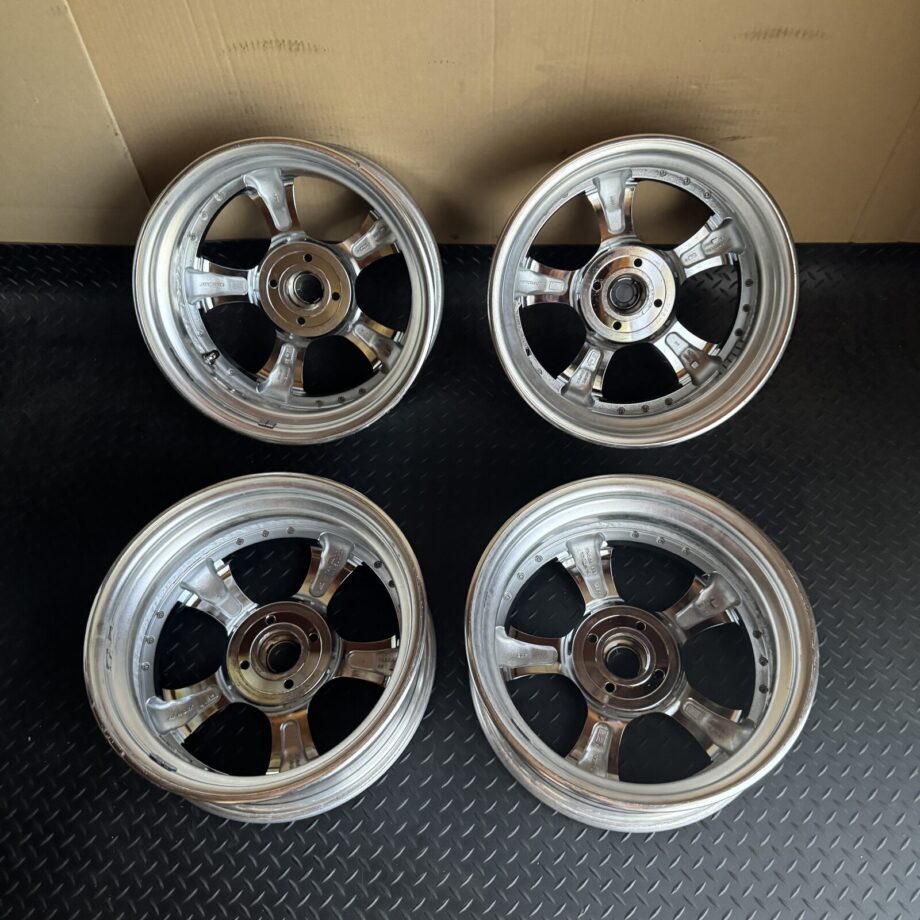
Most guides to spotting a fake wheel are written from photographs found on the internet. This one is not. Everything below was photographed by us, on two sets of WORK wheels that were physically in our hands in Osaka: a set of four WORK VS-KF in 16×5½JJ, and a set of four WORK Meister S1R in 16×6.0JJ and 16×6.5J.
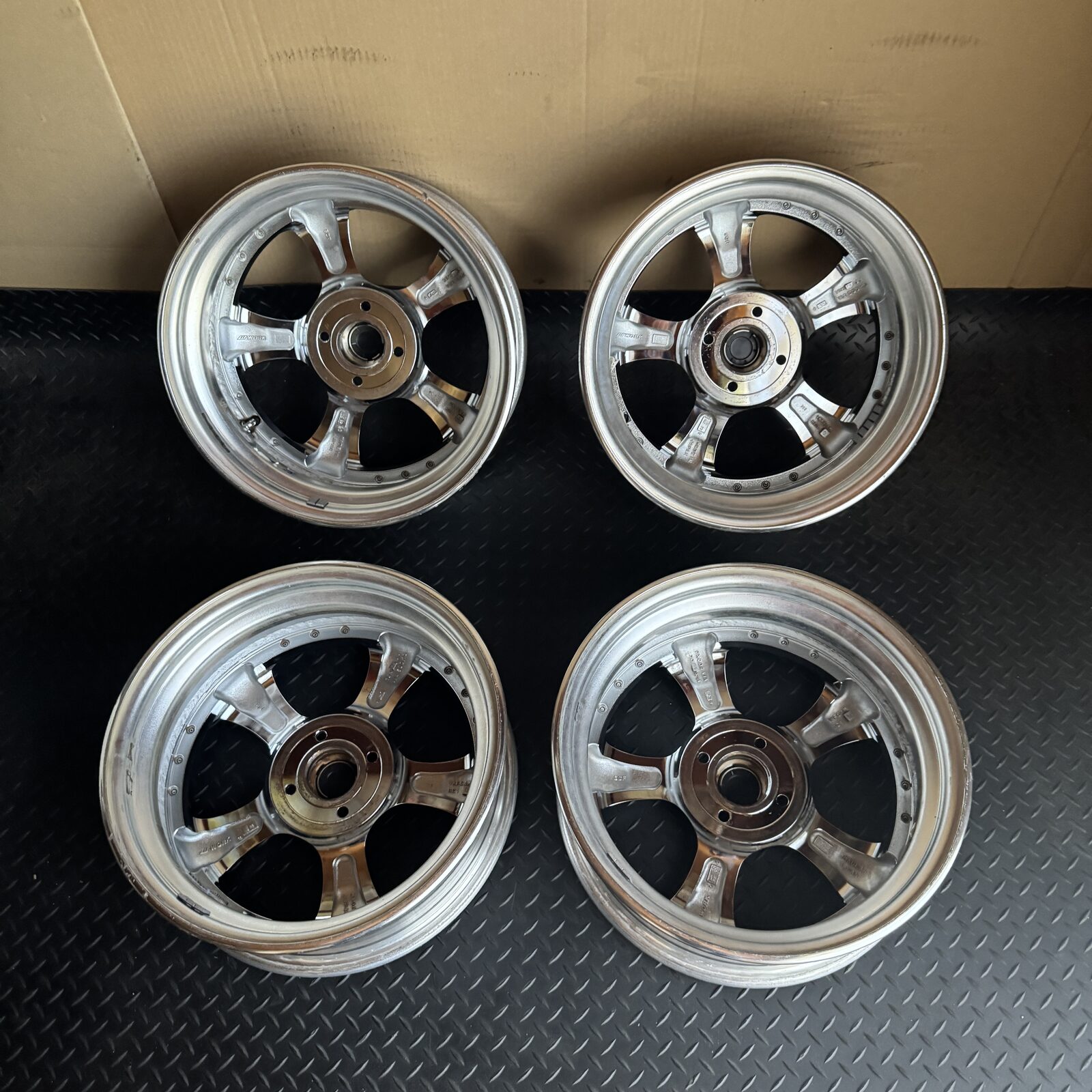
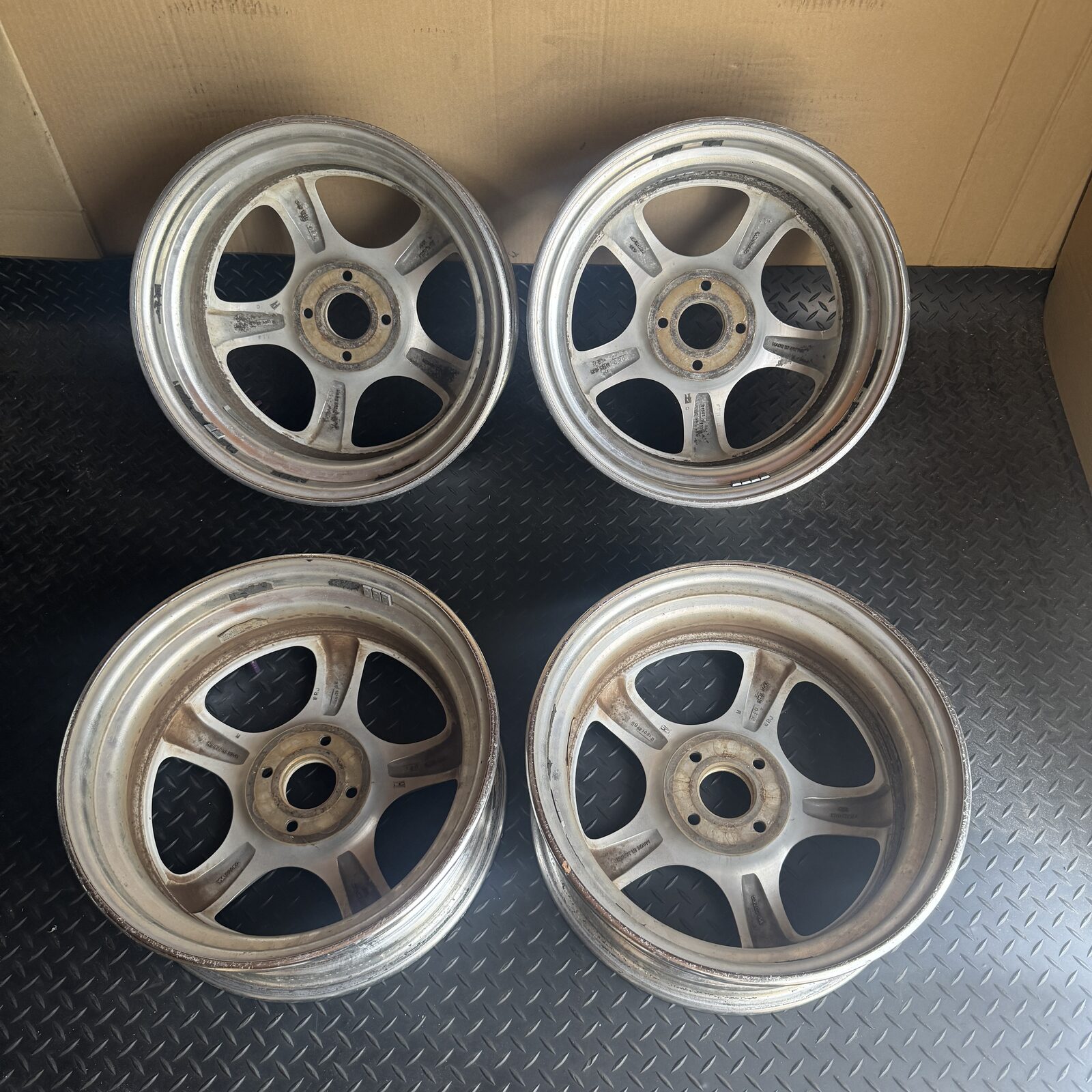
We started out intending to document one wheel. Photographing a second set turned out to be the more useful exercise, because the two wheels are built differently — and that difference changes where the markings are. If you only ever learn one wheel, you will look in the wrong place on the next one.
A note on what this article is and is not. We are a seller. We are not a WORK dealer, we have no access to WORK’s internal records, and nothing here is an authentication service. What follows is a description of what is physically stamped and cast into two sets of wheels we own, and what we can and cannot conclude from it.
Two Wheels, Two Constructions
The VS-KF is a multi-piece wheel: a cast centre disc bolted to a separate barrel. The Meister S1R, despite the Meister name being best known on multi-piece wheels, is a one-piece wheel — we confirmed this on the wheels themselves, not from a catalogue.
| WORK VS-KF | WORK Meister S1R | |
|---|---|---|
| Construction | Multi-piece (disc + barrel) | One-piece |
| Size | 16×5½JJ ×4 | 16×6.0JJ ×2, 16×6.5J ×2 |
| Offset | as marked on disc | +42, both widths |
| PCD | 4×100 | 4×100 |
| VIA load rating | 500KG | 530KG |
| Model name on the wheel | None — only VS on the centre cap |
MEISTER cast into the rim, MST-S1R stamped on the barrel |
Where the Markings Are Depends on How the Wheel Is Built
This is the single most useful thing we learned from photographing both sets, and we have not seen it stated plainly anywhere in English.
On the multi-piece VS-KF, the markings are split across the two parts. The size, flange profile and load rating are cast into the back of the centre disc. JWL, VIA and the ///WORK logo are on the outer barrel — a different piece of metal entirely, spaced around its circumference between the assembly bolts. You have to rotate the wheel to read them all, and if you photograph only the disc you will miss half of them.
On the one-piece Meister S1R, there is only one piece of metal, so everything sits together on the back of the spokes: ///WORK SCF, VIA 530KG, MADE IN JAPAN and the serial, all cast in, all within a quarter-turn of each other.
That is not a quirk of these two particular models. It follows from how the wheels are made and certified: on a multi-piece wheel the disc and the barrel are separate components, so they carry their own marks. Once you know that, you know where to look on a wheel you have never handled before.
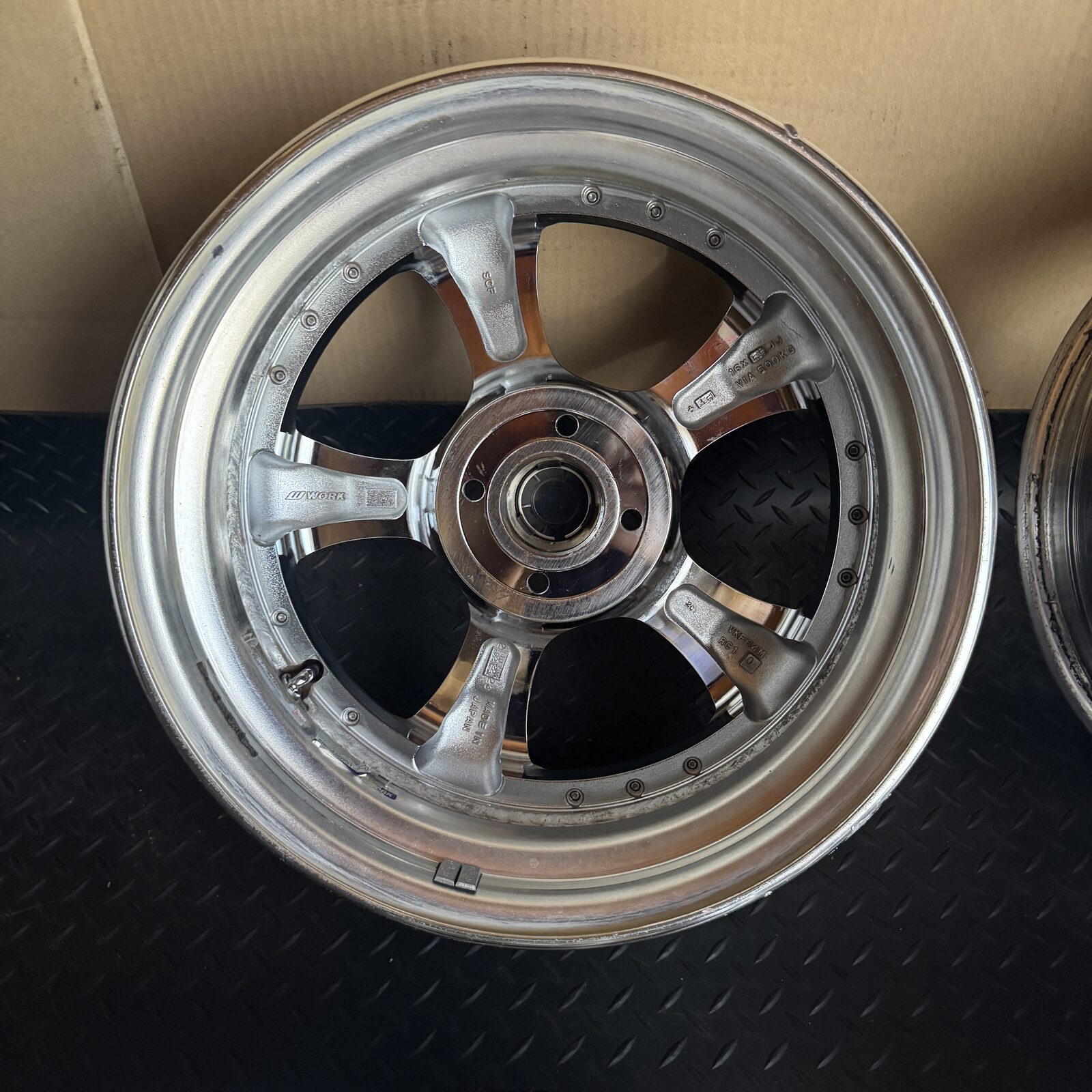
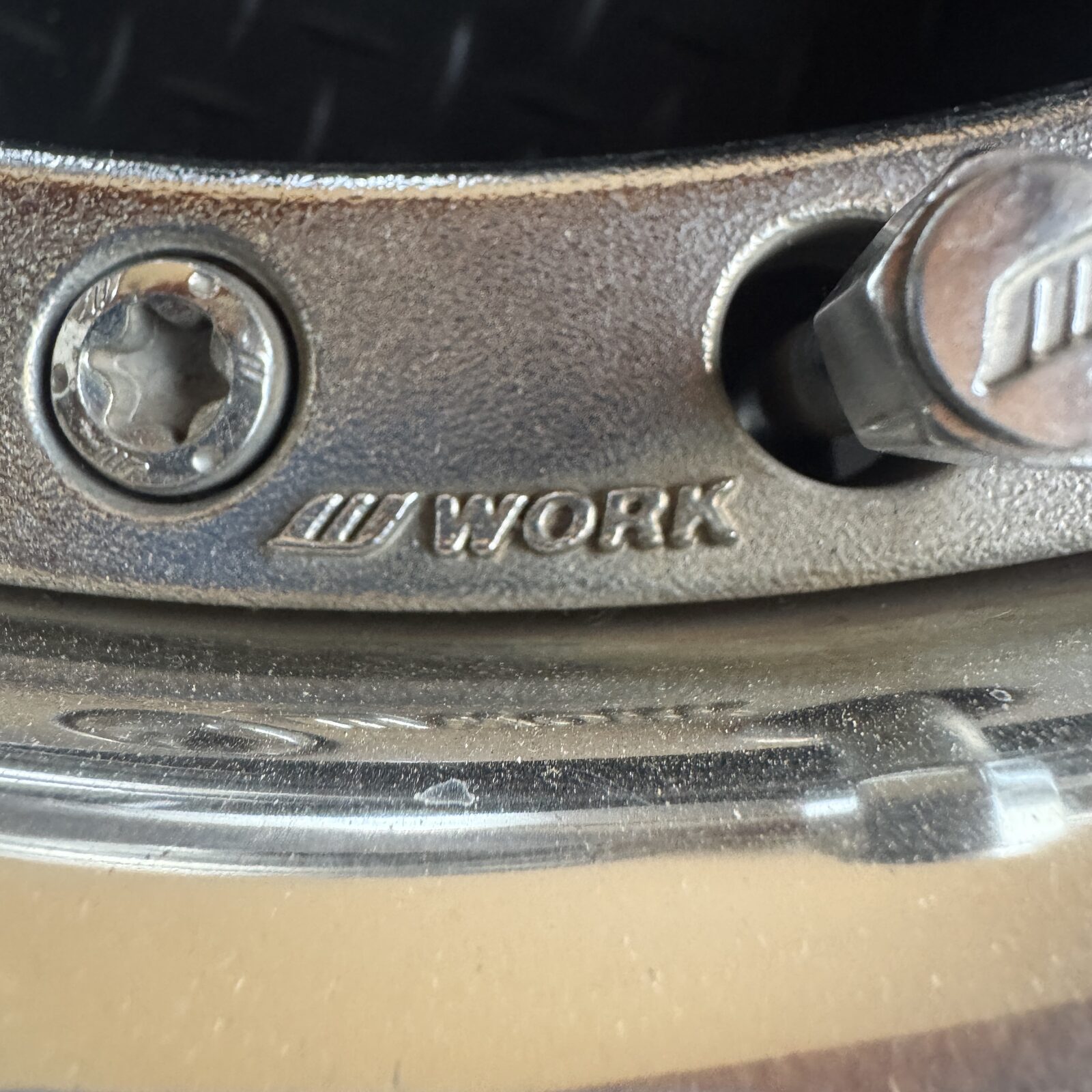
///WORK logo, on the barrel — a separate component. The marks are on two different pieces of metal.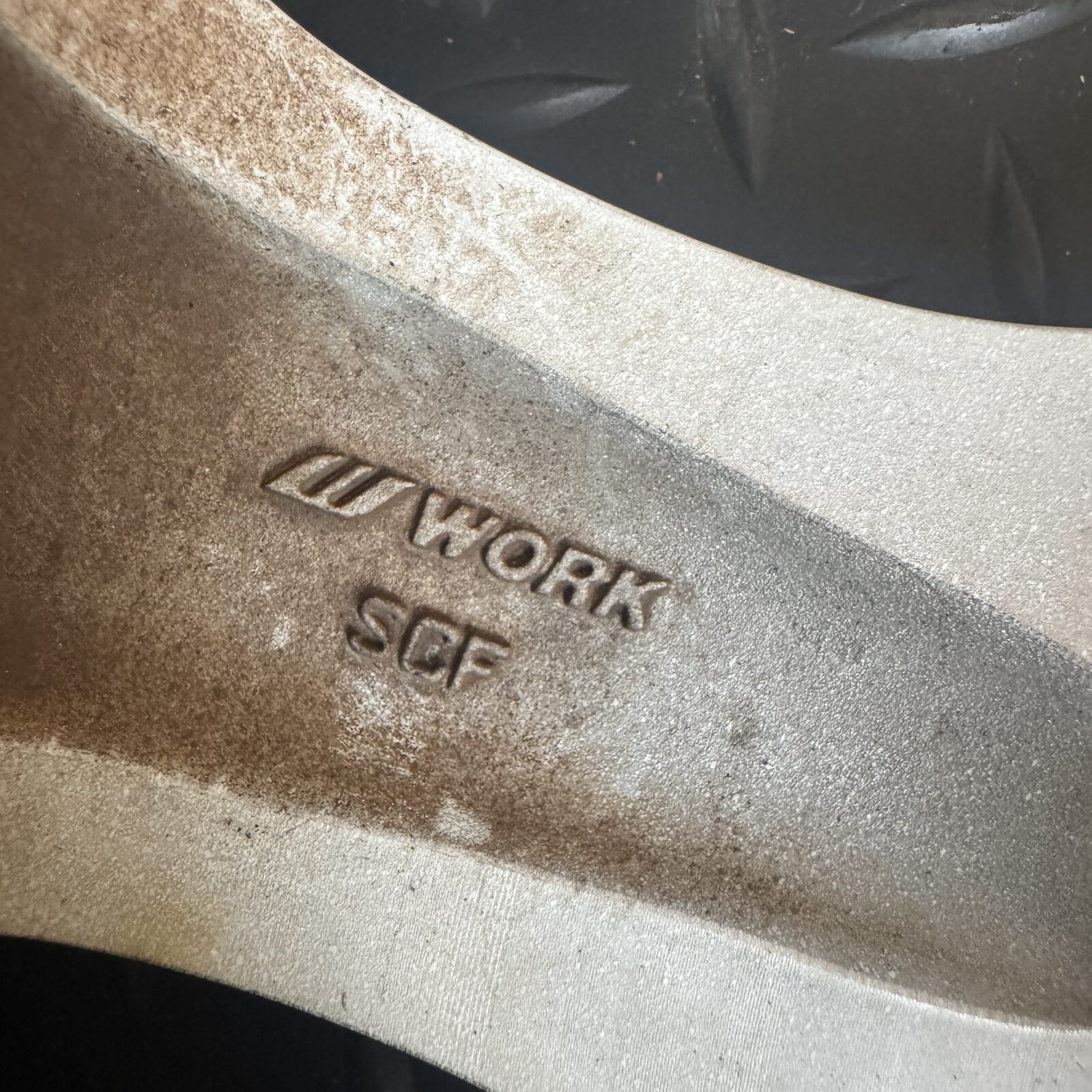
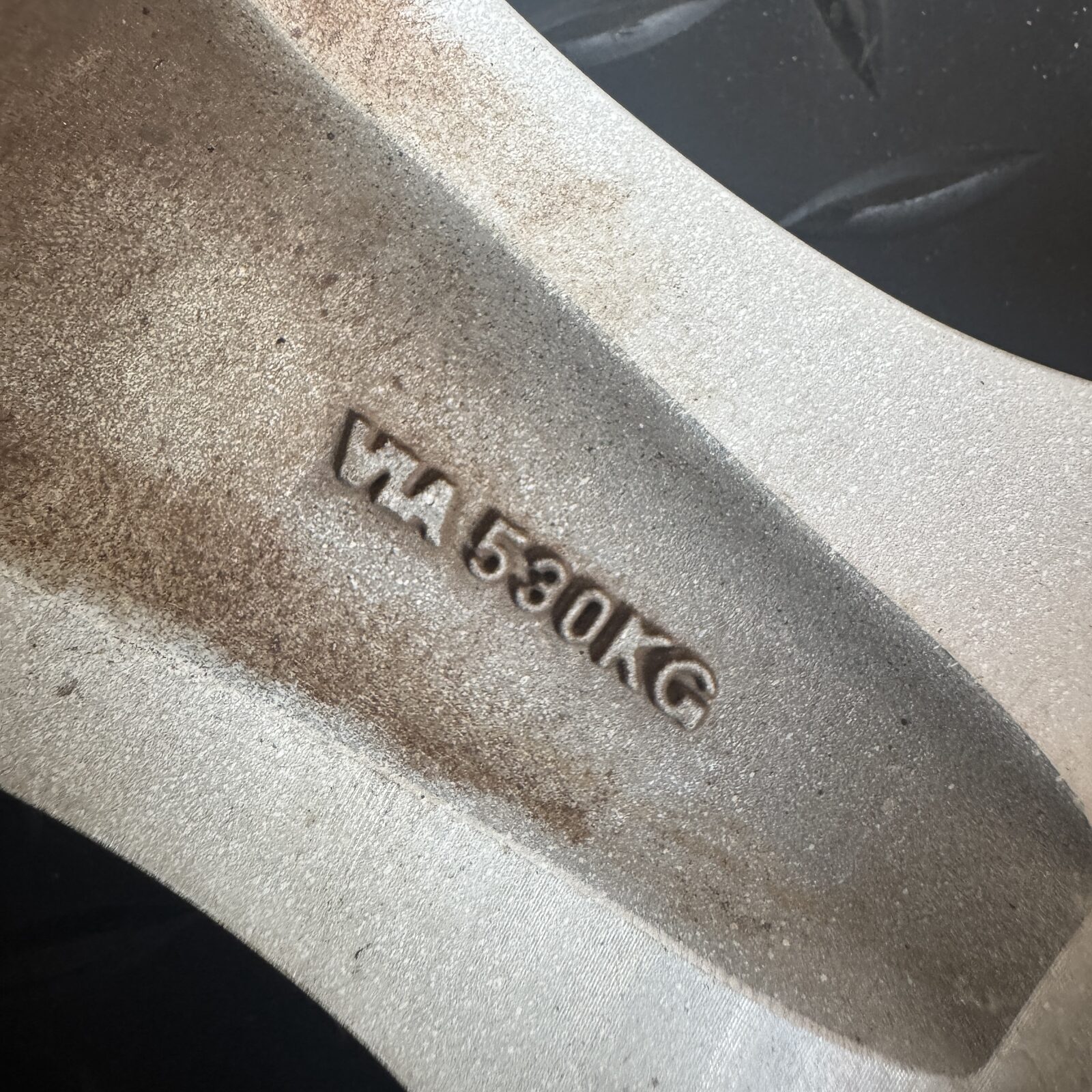
///WORK above SCF. Right: VIA 530KG. Both cast into the back of the spokes on the one-piece S1R — on the multi-piece VS-KF the equivalent marks are on the barrel instead.The Size Stamp, and Why It Is in Two Different Places
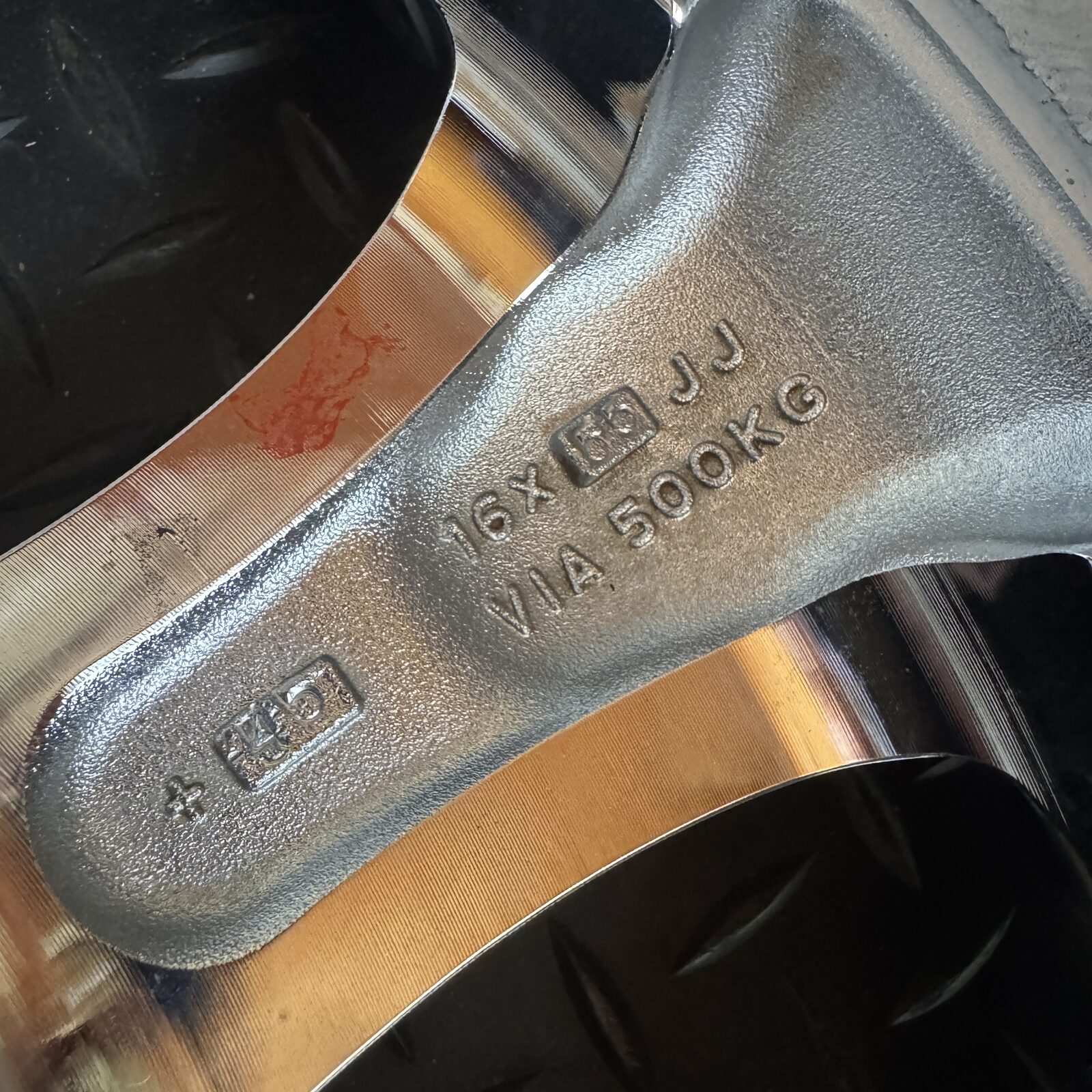
On the VS-KF, the size is cast into the back of a spoke along with the flange designation and the load rating — one compact block, in raised letters, part of the casting.
On the Meister S1R it is different, and this one is easy to miss entirely. The full specification is pin-stamped into the barrel — each character formed from a row of tiny punched dots, dot-matrix style, rather than cast. It is shallow, it catches the light from only one angle, and on a dirty wheel you can look straight at it and not see it. Ours reads:
MST-S1R16x6.0JJ+42 (O)4 100WHT
Model code, size, offset, PCD, and a colour code — plus a longer alphanumeric production number underneath that we cannot decode. That is more information than most sellers put in a listing title, and it is on the wheel itself. If you are buying a used WORK wheel and the seller cannot produce a photograph of this stamp, they have not looked.
The photographs below are contrast-enhanced crops of our own images. We have done that so the characters are legible on screen; in the metal they are considerably fainter than this.
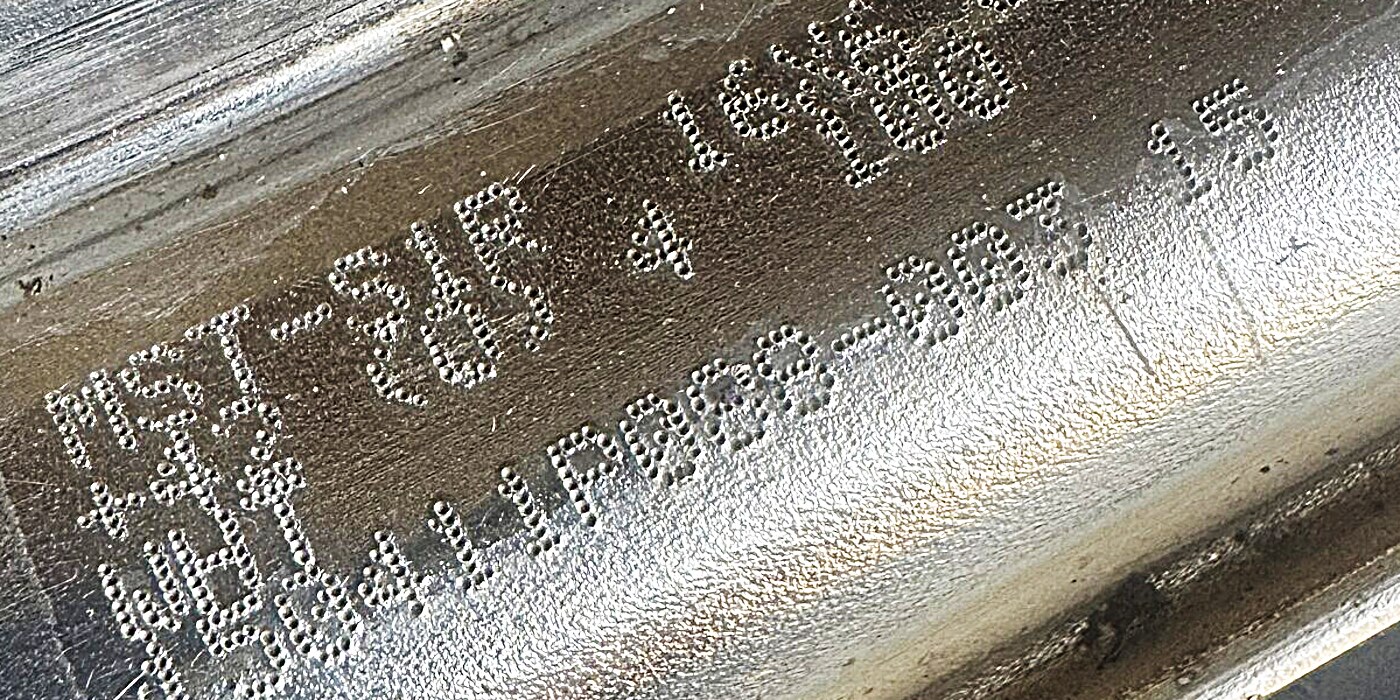
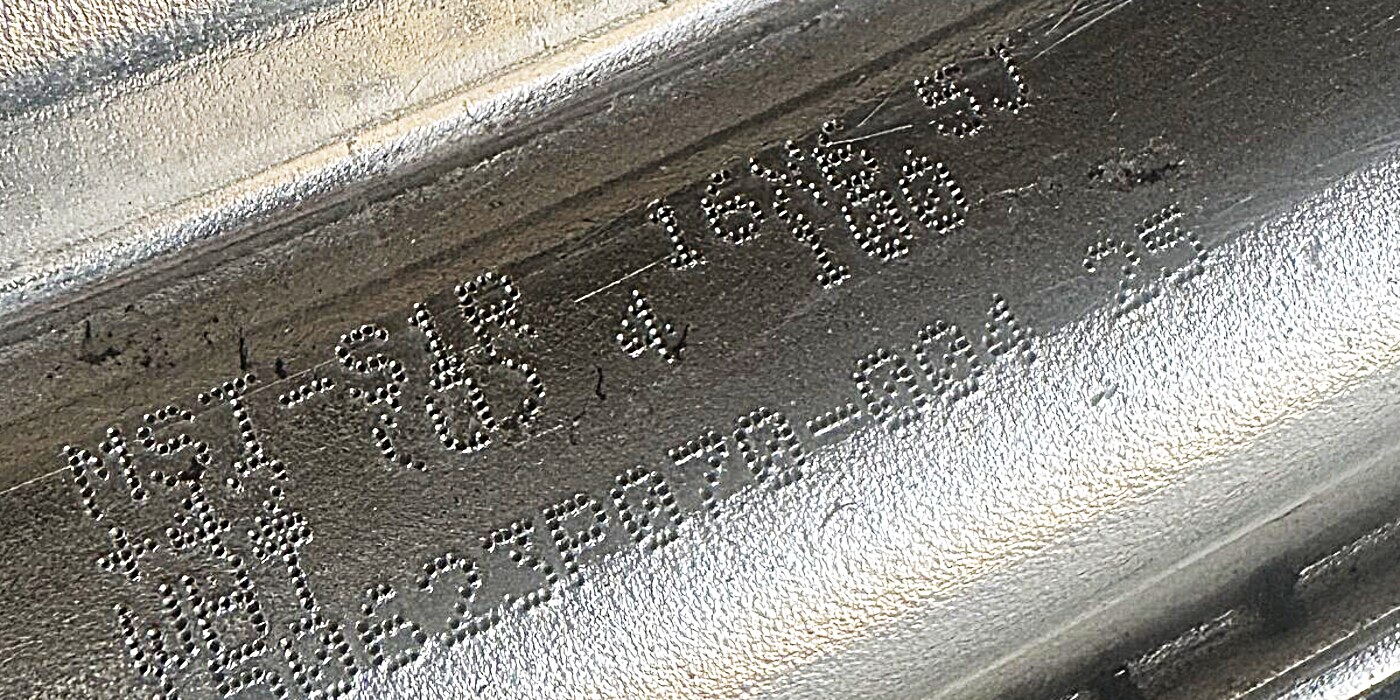
16x6.0JJ. Right reads 16x6.5J. They are not the same wheel.The Set We Photographed Is Not Four Identical Wheels
Two of the four are 16x6.0JJ. The other two are 16x6.5J. Both are +42. This is a staggered set — narrower front, wider rear — and there is nothing wrong with it. But nothing about the wheels sitting side by side on the floor tells you that. They look identical. The half-inch is only visible in the stamp.
Notice also that the flange letters differ: JJ on the 6.0, J on the 6.5. J and JJ describe different rim flange contours. We are not going to quote dimensions for the difference, because the only sources we found for the exact figures were forums and SEO pages, and we could not confirm them against a standards document.
The practical lesson is blunt: read the stamp on all four wheels. Not one. Not two. If you are the buyer, ask for four photographs. If a seller sends you one photograph and says “all four are the same,” they may sincerely believe it and still be wrong — we own a set that proves it.
JWL and VIA, and the Load Rating Next to Them
JWL is the Japanese Light Alloy Wheel technical standard for passenger cars. VIA indicates the wheel was registered with the Vehicle Inspection Association after third-party strength testing. JWL-T is the equivalent standard for trucks and buses — if you see it on a wheel offered for a passenger car, that is worth a question.
What is more useful than the letters themselves is the number cast next to VIA. Our VS-KF set reads VIA 500KG. The Meister S1R set reads VIA 530KG. That is the per-wheel load rating, and it is a real number you can check against your vehicle’s axle weight. Four wheels at 530 kg is 2,120 kg of rated capacity — comfortable for the light Japanese cars a 4×100 16-inch wheel usually goes on, and something to actually calculate if you are fitting older 4×100 wheels to something heavier.
One caution. Marks can be copied. A counterfeiter capable of casting a wheel is capable of casting JWL into it. The presence of these marks is not proof of anything on its own; their absence, on a wheel claimed to be a Japanese-market WORK, is a reason to stop.
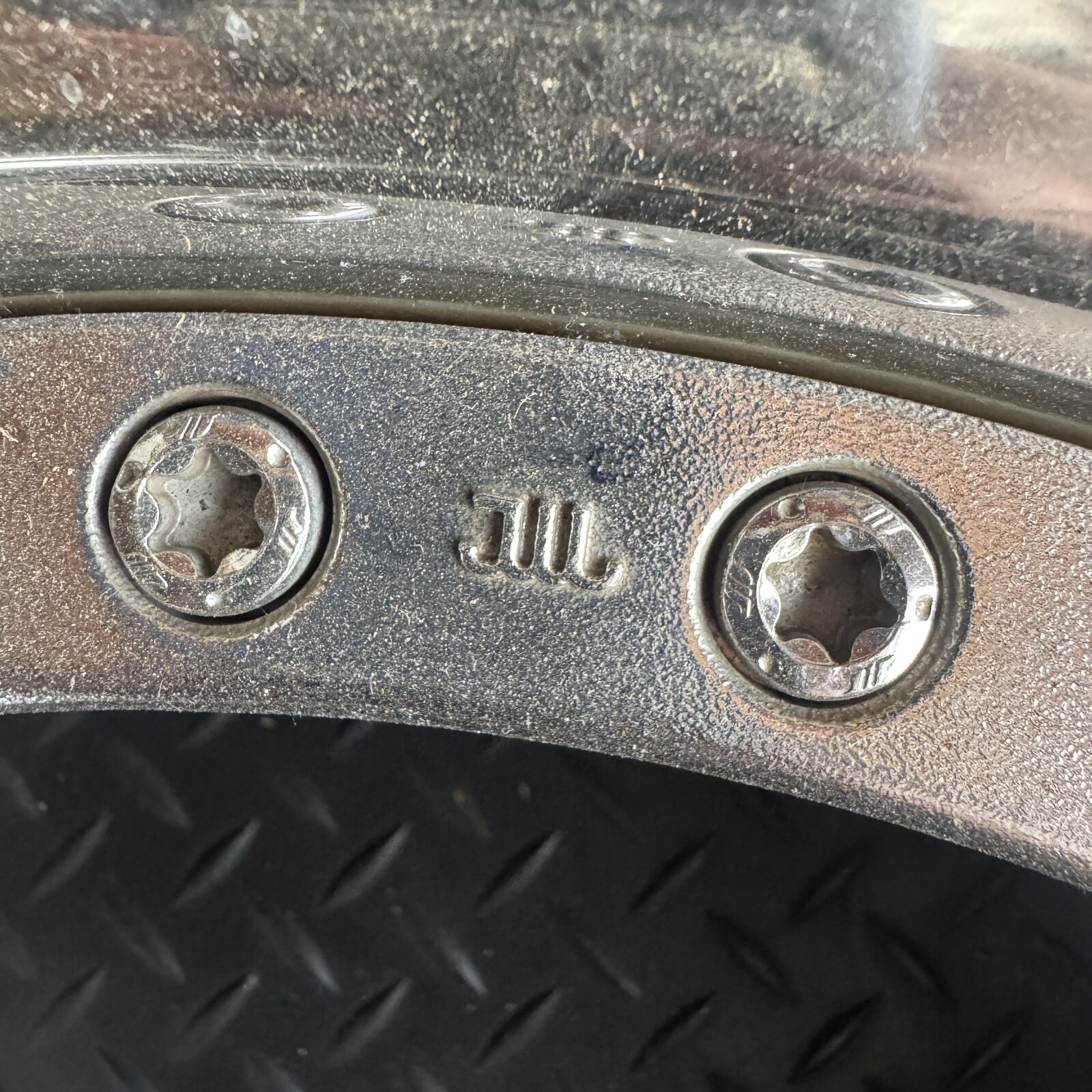
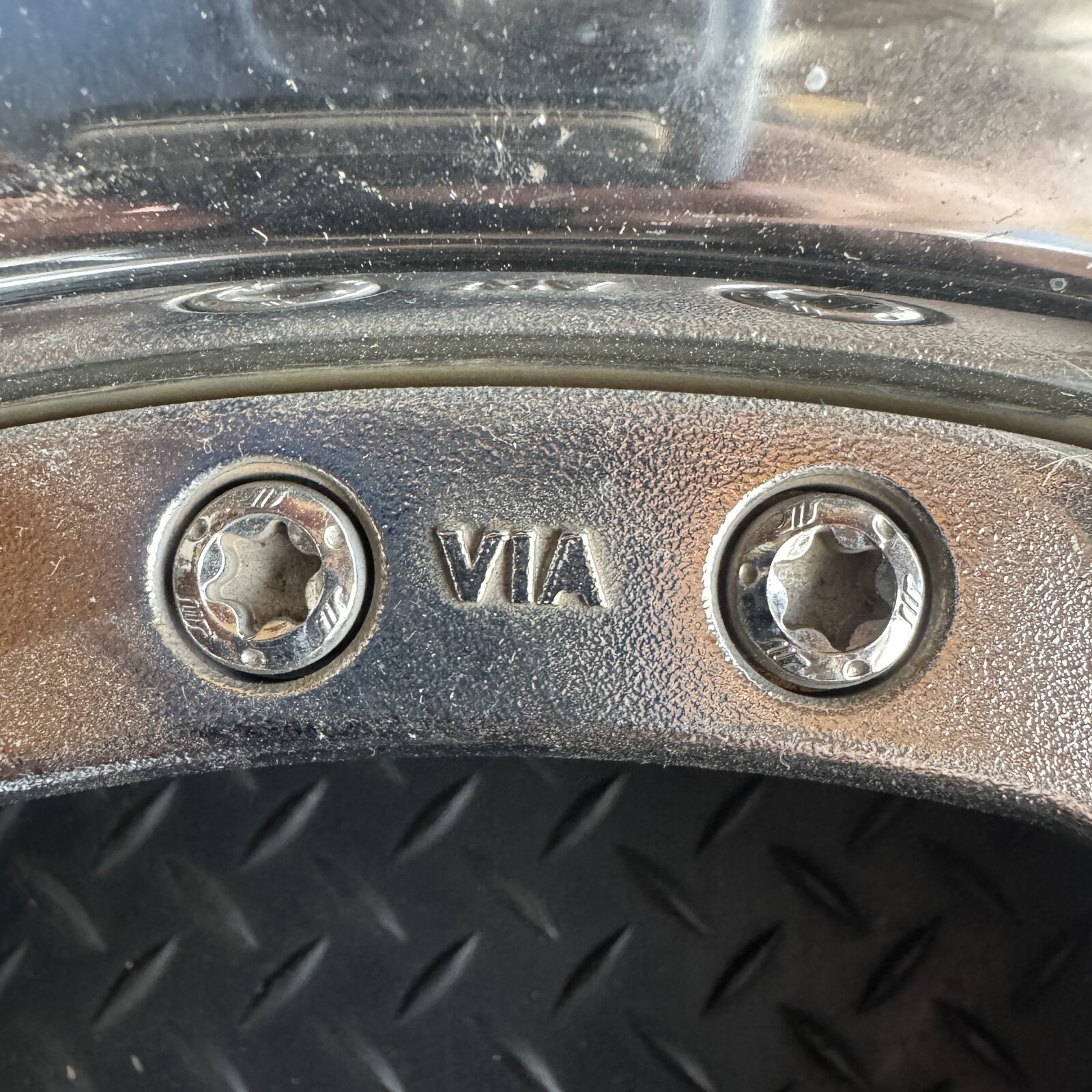
JWL and VIA are on the outer barrel, spaced around the circumference between assembly bolts.Country of Manufacture
MADE IN JAPAN, cast into the metal as part of the casting itself. Not printed. Not a sticker. On both sets.
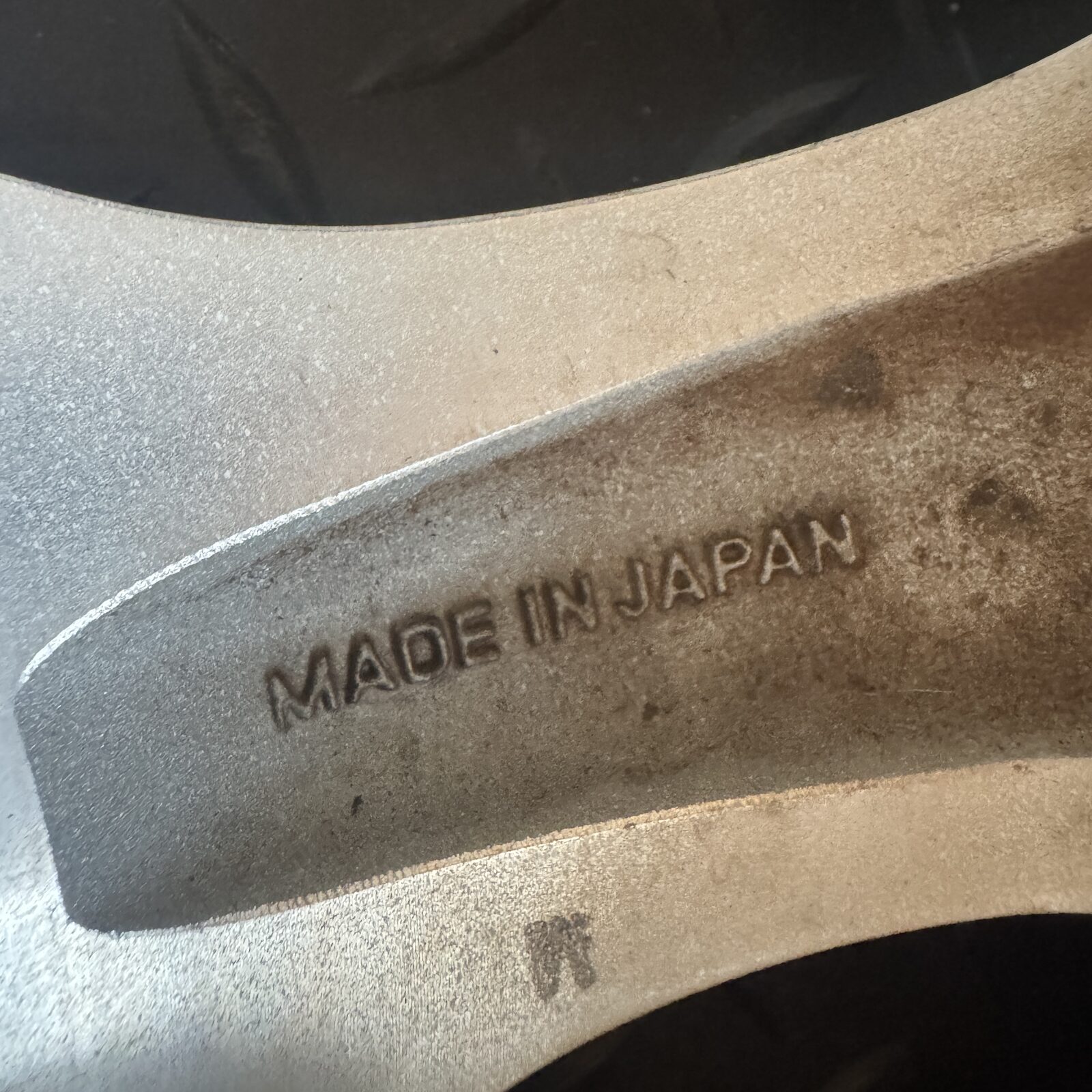
MADE IN JAPAN on the Meister S1R, cast into the back of a spoke.The Maker’s Name Appears More Than Once — and the Model Name Sometimes Does Not
On the S1R, ///WORK appears twice in two different ways: cast small into the back of a spoke alongside SCF, and cast large into the outer face of the rim where it is visible on the car. MEISTER is cast into the rim face as well, on the opposite side.
The VS-KF has no model name on the wheel at all. Nothing anywhere on the disc or barrel says “VS-KF.” The only place the model appears is the centre cap, which reads VS above ///WORK — and centre caps are the single most swappable part of a wheel. If you are identifying a VS-series wheel from a cap, you are identifying the cap.
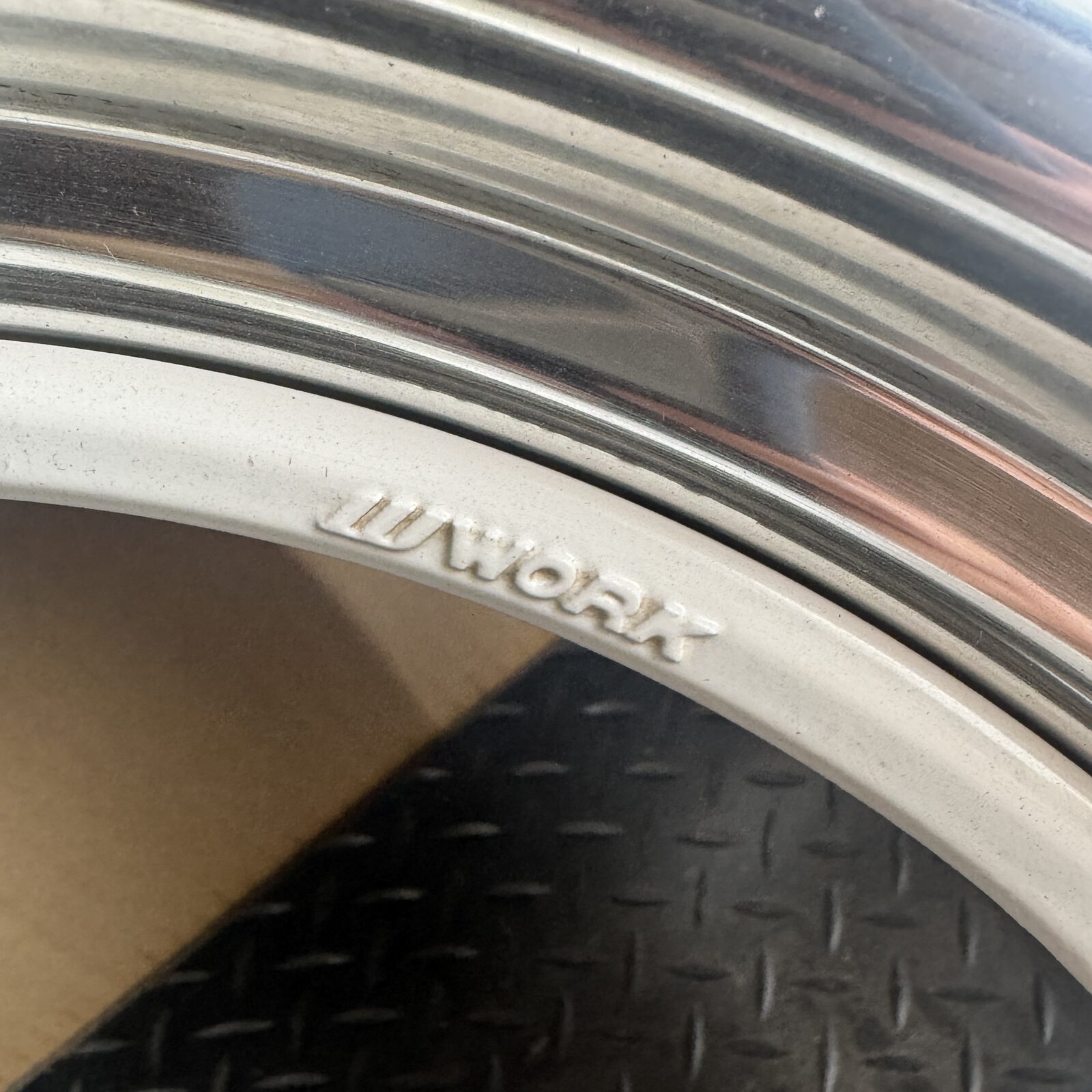
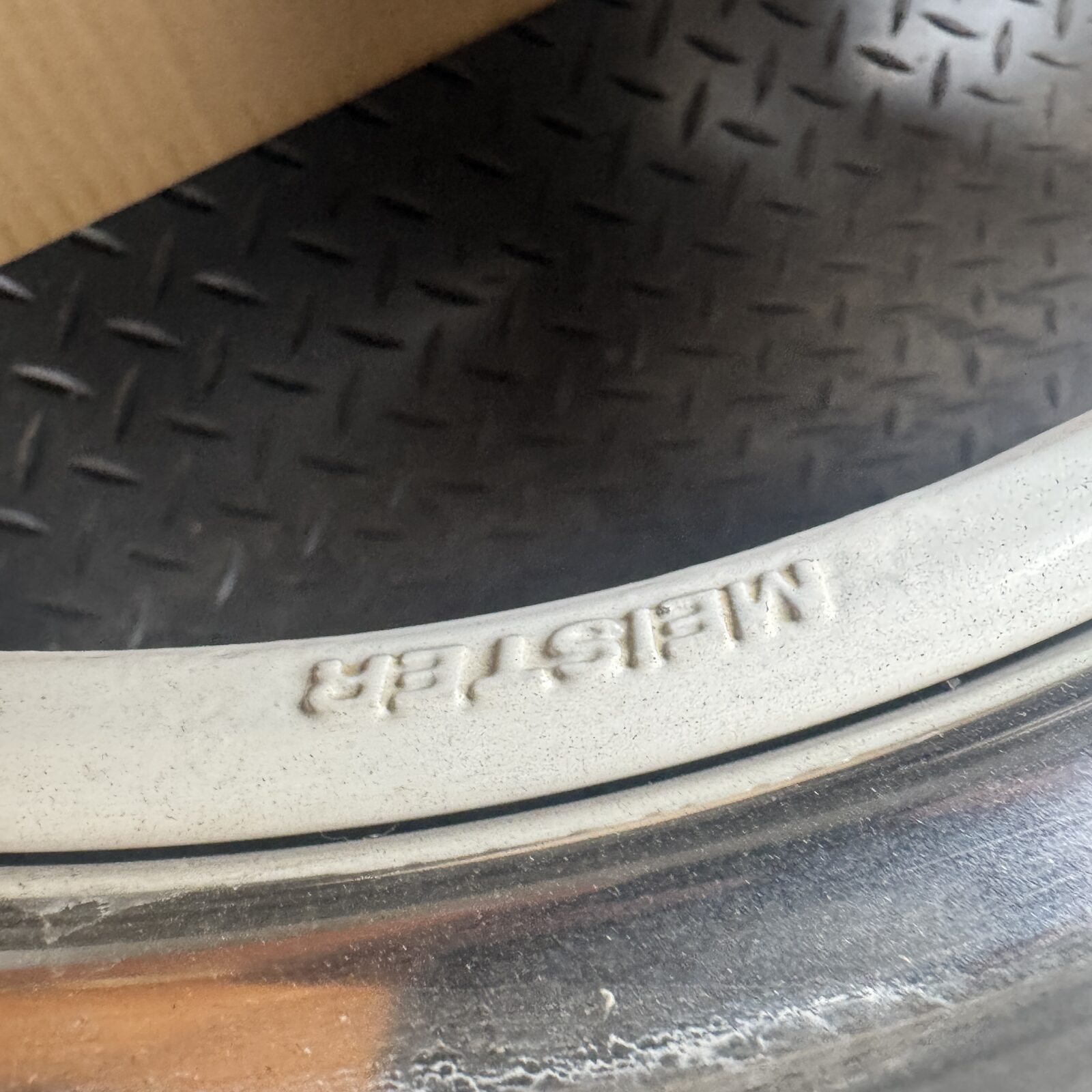
///WORK and MEISTER, cast into the outer rim face of the S1R. The VS-KF carries neither — on that wheel the model name exists only on a removable cap.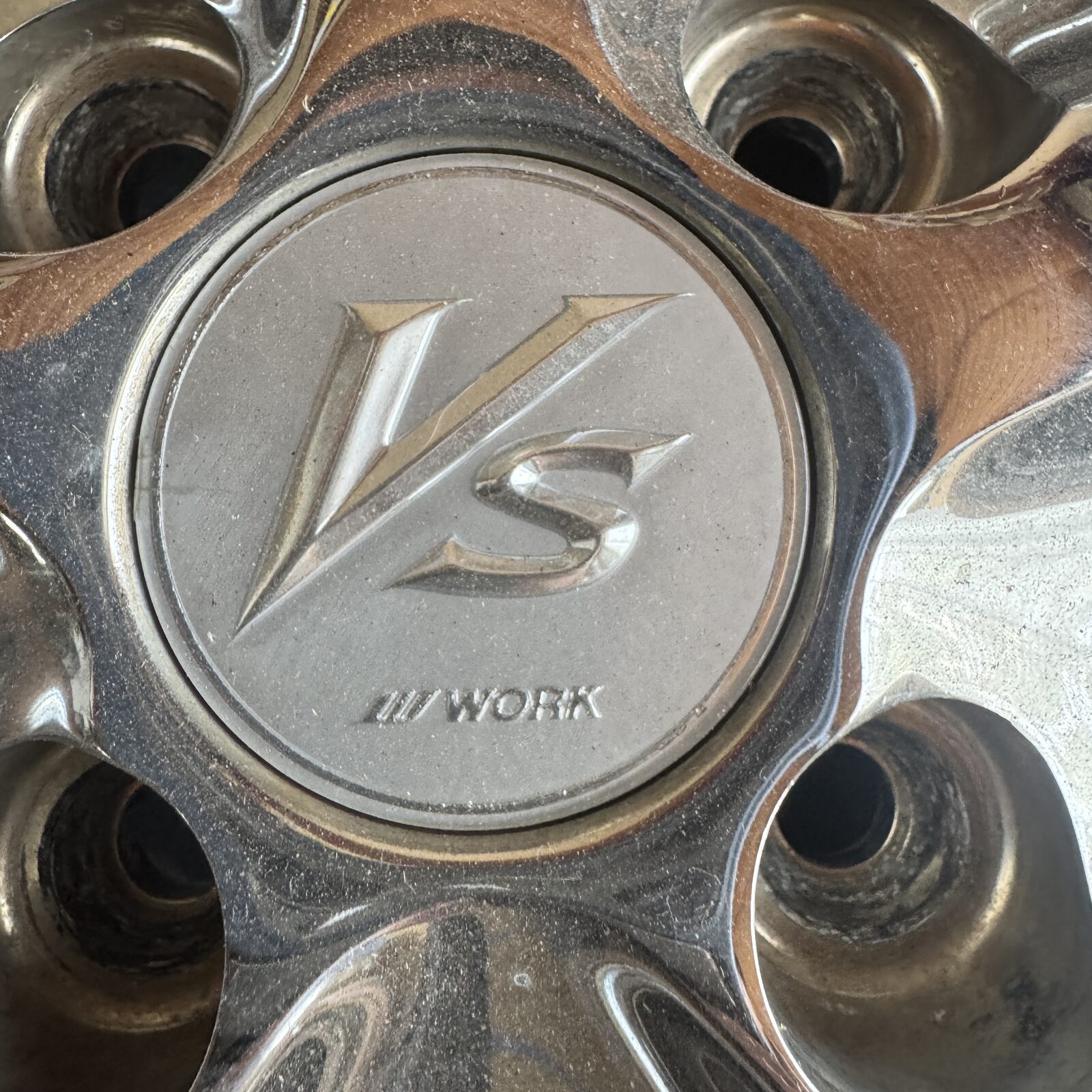
VS above ///WORK. This is the only place the model appears — and it unbolts.This is worth stating plainly, because it is the practical takeaway from everything above: a listing title is a claim; the stamp is the wheel telling you what it is. Model names in the used market get typed from memory, copied from an old listing, or read off a centre cap. When the title and the markings disagree, the markings are the evidence. The right response is usually not to assume fraud — it is to ask the seller for a photograph of the stamp.
Serial Numbers: We Were Wrong About This
When we photographed the VS-KF set, all four wheels carried the same serial: HSH655. We drew what seemed like a reasonable conclusion — that a genuine matched set should show the same serial on all four, and that mismatched serials would be a warning sign.
The Meister S1R set disproves that. The serials on those four wheels are not identical. One reads 2 150129 84, another 2 1501 29 94, each preceded by №RJ. Same set, same finish, same condition, different numbers.
So “all four serials must match” is not a valid authenticity test, and we are retracting it. We do not know what the digits encode. The 150129 group is tempting to read as a date — 29 January 2015 — but we have no source confirming that and we are not going to present a guess as a fact.
What the serial is useful for is the opposite question: it is one more piece of physically cast detail that a crude counterfeit tends not to reproduce convincingly.
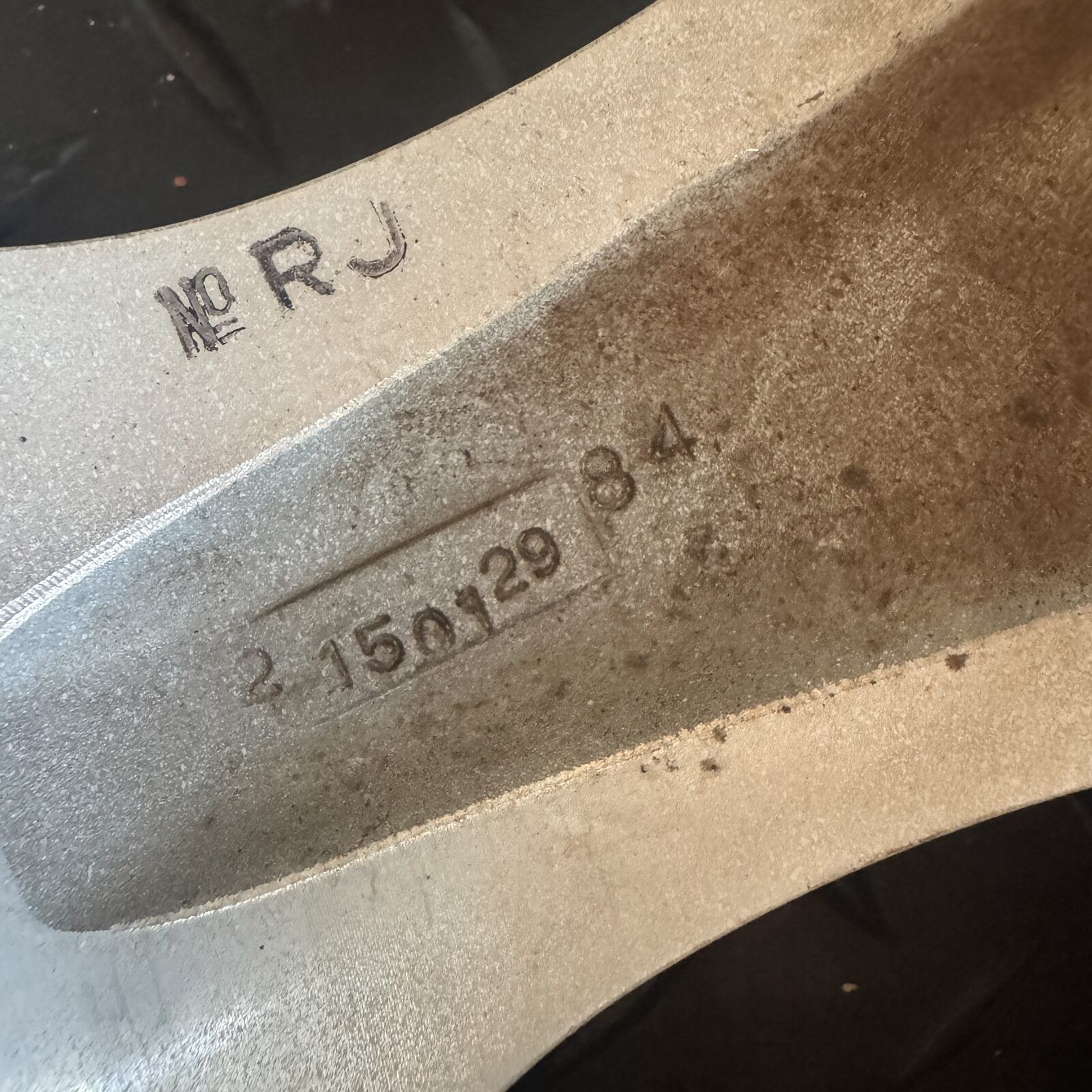
№RJ with 2 150129 84 below. The next wheel in the same set reads differently.The Registration Label
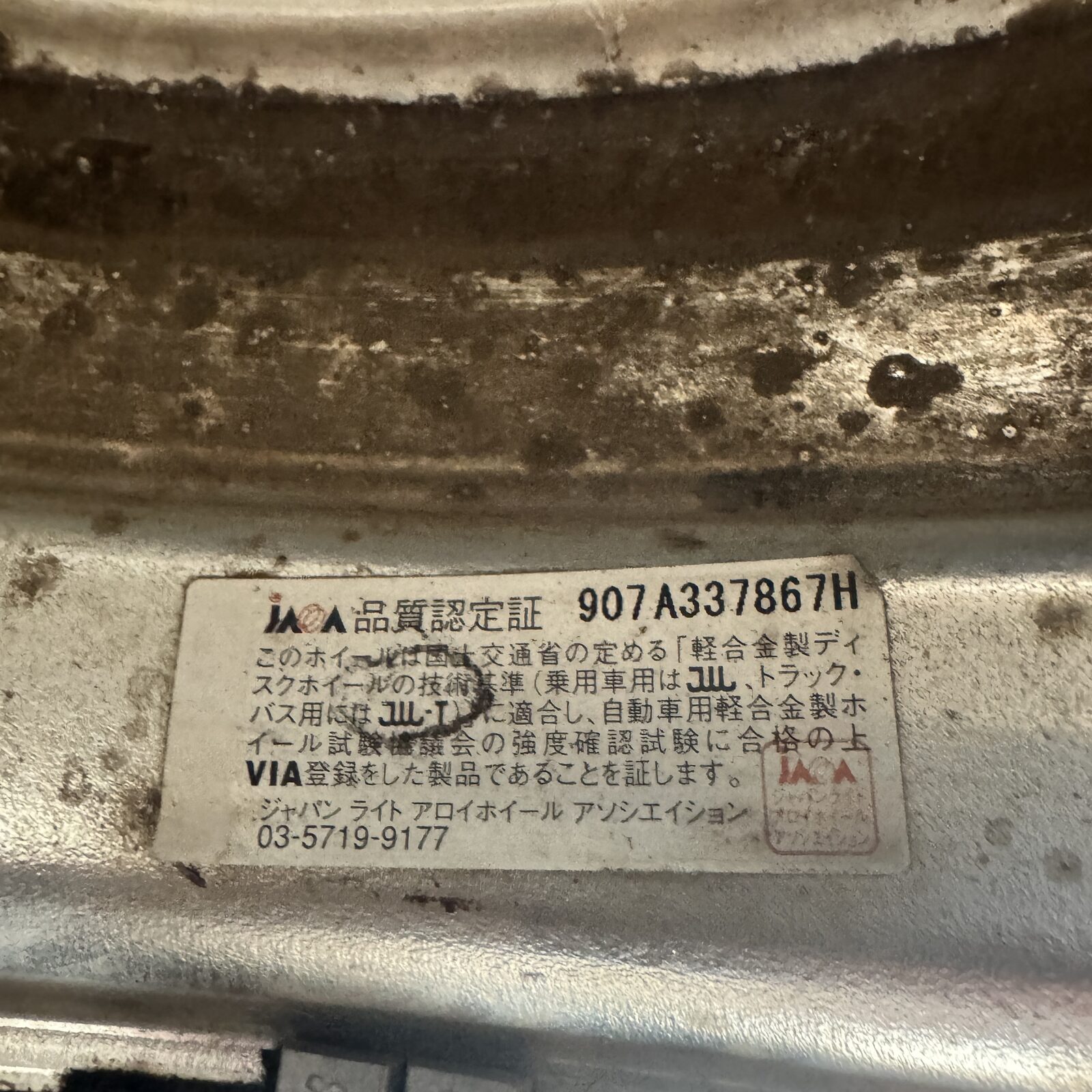
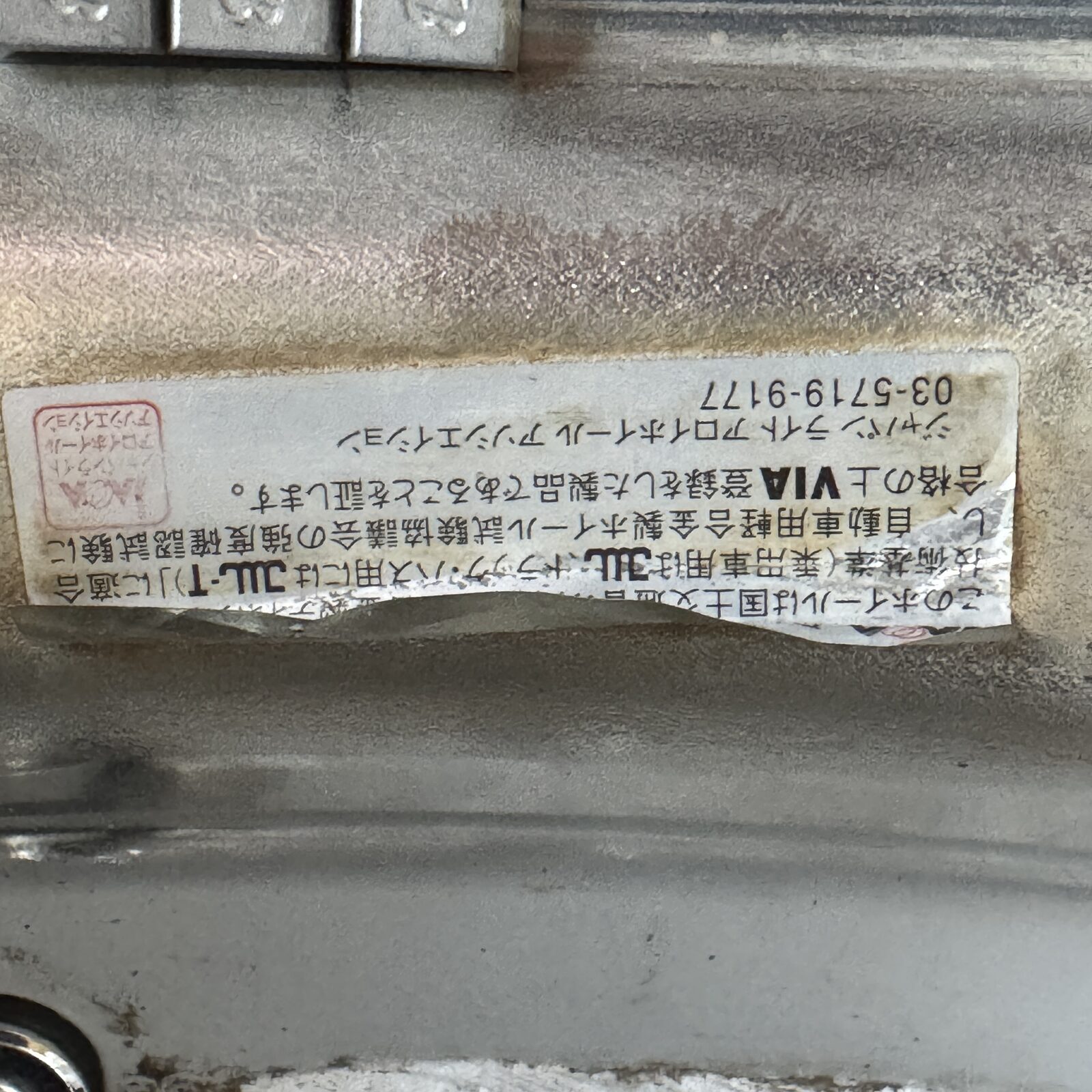
Both sets still carry a Japanese-language paper label inside the rim, headed JAWA 品質認定証 (Japan Light Alloy Wheel Association quality certificate) with a certificate number — 907A337867H on the S1R. The text states that the wheel conforms to the JWL standard for passenger cars, has passed strength testing, and is VIA-registered.
A surviving label is a good sign in the sense that it suggests the wheel has not been refinished or heavily cleaned. It is not proof of anything: labels can be reproduced, and plenty of genuine wheels have lost theirs after twenty years. Treat it as texture, not evidence.
The Codes We Cannot Explain
Both sets carry short alphanumeric codes we have not been able to decode from any source we trust:
SCF, cast under the///WORKlogo on the S1R spoke.№RJ, preceding the serial on the S1R.VKF64M / RC1, on the VS-KF.
They are almost certainly internal manufacturing references — die numbers, line codes, finish codes. We are listing them rather than inventing meanings for them, so that if you see the same codes on a wheel you are considering, you know they are normal and appear on wheels we own.
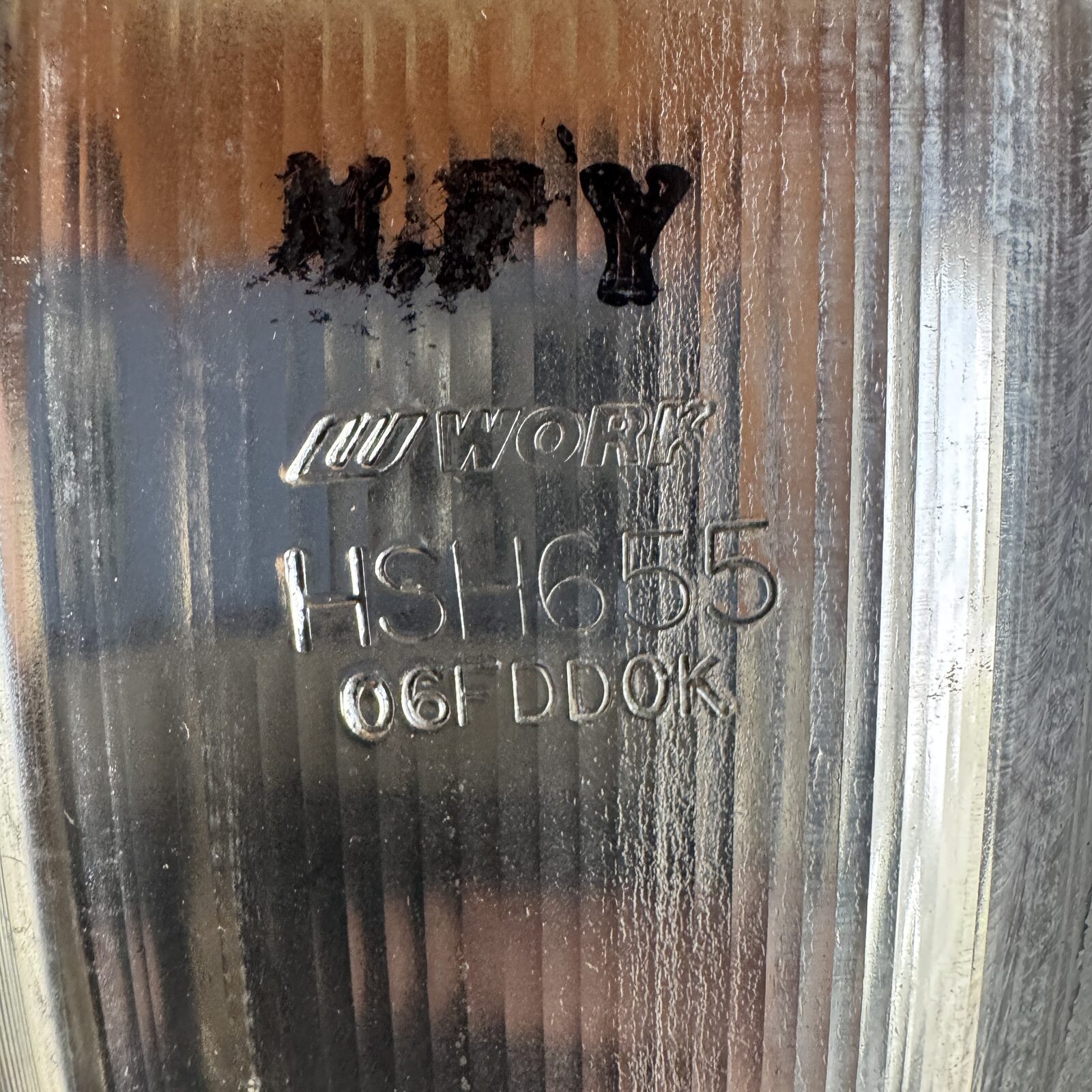
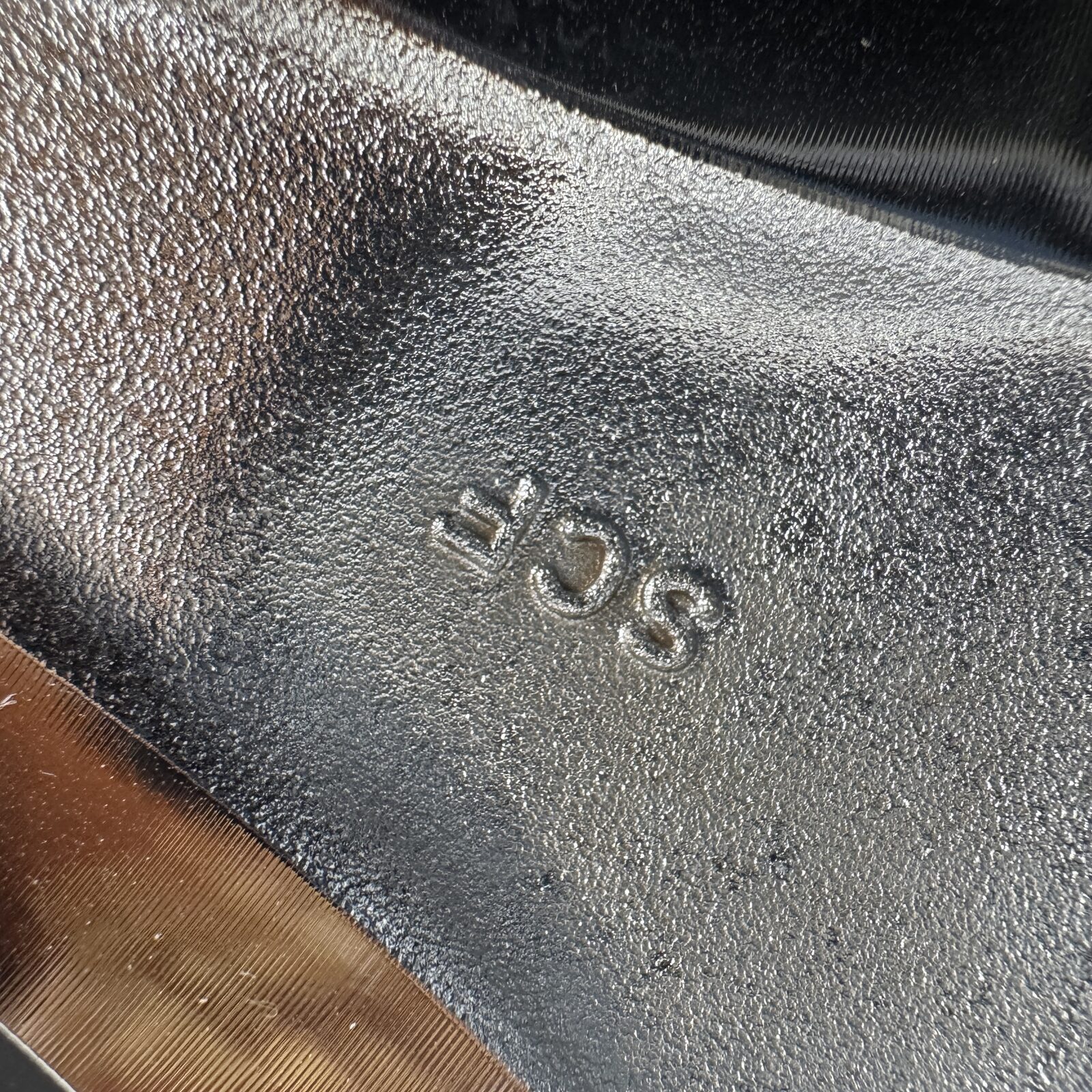
VKF64M and RC1 on the VS-KF. We cannot tell you what they mean.Reading the Condition, Not Just the Markings
The markings tell you what the wheel claims to be. The condition tells you what has happened to it since. On both of our sets the useful observations were the same ones a buyer can make from good photographs: consistent oxidation across all four wheels rather than one suspiciously clean one; assembly bolts on the multi-piece wheel that are all equally weathered rather than one bright new set; no filler, no ripples in the barrel, no welded repairs.
A wheel that has been refinished is not a bad wheel. But refinishing removes exactly the surface evidence this article relies on, and it can hide a repair. If the finish looks newer than the wheel, ask what was done and by whom.
What This Does and Does Not Prove
What we can say: these eight wheels carry cast — not printed — JWL and VIA marks, MADE IN JAPAN, WORK branding in more than one location, per-wheel serials, load ratings, and in the case of the S1R a full factory specification stamp. That combination is consistent with genuine Japanese-market WORK production, and it is a lot of detail for a counterfeiter to reproduce.
What we cannot say: that this is how you authenticate a WORK wheel. We are not WORK, we have no access to their records, and we cannot verify a serial against a factory database. A sufficiently good fake would pass every check in this article. What this article gives you is a baseline — a photographic record of what the markings on two real WORK wheels look like and where they sit — so that you can spot a wheel that does not match it.
What We Could Not Verify
- What the serial digits encode.
150129looks like a date. We have no source confirming it. - The meanings of
SCF,№RJ,VKF64MandRC1. No official source found. - The exact dimensional difference between
JandJJflanges. Forum and SEO sources give figures; we could not confirm them against a standards document, so we have not quoted any. - Whether WORK’s marking positions have changed over time. Both of our sets are used wheels of unknown production year. A current-production wheel may differ.
- Whether any of this applies to WORK wheels produced for markets outside Japan. We have only handled JDM stock.
If you own a WORK wheel with markings that differ from what we have photographed here, we would like to see it. That is not a rhetorical offer — this article gets better with more wheels in it.
Related Guides
- WORK Wheels brand profile — why this company builds multi-piece wheels, from its own records
- RAYS — a company history told in forging presses
- ENKEI — the multinational behind a “JDM” badge
- OZ Racing — why a brand name does not tell you where a wheel was made
- Honda Civic fitment guide — 4×100, the pattern this set fits
Looking for a specific set? We specialise in genuine Japanese wheels — RAYS, Volk, Enkei, SSR, WORK, BBS Japan and the rare discontinued sets that never left the country. Tell us the wheel, the fitment, the year — our team searches our networks until we find it.