

Read this first. We sell wheels. We are not lawyers, we are not licensed to give legal advice, and nothing below is legal advice. Every state-level statement here is what we could find as of July 2026, with a source, and these rules have changed repeatedly — in both directions — over the last two years. Confirm with your own state DMV before you buy a truck.
The single most useful thing to understand about kei trucks in America is that two completely separate questions are involved, decided by different people:
- Can it be imported? Federal question. Answered by NHTSA and EPA. Broadly settled.
- Can it be driven on a public road? State question. Answered by your DMV. Not settled at all.
A truck can be perfectly legal to bring into the country and still be impossible to register in the state you live in. That is not a contradiction; it is how the system works.
The Federal Side
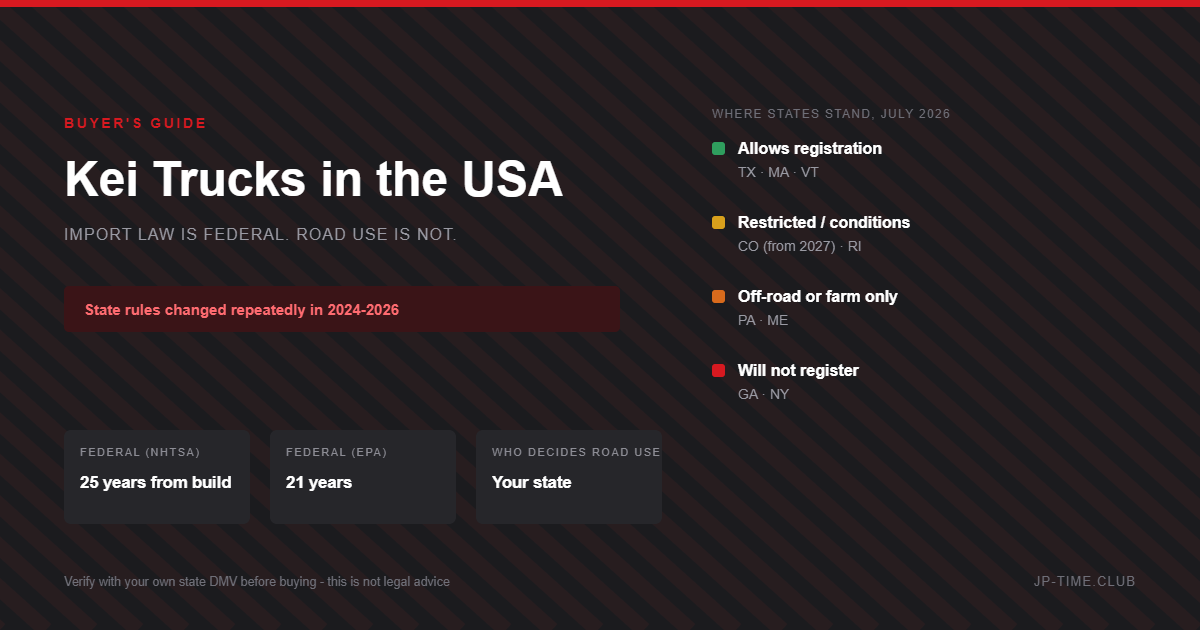
NHTSA: 25 years. Importing a vehicle that does not meet Federal Motor Vehicle Safety Standards is prohibited under 49 U.S.C. §30112. The age exemption sits at 49 CFR §591.5(i): once 25 years have passed from the month and year of manufacture, the vehicle is exempt. Note the wording — it is the build date, not the model year. A truck built in November 2001 is not eligible until November 2026, whatever the title says.
The declaration is made on NHTSA Form HS-7, and a 25-year-exempt vehicle is declared under Box 1.
EPA: 21 years. A separate and shorter clock. Under 40 CFR 1068.315, a vehicle at least 21 calendar years old in original unmodified configuration is exempt, declared as Code E on EPA Form 3520-1. The EPA clock runs out first, which means the binding constraint for a road-going import is always the NHTSA 25-year rule.
Under 25 years? A newer kei truck can be imported for off-road use only. In practice that means speed-limited to 25 mph, meeting nonroad emissions requirements, and restricted to private property. If someone offers to import you a 2015 Hijet, this is the category they are using, and it is not a road vehicle.
Why Your State Might Say No Anyway
Federal exemption means the vehicle may enter the country. It says nothing about titling, registration or road use, all of which are state powers.
The reason so many states moved against kei trucks at once is a body called AAMVA — the American Association of Motor Vehicle Administrators. AAMVA is not a regulator. It is a voluntary association of state DMV administrators that publishes model policies.
Its 2021 document Regulation of Off-Road Vehicles: Best Practices — written by a subgroup from Maine, Georgia, Colorado and South Dakota — classifies mini trucks, explicitly including those over 25 years old, as off-road vehicles, and recommends that states refuse on-road registration “regardless of any retrofitting.”
That is a recommendation, not a law. But when several states adopt the same recommendation in the same eighteen months, it looks like a wave. Georgia, New York, Rhode Island and Pennsylvania have all cited or echoed this reasoning.
Where the States Stand
These are the states we found specific, sourced information for. Absence from this table does not mean a state is permissive — it means we did not find a documented position, and you should ask.
| State | Status | What it means | Basis |
|---|---|---|---|
| Texas | Allows registration | TxDMV reversed its ban in April 2024; SB 1816 then wrote “miniature vehicle” status into statute, effective 1 Sept 2025. Vehicle must be 25+ years old. No state-specific speed or road-class cap reported. | Statute |
| Massachusetts | Allows registration | The RMV banned kei vehicles in 2024, then reversed effective 18 Sept 2024. New registrations get passenger or commercial plates depending on use. A formal safety study is still described as under development. | Agency policy, not statute |
| Vermont | Allows registration | S.326 / Act 153 defines “kei truck” and permits registration similar to a pleasure car or farm truck. Signed 16 June 2026, effective 1 July 2026. | Statute — very new |
| Colorado | Restricted — not yet in effect | HB25-1281 legalises kei vehicles but bans them from roads over 55 mph and limited-access highways, and requires a two-speed-idle emissions test. Signed 9 May 2025. The law does not take effect until 1 July 2027. | Statute, future-dated |
| Rhode Island | Restricted, grandfathered only | H8013 protects kei vehicles registered before 1 June 2024 but bars new registrations. Grandfathered vehicles are limited to roads posted 35 mph or less, and may cross 35–45 mph roads at controlled intersections. Effective 1 July 2024. | Statute |
| Pennsylvania | Off-road, farm or antique only | Since 1 Dec 2021 PennDOT will not issue unrestricted on-road registration. Available categories are off-road (private property), farm-exempt, or antique (25+ years, occasional non-commercial use). Owners registered before that date keep unrestricted status, but it does not transfer on sale. | Agency policy |
| Maine | Off-road only in practice | The BMV stopped honouring on-road registrations from 2021. A 2023 legalisation bill died in committee; a 2026 follow-on to the 2025 study bill failed on 29 April 2026. | Agency practice + legislative record |
| Georgia | Will not register | Department of Revenue Policy Bulletin MVD-2023-05 bars titling and registration and directs revocation of previously issued titles. HB 308 would have allowed 25+ year kei vehicles on municipal and county roads; it passed the Senate 46–6 and was vetoed on 14 May 2025. | Agency policy + veto |
| New York | Will not register | The DMV will not title or register a kei-class vehicle unless the owner proves compliance with the FMVSS and EPA standards in force when it was built — a bar these vehicles structurally cannot clear. New York does not treat the federal 25-year exemption as sufficient. | Agency policy |
| Wisconsin | Unclear | Sources conflict. One cites a statute requiring the DMV to refuse registration of post-1969 kei-class vehicles; another describes registration being possible via collector plates but refused in practice at counter level. We could not resolve it and are not going to guess. | Conflicting |
Two entries in that table are easy to misread, so we will say them again plainly.
Colorado is not legal yet. The bill is signed, and it is good news, and it does not help you in 2026. Do not buy a truck on the strength of a law that takes effect in July 2027.
Massachusetts is agency policy, not statute. The RMV reversed its own ban, and the RMV can revise its own position again, particularly once the safety study it has promised is finished. That is a weaker foundation than Texas or Vermont, where the legislature acted.
The Trend, and What It Tells You
Reading the dates in that table together is more useful than reading any single row.
Between 2021 and 2023, several states moved against kei trucks, largely along AAMVA lines. From 2024 onward, organised owners started winning: Massachusetts reversed within months, Texas reversed and then legislated, Colorado legislated, Vermont legislated, Rhode Island produced a grandfathering compromise. Georgia’s legislature agreed and its governor did not.
So the direction of travel is toward permission, state by state, driven by owners rather than by regulators. But it is slow, it is uneven, and there is nothing inevitable about it. Maine has been trying since 2023 without success.
The practical consequence for a buyer: check your own state, this month, from your own DMV. Not a forum, not a seller, and not this article.
Speed Limits, Insurance and Low-Speed Vehicle Titling
Speed and road class. Where states permit kei trucks, restrictions by road class are common. Colorado’s law bars roads over 55 mph. Rhode Island caps grandfathered vehicles at 35 mph roads. The AAMVA model policy itself suggests 35 mph. Texas appears to be the outlier with no stated cap. This is worth knowing before you buy, because a truck you cannot take on the road between your house and your land is a different purchase.
Insurance. Mainstream carriers do write policies, and secondary sources report annual liability premiums in a fairly low range, with some carriers classifying flatbed kei trucks as commercial vehicles. We could not verify any of those figures against an insurer’s own published material, so we are not going to quote numbers. Ask your carrier before you buy, not after.
Low-speed vehicle titling. LSV is a separate federal category (49 CFR 571.500) capped at 20–25 mph. Some states treat it as a route to road access for vehicles that cannot otherwise be registered. NHTSA has stated it does not endorse LSV or mini-truck use on general public roads. It is a real option in some places and a poor substitute for registration in most.
What We Could Not Verify
- Wisconsin’s actual current status. Genuinely conflicting sources.
- Whether Colorado’s DMV is still refusing applications in the gap before the 2027 effective date. We found no current statement.
- Insurance rates and carrier policies. Only aggregator reporting, no primary insurer document.
- Movement on Pennsylvania HB1205 or a new Georgia bill after roughly Q2 2026. Both are live.
- The exact text of 49 CFR §591.5(i). We relied on legal summaries; the full regulation should be read directly at eCFR before anyone relies on it.
- Reports from December 2025 of federal statements about approving kei truck production had not produced any actual FMVSS rule change as far as we could tell. Treat as an intention, not a rule.
Where This Leaves a Buyer
If you are in Texas, Massachusetts or Vermont, this is a straightforward purchase today. If you are in Colorado, it is a purchase for 2027. If you are in Georgia, New York or Maine, a kei truck is currently a private-property vehicle and you should buy it as one, deliberately, rather than hoping.
And in every state, the 25-year clock is counted from the build month. A great many trucks advertised as importable are not yet. Check the plate.
Sources
Federal rules from NHTSA’s vehicle import material and Form HS-7, EPA Form 3520-1 and 40 CFR 1068.315, and 49 CFR §591.5(i) via legal summaries. AAMVA’s Regulation of Off-Road Vehicles: Best Practices (June 2021). State positions from official sources where available — the Massachusetts RMV advisory, the PennDOT mini trucks FAQ, the New York DMV imported-vehicle page, Colorado’s enrolled HB25-1281, Texas SB 1816 bill analysis, Vermont’s governor’s office — and from Rhode Island, Georgia and Maine legislative records and reporting. Everything we could not confirm is listed above.