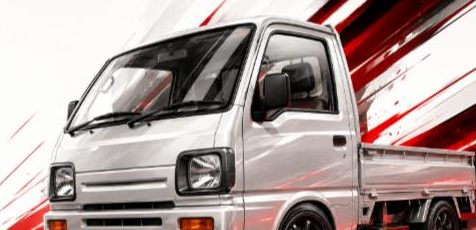
If you count badges rather than vehicles, Suzuki builds more kei commercial vehicles than anyone. The Carry truck and the Every van are also sold as the Mitsubishi Minicab, the Nissan NV100 Clipper and the Mazda Scrum. Four badges, one pair of vehicles.
They are not, however, the same vehicle as each other. The Carry truck and the Every van of the same era use different drivetrain layouts, and that is worth knowing before you assume wheels and parts cross over.
The Short Version
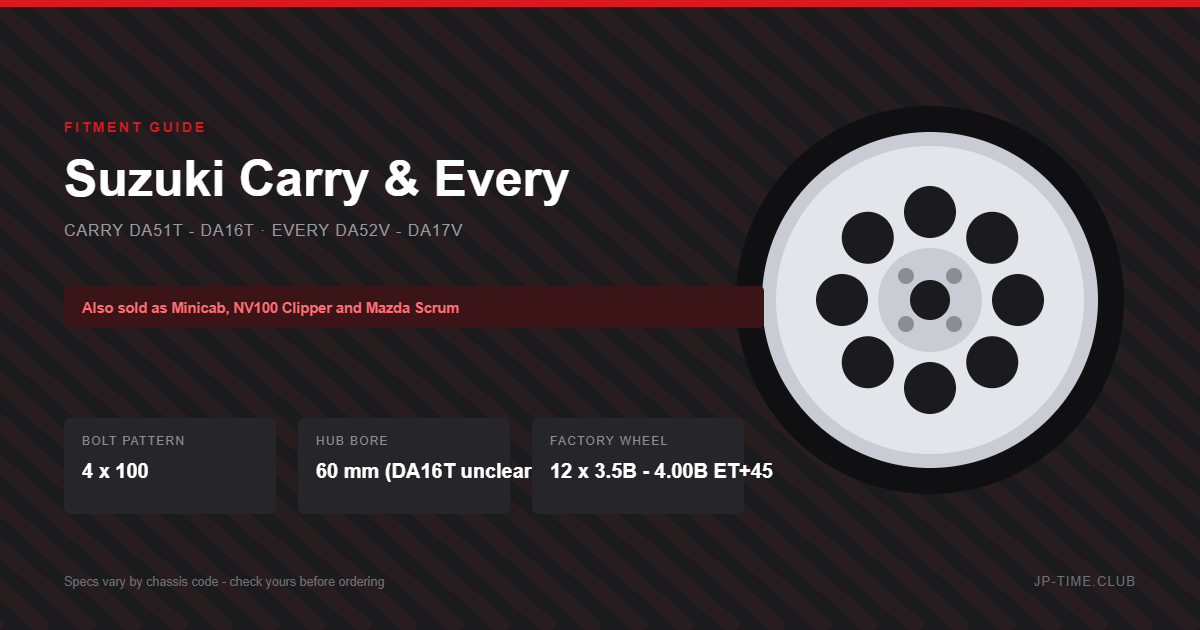
- 4×100, roughly 60 mm hub bore, 12-inch wheel at +45.
- The current Carry DA16T hub bore is genuinely unclear. Sources give both 54 mm and 60 mm. We are not going to print a number we cannot stand behind — measure yours.
- The rim narrowed from 4.00B to 3.50B in September 2001, to tighten the turning circle. Two trucks that both say “Carry” can have different rim widths.
- Carry truck and Every van are different layouts. Carry is a front-engine cab-over. Every, from the 1990s onwards, carries its engine amidships ahead of the rear axle.
- Factory alloy exists — but only on Every Wagon passenger grades. Never on a Carry truck, and not on a plain Every commercial van.
Which Suzuki Do You Have
| Chassis | Years | Engine | US 25-year status |
|---|---|---|---|
| Carry DA51T / DB51T | 1989–1991 | F6A 660 cc SOHC | Eligible |
| Carry DA52T | 1999–2001 | F6A SOHC, EPI | Eligible up to July 2001 |
| Carry DA63T | 2002–2013 | K6A DOHC | Not eligible |
| Carry DA16T | 2013– | R06A DOHC | Not eligible |
| Every DA52V | 1999–2001 | F6A SOHC, NA and turbo | Eligible up to July 2001 |
| Every DA64V | 2005–2015 | K6A DOHC turbo | Not eligible |
| Every DA17V | 2015– | R06A DOHC | Not eligible |
One historical note that matters if you are cross-shopping used parts: Suzuki changed the Carry bolt pattern from 4×114.3 to 4×100 in 1995, at the DC51T/DD51T generation. Anything older than that is a different pattern. Modern parts listings rarely make this clear.
Factory Wheel and Tyre
| Bolt pattern | 4×100 (from 1995; earlier Carry is 4×114.3) |
| Hub bore, Carry DA63T | 60 mm |
| Hub bore, Carry DA16T | Unresolved — 54 mm and 60 mm both reported |
| Hub bore, Every DA64V / DA17V | 60 mm |
| Factory wheel, Carry | 12×4.00B to Sept 2001, then 12×3.5B |
| Factory wheel, Every | 12×4.00B |
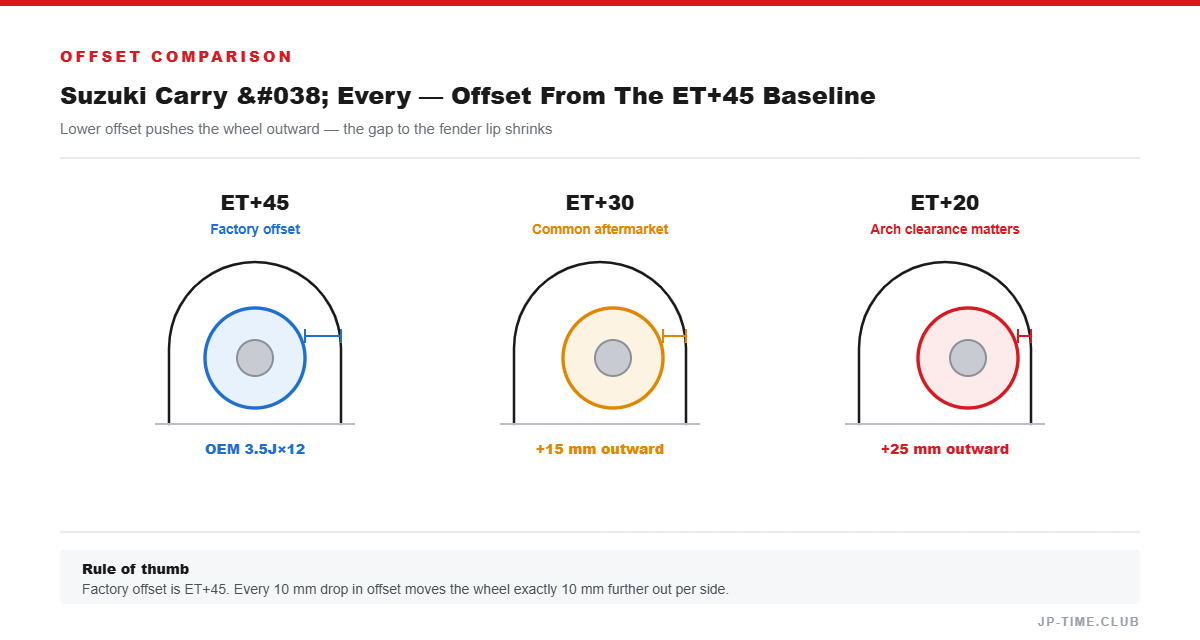
| Offset | +45 |
| Standard tyre | 145R12 6PR |
| Stud thread | Not confirmed — do not assume Daihatsu’s M12×1.5 |
Two things in that table deserve more than a row.
The DA16T bore. One source gives 54 mm; the outgoing DA63T is documented at 60 mm and there is no obvious engineering reason for Suzuki to have shrunk it. We could not resolve it, and this is the current-production truck, so it is the one people are buying wheels for right now. If you have a DA16T, measure the hub with a caliper before you order anything.
The 4.00B to 3.50B change. In September 2001 Suzuki narrowed the rim to reduce the turning circle. That means two Carry trucks a year apart can take different width wheels as standard. Neither is wrong; they are just different, and a listing that says “Carry 12-inch” has not told you which.
Carry and Every Are Not the Same Vehicle
This is the part US buyers most often get wrong, because the two share a badge family and look related.
The Carry truck is a conventional front-engine, rear-drive cab-over: engine under the seats, drive to the back.
The Every van, from the 1990s onward, mounts its engine transversely amidships, ahead of the rear axle. That is a different architecture, and it changes weight distribution, floor height and what is behind the wheel.
They share a bolt pattern and a hub bore, so wheels do interchange in practice. Suspension, brakes and running gear are a different conversation, and “it’s all Suzuki” is not a safe assumption.
What Changed Between DA63T and DA16T
More than the badge suggests. The DA16T is not a facelifted DA63T — it is a new frame and cab, with a redesigned front structure and more high-tensile steel, developed to meet a 56 km/h offset crash requirement the DA63T was never designed for. The engine changed from the K6A DOHC to the R06A, mounted longitudinally and tilted toward the passenger side.
We found no documented difference in offset or backspacing between the two. But given that the entire front structure and suspension were redesigned, we would treat “same bolt pattern therefore same fitment” as an assumption rather than a fact. If you are moving wheels from a DA63T to a DA16T, check clearance rather than trusting the numbers.
If Your Truck Says Mitsubishi, Nissan or Mazda
From spring 2014, the Mitsubishi Minicab is a rebadged Suzuki Carry (truck) and Every (van). The Nissan NV100 Clipper and Clipper Van are Suzuki. The Mazda Scrum is Suzuki. All of them take Suzuki wheels.
Before 2014, the Minicab is a Mitsubishi and the specifications are different — and if it is a 1991 to 1999 Minicab Truck, it is 4×114.3, which is not the pattern on anything else in this class. That is covered in the overview guide.
Where the Factory Alloys Are
If you want a factory alloy wheel in this family, you are looking for an Every Wagon — the passenger version, not the commercial van. Turbo grades from 1999 onward, and later the PZ Turbo and PZ Turbo Special with power sliding doors, carried alloy as standard.
We found no evidence of a factory alloy on a Carry truck or on a plain Every commercial van in any generation. If someone is selling you “factory alloys off a Carry,” ask which vehicle they actually came off.
What We Could Not Verify
- The DA16T hub bore. Sources conflict. This is the most important open question in this guide.
- Factory tyre sizes for DA51T/DB51T and DA52T-era Carry. Only DA63T and DA16T are confirmed at 145R12 6PR.
- Stud thread pitch for any Suzuki in this family.
- Whether DA63T and DA16T offsets are genuinely identical, given the redesigned front structure.
- Exact chassis-code cutover dates for Every around the July 2001 import-eligibility line.
Related Fitment Guides
- Kei trucks and kei vans overview — rebadging, the Minicab bolt pattern trap, JWL-T
- Daihatsu Hijet — the other volume kei truck, and a 54 mm hub
- Suzuki Jimny
Getting Carry and Every Wheels From Japan
We source to order in Japan. Send us the chassis code — DA16T, DA63T, DA17V — and if you have a DA16T, send us the hub diameter you measured, because we would like to settle that question too. The Request page is the place.