The Short Version
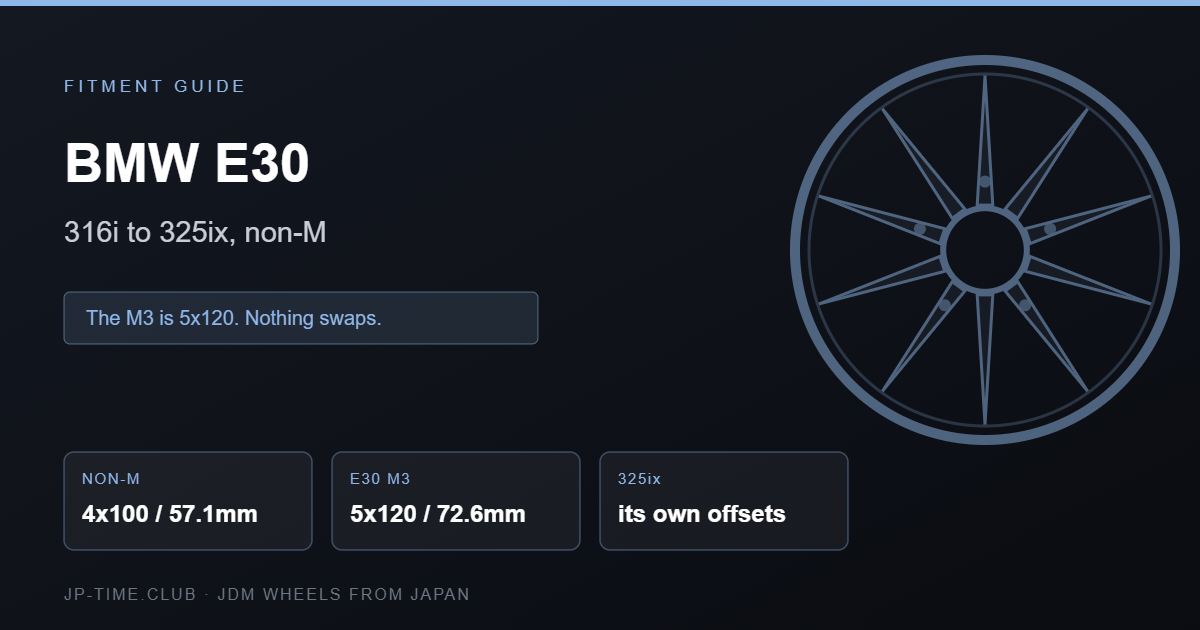
- Every non-M E30 is 4×100 with a 57.1 mm hub bore. 316, 316i, 318i, 318is, 320i, 325i, 325is and the four-wheel-drive 325ix.
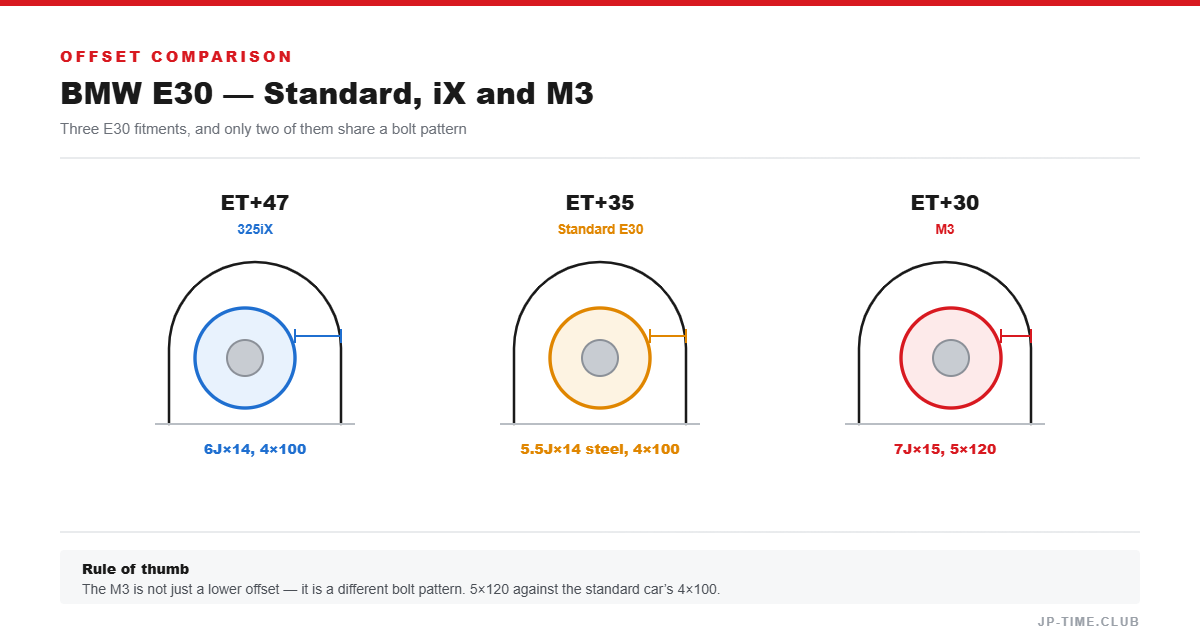
- The E30 M3 is 5×120 with a 72.6 mm bore. Nothing swaps in either direction. This is the single most important fact on this page.
- The 325ix has its own offsets — ET41 to ET47 — and its own part numbers, distinct from the two-wheel-drive cars.
- This is the one guide on our site with no Japanese source. The Japanese factory databases carry no E30 at all, and we explain why below.
A Note on Sourcing, Up Front
We normally build these guides from Japanese factory wheel tables, because that is what we can read and what our competitors do not. For the E30 that is not possible: the Japanese databases have no E30 records. We checked and confirmed the absence rather than assuming it.
The reason is that the E30 came to Japan as a low-volume dealer import rather than through the domestic registration system those databases are built from. It is a genuine gap, not an oversight.
So the table below comes from a European parts specialist’s cross-referenced catalogue listing, complete with BMW part numbers. It is good data. It is also a single source that we have not independently checked against BMW’s own parts catalogue, and you should read it in that light. We would rather tell you that than dress it up.
Factory Wheel Specification, Non-M
| Wheel | Size | Offset | PCD | Bore | Fitment |
|---|---|---|---|---|---|
| Steel 5J | 14×5 | ET35 | 4×100 | 57.1 | 316 / 316i / 318i base, 1982 on |
| Steel 5.5J | 14×5.5 | ET35 | 4×100 | 57.1 | all except iX and M3 |
| Steel iX | 14×6 | ET47 | 4×100 | 57.1 | 325iX |
| Bottlecap alloy | 14×6 | ET35 | 4×100 | 57.1 | most non-iS / iX / M3, 1982–91 |
| Basketweave 14 in | 14×6.5 | ET30 | 4×100 | 57.1 | 318is / 325is / 320is and sport, 1986 on |
| Basketweave iX 14 in | 14×6.5 | ET45 | 4×100 | 57.1 | 325iX, 1988 on |
| Basketweave iX 15 in | 15×7 | ET41 | 4×100 | 57.1 | 325iX option |
| Euroweave 15 in | 15×7 | ET24 | 4×100 | 57.1 | UK 325i Sport standard, option elsewhere |
| Styling 10 | 15×7 | ET24 | 4×100 | 57.1 | facelift option, 1990 on |
| M3 cross-spoke | 15×7 | ET30 | 5×120 | 72.6 | M3 and M3 Cabrio only |
The M3 Is a Different Car
The E30 M3 shares a silhouette with a 325i and almost nothing else at the hub. It runs 5×120 on a 72.6 mm bore, against 4×100 on 57.1 for everything else in the range.
This matters commercially in a specific way. E30 M3 wheels are valuable, and E30 M3 lookalike builds are common. If a set of “E30 wheels” is being offered cheaply, count the studs. Four studs means it came off an ordinary E30 and will not go on an M3. Five studs at 120 means the opposite. There is no adapter answer we would recommend on a car of this value.
One more thing worth knowing, and it is the sort of error that propagates for years: many sources list the M3’s 15-inch wheel at ET24. It is ET30. The ET24 figure belongs to the unrelated 4×100 Euroweave. Our source flags this itself, which is part of why we trust the rest of its table.
The 325ix Runs Its Own Numbers
The four-wheel-drive 325ix keeps the 4×100 pattern and the 57.1 mm bore, but every one of its factory wheels sits at a higher offset than the equivalent two-wheel-drive part: ET47 on the steel wheel, ET45 on the 14-inch basketweave, ET41 on the 15-inch. Each has its own BMW part number.
That is the front driveshafts and the wider track talking. If you fit standard rear-drive E30 wheels to an ix, they will sit 10 to 17 mm further out than the car was designed for. They will bolt on. Whether that is what you want is a separate question, and on a car whose appeal is that it works in snow, geometry is not a cosmetic concern.
Upsizing
The E30 is a small car with modest arches and everything from the factory is 14 or 15 inch. The usual move is 15×7 to 16×7.5 in the ET15 to ET30 band, which is where most period-correct Japanese wheels in 4×100 happen to sit.
That is the reason this guide exists on a Japanese wheel site. 4×100 is one of the most common Japanese bolt patterns, so the E30 has access to a very large pool of JDM wheels — but almost all of them were made for cars specified around +38 to +45, not the E30’s ET24 to ET35. A Japanese 4×100 wheel at +42 will tuck noticeably on an E30. Check the offset, not just the pattern.
57.1 mm hub rings will be needed with essentially any Japanese wheel, since Japanese 4×100 wheels are bored for hubs in the 54 to 60 mm range and up.
Importing
The E30 ran from 1982 to 1994 and is entirely past the US 25-year mark. It was sold new in the United States, the UK and Australia, so the cars are already local in all three.
What Japan can offer an E30 owner is not the car — it is the wheels. Period Japanese 4×100 in 15 and 16 inch is a deep market here and a thin one almost everywhere else.
What We Could Not Verify
- Everything in the table above is single-sourced by us to one European specialist’s catalogue listing. We did not cross-check it against BMW’s own parts catalogue or a second independent source.
- Offset for the Cecotto and Ravaglia Edition wheels. Our source itself marks this as presumed rather than confirmed.
- Original-production Alpina 20-spoke part numbers, weights and rear offset. Marked unknown at source.
- No Japanese-market data exists for this vehicle in the databases we use. Confirmed absence, not an oversight.