

The Short Version
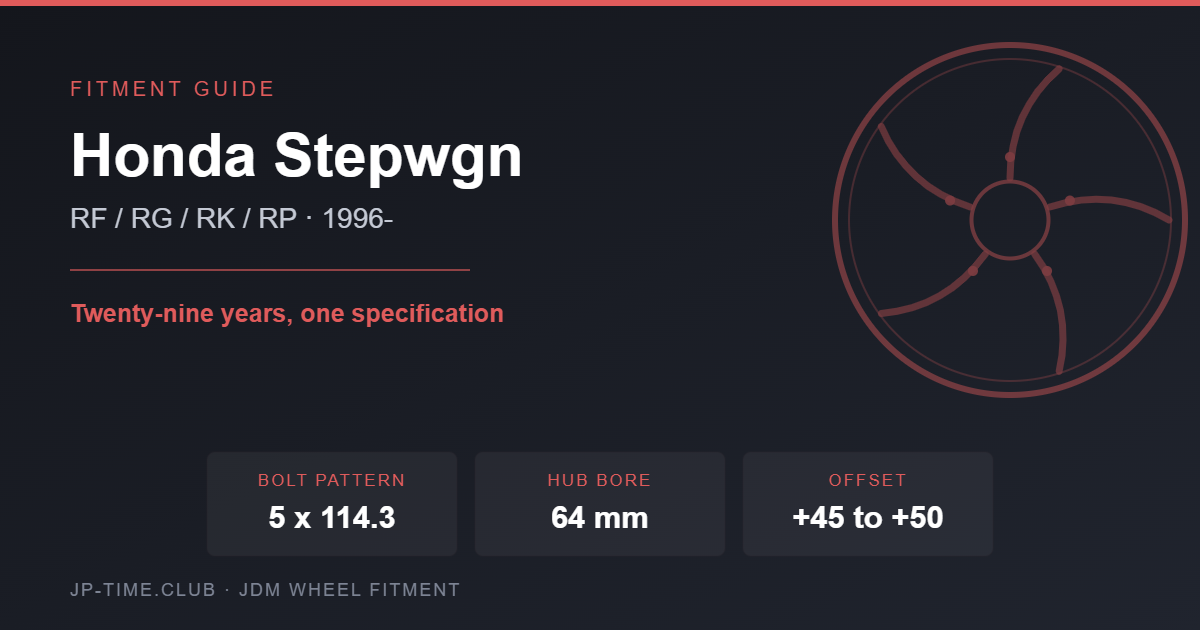
- 5×114.3 on a 64 mm bore. Every generation, every grade, 1996 to the current car.
- No four-lug variant exists. Not even on the earliest RF1.
- Spada is not different. Same hub, bigger wheel.
- The database prints 64, not 64.1. We report it as printed.
Twenty-Nine Years, One Answer
We usually open a vehicle expecting to find a split somewhere. The Stepwgn has none. We read 336 grade rows across four generations:
| Generation | Chassis | Period | Example grade | Wheel | PCD / Holes / Bore |
|---|---|---|---|---|---|
| 1st & 2nd | RF1–RF8 | 1996–2005 | 2WD Happy Edition 4AT (CBA-RF3) | 5.5J×15 +50 | 114.3 / 5 / 64 |
| 3rd | RG1–RG4 | 2005–2009 | 2WD G L HDD Navi Package | 6J×15 +50 | 114.3 / 5 / 64 |
| 4th | RK1–RK7 | 2009–2015 | 2WD 5-door 2.0 G CVT | 6J×15 +50 | 114.3 / 5 / 64 |
| 5th & 6th | RP1–RP8 | 2015– | 2.0 2WD 7-seat e:HEV Air | 6.5J×16 +45 | 114.3 / 5 / 64 |
Petrol, hybrid, 2WD, 4WD, standard and Spada: 114.3 mm, 5 holes, 64 mm bore, all of it. The offset holds at +50 for nearly three decades and only moves to +45 on the current e:HEV cars.
That makes the Stepwgn one of the easiest Japanese vehicles to buy wheels for, and one of the few where a wheel from a 1996 car will sit correctly on a 2015 one.
Spada Is a Wheel, Not a Hub
The Spada is the sporting-appearance grade and people reasonably assume it sits on different hardware. It does not. We compared Spada against the standard car in each generation — RF5 against RF3, RG3/RG4 against RG1/RG2, RK5/RK6 against RK1/RK2 — and the PCD, hole count and bore are identical every time.
What Spada gets is diameter. Where the base car runs 15 or 16 inch, Spada runs 16 or 17. The offset stays at +50.
So a set of Spada wheels will bolt straight to a base Stepwgn of the same era and is a common, sensible upgrade. Check the tyre load index if you are moving to a lower-profile tyre — a seven-seat minivan with a full load is heavier than the wheel’s original application may assume.
The 64 Versus 64.1 Question
Honda’s hub bore is usually written 64.1 mm in the English-language aftermarket, and that figure is correct in the sense that everyone uses it and rings are sold to it.
Both Japanese factory databases print 64 mm, with no decimal, on every Stepwgn row. We are reporting what the source says rather than silently correcting it to the familiar number.
Practically the distinction does not matter — a 64.1 mm ring fits a 64 mm hub with a tenth of a millimetre of clearance, which is nothing. We mention it only because we have spent a lot of this series pointing out that 64.1 is the industry’s most-invented default bore, quoted for cars that have never been measured. On the Stepwgn it is close to right. On many other cars it is not, which is the point of our hub bore reference.
Sizing
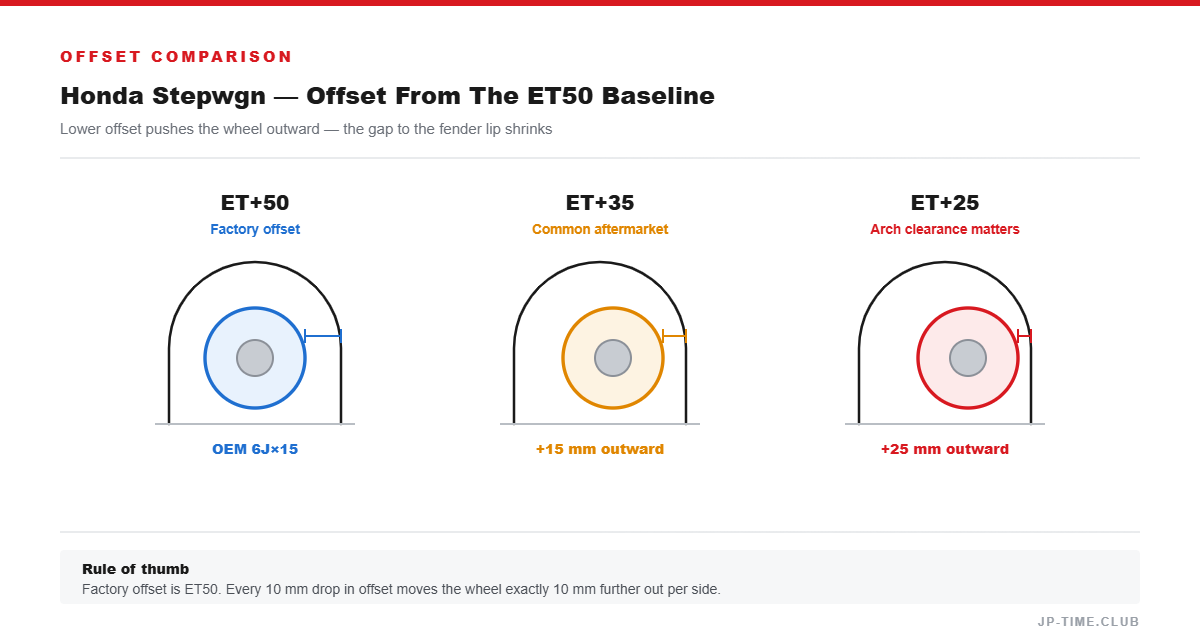
+50 is a high offset and the Stepwgn’s arches are square and shallow. The usual move is 16×7J or 17×7J in the +45 to +53 range. Going much below +40 will bring the tyre out past the arch line, which is a shaken problem in Japan and a rubbing problem everywhere.
The 64 mm bore is the Honda passenger-car figure, shared with the Odyssey, the CR-V and the Accord, so Honda wheels move freely between them. It is not Nissan’s 66 or Toyota’s 60.1, and a wheel bored to either will not work — 66 is loose on the hub and 60.1 will not go on at all.
Importing
The first-generation RF1 launched in May 1996, so cars through mid-2001 are eligible for US import now, with the rest of that generation following. The RG generation is 2030 onward.
The Stepwgn was never sold in North America in any form, and the early RF cars — boxy, tall, with the roof hatch and the tailgate that swings sideways — are the ones with genuine JDM character. They are also cheap in Japan, which is part of the appeal.
What We Could Not Verify
- Nothing significant. This model’s data is fully populated across every generation we opened, with no unresearched cells.
- We did not individually check every one of the 336 rows, but the pattern is uniform across every generation, drivetrain and grade family we sampled.