

The Short Version
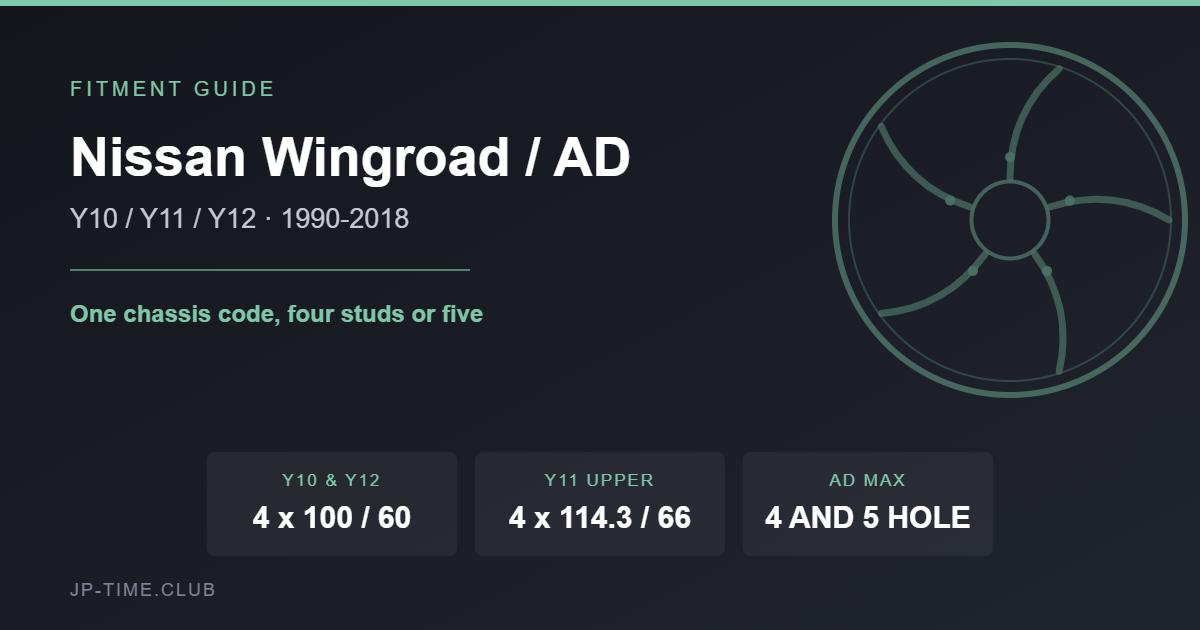
- Never five-lug. Four studs across all three generations, 1990 to 2018.
- The Y11 splits by grade: base cars 4×100, upper grades 4×114.3.
- The AD MAX splits by hole count under one chassis code: LE is 4-hole, SLX is 5-hole.
- Y10 and Y12 are 4×100 on 60 mm. The Y11 uses 66 mm.
The Most Extreme Example We Have Found
We have now documented several vehicles where the same chassis code carries two bolt patterns. The AD MAX is the sharpest case, because it changes the number of studs.
| Chassis | Grade | Wheel | PCD | Holes |
|---|---|---|---|---|
| E-WFGY10 | 3-door 1.5 LE 4AT | 5J×13 +40 | 100 | 4 |
| E-WFGY10 | 3-door 1.5 SLX 4AT / 5MT | 5.5J×14 +45 | 100 | 5 |
One chassis code. Four studs or five, decided by trim level. If you are buying wheels for an AD MAX, the chassis plate is worthless to you — count the studs.
The Wingroad Y11 Splits Too
Less dramatic but far more likely to affect you, because there are a lot more Y11 Wingroads than AD MAXes.
- GF-WFY11 LE Extra and its LEV variants — the cheapest grades, on 4.5J×13 at +40 — are 4×100 with a 66 mm bore. Eight rows.
- Everything above them — G, X, S Aero, Rider, Rider Alpha, 1.8, the 4WD WHNY11 — is 4×114.3 with a 66 mm bore, on 6J×15 or 6J×16 at +45. 168 rows.
So the split is base-versus-everything-else, and it correlates with wheel diameter: if the car came on 13-inch steels it is 100 mm; if it came on 15 or 16-inch it is 114.3.
Generation by Generation
| Generation | Period | PCD | Holes | Bore | Typical wheel |
|---|---|---|---|---|---|
| Y10 | 1990–1999 | 100 | 4 | 60 | 5J×13 to 5.5J×14 |
| Y11 base (LE Extra) | 1999–2005 | 100 | 4 | 66 | 4.5J×13 +40 |
| Y11 upper | 1999–2005 | 114.3 | 4 | 66 | 6J×15 or 16 +45 |
| Y12 (incl. AD, AD Expert) | 2005–2018 | 100 | 4 | 60 | 5.5J×15 +40, 6J×16 +42 |
The Y11 is therefore an island. It is the only generation using 114.3, and it is the only generation using a 66 mm bore. Go back to a Y10 or forward to a Y12 and you are on 4×100 / 60 mm again.
The Commercial AD Does Not Differ
We expected the commercial AD Van to split from the passenger Wingroad the way the TownAce splits by drivetrain. It does not. The current-generation AD (VY12, VZNY12, VAY12) and the AD Expert both return 4×100 / 60 mm, identical to the Y12 Wingroad.
So on the current generation, van and estate share wheels freely. What differs is tyre load rating, and on a working van that matters — see our load rating guide.
Buying
Four-lug 114.3 is the awkward one. Your realistic sources for a Y11 upper grade are the B15 Sunny and the P11 Primera, both of which share the pattern and the 66 mm bore exactly.
For a Y10 or Y12, 4×100 / 60 mm is the ordinary small-Nissan figure and wheels are plentiful. Watch the bore: 4×100 wheels are commonly made for 54.1 mm Toyota hubs or 56.1 mm Honda hubs and neither will pass over a 60 mm Nissan hub.
What We Could Not Verify
- Hub bore for the AD MAX, either grade. Unresearched.
- The Y10-era AD Wagon bore. Its page shows unresearched on the very same chassis codes where the Wingroad Y10 page shows 60 mm — another case of the database disagreeing with itself across badge pages.
- A distinct Y11-generation commercial AD Van page. We could not find one; the Y11 data we read is all passenger-trim.
- The Y11 66 mm bore on a second source. We read it on the aggregate table only.