
Why This Page Exists
The chassis code is supposed to be the answer. It is stamped on the plate, it is in every listing, and the whole used-parts trade runs on it.
On a growing number of Japanese cars, it is not enough. The same code carries two different bolt patterns, or two different hole counts, decided by grade, by badge, or by build date. We have now found six, and we expect to find more, so this page is the running list.
The List
1. Nissan Sunny B14 — grade decides
Chassis KD-SB14, the 2.0 diesel, appears twice:
- EX Saloon Limited — 4×100, 60 mm bore
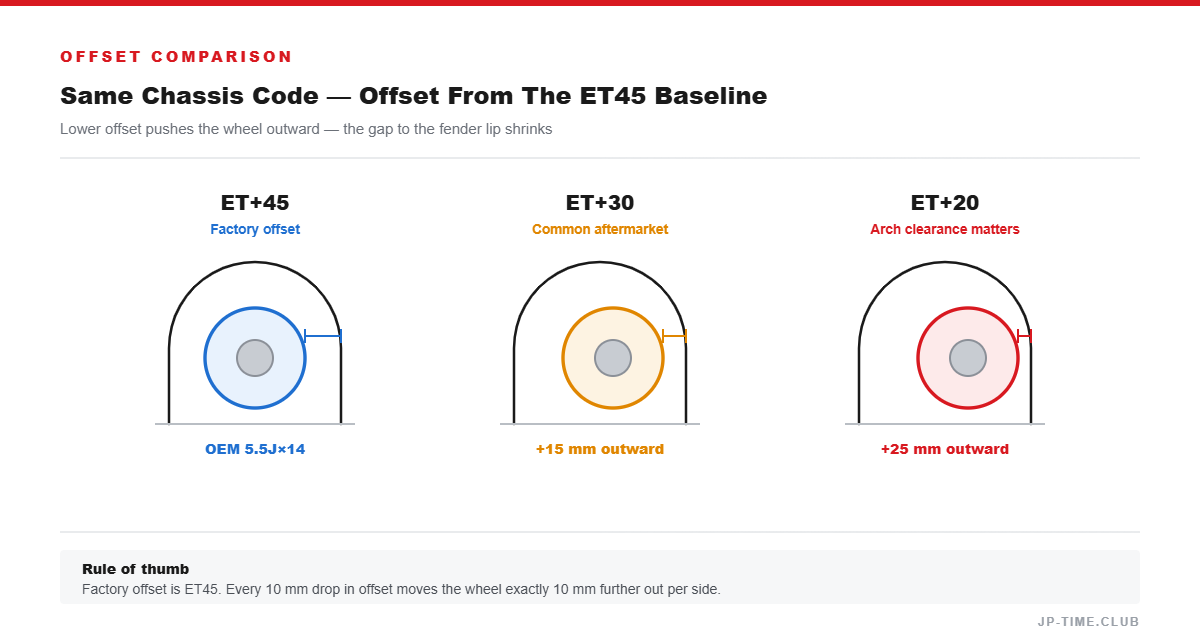
- Super Saloon Limited — 4×114.3, 66 mm bore, 5.5J×14 +45
Both PCD and bore change. Across the whole B14 range, 134 rows are 4×100 and 51 are 4×114.3. The 114.3 grades are the 1.6 and 1.8 Super Touring, the diesel Super Saloon, the 4WD ATTESA diesels, and the 1.5 4WD Super Saloon Type S. Full guide.
2. Mitsubishi Mirage / Lancer CJ4A and CK4A — grade decides
350 rows at 4×100 / 56 mm. Twenty-four rows at 4×114.3 / 67 mm — the Cyborg ZR and the Lancer VR, on 6J×15 +46.
Eleven millimetres of bore difference alongside the bolt circle change, so there is no partial compatibility in either direction. Full guide.
3. Nissan AD MAX — grade decides the hole count
Chassis E-WFGY10, both rows on the same page:
- LE — 5J×13 +40, 100 mm, 4 holes
- SLX — 5.5J×14 +45, 100 mm, 5 holes
Same bolt circle, different number of studs, decided by trim level. Full guide.
4. Nissan Avenir W10 — the badge decides
Chassis E-W10, same 5.5J×14 +45, on two model pages:
- Avenir page — 114.3 mm, 4 holes (91 rows)
- Avenir Salut page — 114.3 mm, 5 holes (53 rows)
Not a stray row on either side; the whole of both pages. Full guide.
5. Mitsubishi RVR N13W and N23W — grade decides the hole count
Two chassis codes carrying both counts, all on a 67 mm bore:
- E-N13W — 22 rows at 4 holes, 1 row (the X2) at 5
- E-N23W — 4 rows at 4 holes (the base R grade), 36 rows at 5
The reliable tell here is the rim: 14-inch cars are four-hole, 15-inch cars are five-hole. Full guide.
6. Suzuki Cultus E-AA44S — the build date decides
The only one on this list where nothing about the specification changes except the calendar. Same chassis code, same grade name, same 4.5J×13 at +45:
- To January 1996 — 4×114.3
- From February 1996 — 4×100
7. Suzuki Wagon R CT21S and CV21S — the build date decides
Added after publication. Japan’s best-selling kei car of the 1990s does exactly what the Cultus does, in the same year:
- CT21S — 18 rows at 4×114.3, 30 rows at 4×100
- CV21S — 11 rows at 4×114.3, 17 rows at 4×100
The changeover falls in 1996. Same chassis codes, same grade names, in several cases the same wheel size and offset. No bore is published for any of it.
That makes Suzuki the only manufacturer to appear twice in this list, both times in 1996, and both times with no announcement in the data.
What These Have in Common
Four things, and they are worth naming because they tell you where to expect the next one.
They cluster in the 1990s. Every case above is a car built between roughly 1990 and 2000. That is the period when Japanese manufacturers were migrating mid-size and small cars from four studs to five, and from 100 mm to 114.3 mm. During a migration, ranges are mixed.
The upper grade usually gets the bigger pattern. Super Touring, Cyborg ZR, SLX, X2 — in almost every case the more expensive, faster or better-equipped grade is the one on 114.3 or on five studs. The Cultus is the exception, where it is chronological.
Wheel diameter is a better clue than the chassis plate. On the RVR, the AD MAX and the Sunny B14, the grades that got the bigger bolt pattern also got a bigger rim. That correlation is not a rule, but it is a useful first check.
The bore often moves too. On the Sunny and the Mirage, the bore changes with the pattern. So even establishing the PCD does not finish the job.
What to Actually Do
- Count the studs. Five seconds, zero ambiguity, and it settles half the cases on this page.
- Measure the bolt circle. On four studs, measure centre-to-centre between two opposite studs — that is your PCD directly. 100 and 114.3 are 14 mm apart and impossible to confuse once measured.
- Measure the hub register while you are there. See our hub bore reference.
- Photograph the hub and keep it on your phone. You will be asked.
- If you are selling, state the grade and the build date, not just the chassis code. On six vehicles we know of, the code alone is not a specification.
A Note on the Databases
Everything above comes from the Japanese factory wheel databases, which are the best sources available and which we rely on constantly. It is worth saying that some of these splits may be recording conventions rather than engineering facts — particularly the single-row cases like the RVR X2, which could be one mis-keyed cell.
We have flagged our confidence in each individual guide. Where a split is one row out of forty, we say so. Where it is the whole of two pages, we say that too.
What we will not do is smooth it over. If the best available source says two different things about one chassis code, the useful thing to publish is that — because it tells you to go and measure, which is the correct action either way.
A Related Category: When the Engine Decides
Since first publishing this list we have found a second pattern, close enough to belong here but mechanically different. On these cars the bolt pattern splits by engine, and the chassis code splits with it — so the code does tell you the answer, but only if you know that two codes exist under one model name.
Mazda Lantis — four-cylinder versus V6
Sold side by side from September 1993 to May 1997, in the same 5-door, 4-door and coupe bodies:
- E-CBA8P, 1.8 four-cylinder, Type G / S / X — 4×100, 5.5J×14 +45 (30 rows)
- E-CBAEP, 2.0 V6, Type R / Type X-V6 / Mazdaspeed Version — 5×114.3, 6.5J×16 +45 (22 rows)
The grade names overlap — there is a Type X on one and a Type X-V6 on the other — which is exactly how people get caught. Bore is unresearched on both.
Mazda Familia S Wagon — 1.5/1.8 versus 2.0
The same structure, and this time the bore moves too:
- BJ5W (1.5) and BJ8W (1.8) — 4×100 on a 54 mm bore, 5J×13 or 5J×14 +45
- BJFW (2.0 Sport 20) — 5×114.3 on a 67 mm bore, 6J×16 +50
Thirteen millimetres of bore difference alongside the pattern change, so there is no partial compatibility in either direction.
Why This Category Is Easier
Because the tell is bigger. On the grade-decided cases above, the two fitments often share a wheel size — the Avenir’s 4-hole and 5-hole cars both run 5.5J×14 at +45, which is no help at all. On the engine-decided cases, the bigger engine gets a visibly bigger wheel: 14-inch means four-lug, 16-inch means five-lug, on both Mazdas above and on the Mitsubishi RVR.
So the rule of thumb from the section above holds and gets stronger: look at what wheel the car came on before you look at the plate.
Related Guides
- Which JDM Cars Changed Bolt Pattern, and When
- Hub Bore: The Number Nobody Publishes
- Staggered From the Factory
Additions, second batch of August 2026
Two more cases where one chassis code carries two bolt patterns:
| Car | Code | Split | What decides it |
|---|---|---|---|
| Mitsubishi Legnum | EC5W | 4 × 114.3 / 56 mm on 4 rows; 5 × 114.3 / 67 mm on 16 rows | The VR-4 badge. Both groups are 4WD 2.5-litre cars |
| Honda Torneo | CF / CL series | 4 × 114.3 on 54 rows; 5 × 114.3 on 3 rows | The CL1 Euro R, 2.2 with the H22A and 5MT |
The Legnum is the sharper case because the code on the plate is identical either side of the split. On the Torneo the code does change — CF to CL1 — but only by a letter, and the cars are otherwise the same model in the same showroom.
Both belong to a broader pattern we now see across Mitsubishi: ordinary cars bored 56 mm on four studs, performance cars bored 67 mm on five. The Colt Ralliart Version R does the same thing.