

The Short Version
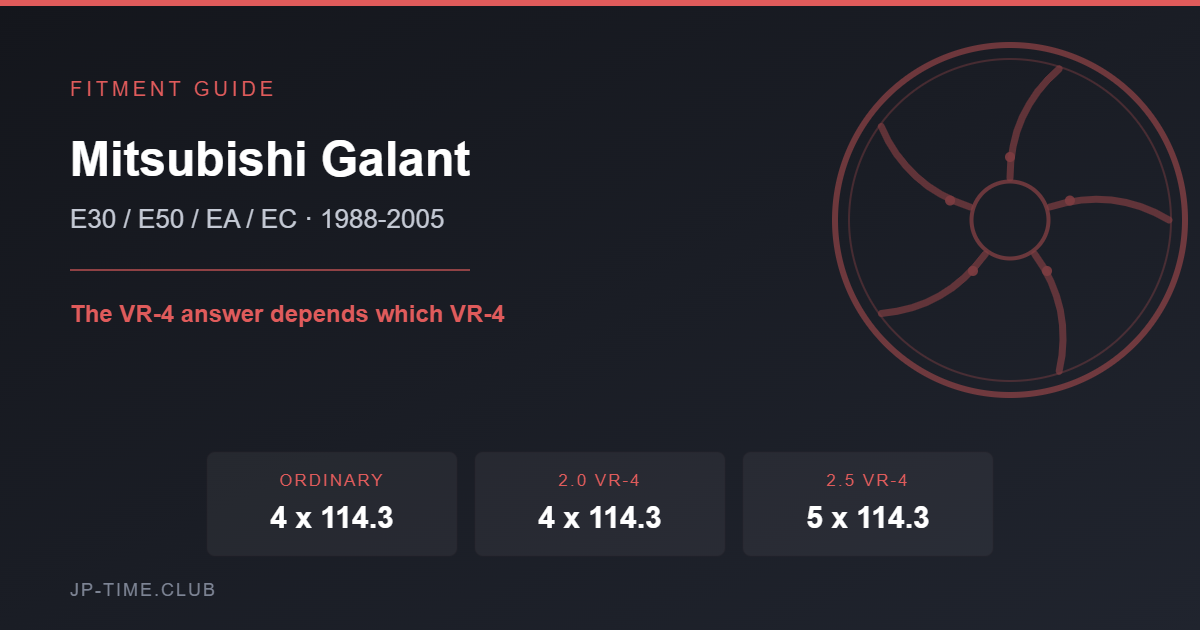
- The ordinary Galant is 4×114.3 across every generation from 1988 to 2005.
- “Is the VR-4 four-lug or five?” has two answers. The 2.0 turbo VR-4 is 4×114.3. The 2.5 V6 VR-4 is 5×114.3.
- No Galant hub bore has ever been researched — not one row, base or VR-4.
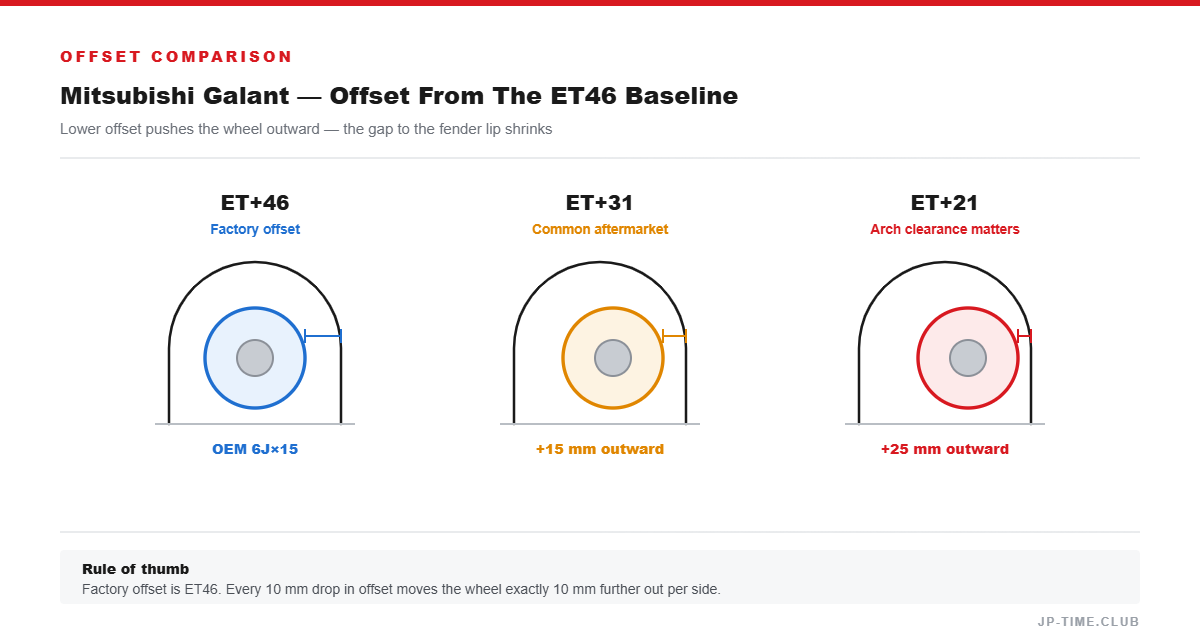
- +46 across essentially the whole range.
The VR-4 Question
This is the finding, and it explains a lot of confused forum threads.
Both VR-4 families appear on the same database page as the ordinary Galant, and they do not agree with each other:
| Chassis | Era | Grade | Engine | Wheel | PCD | Holes |
|---|---|---|---|---|---|---|
| E-E38A, E-E39A | E50 series | VR-4 RS, VR-4 RS 4WS | 2.0 turbo | 6J×15 +46 | 114.3 | 4 |
| E-E74A | E50 series | VR-4 S type | 2.0 turbo | 6J×15 +46 | 114.3 | 4 |
| E-E84A | 1994.10–1995.10 | VR-4 | 2.0 turbo | 6J×15 +46 | 114.3 | 4 |
| E-EC5A | 1996.08–1997.09 | VR-4, Super VR-4, VR-4 type S | 2.5 V6 twin turbo | 6J×15 or 16 +46 | 114.3 | 5 |
| GF-EC5A | facelift | VR-4 type V, type S | 2.5 V6 twin turbo | 6J×16 +46, 6.5J×16 +38 | 114.3 | 5 |
So the 1996-onward 2.5-litre V6 VR-4 — the one most people mean when they say “Galant VR-4” — runs the five-lug pattern shared with the GTO and the Evolution family. The earlier 2.0 turbo VR-4 grades run four lugs, exactly like an ordinary Galant.
Both are called VR-4. Both are four-wheel drive and turbocharged. Neither’s wheels fit the other.
The Ordinary Galant
Every mainstream grade, across 285 rows and thirty chassis-code groups, is 4×114.3 at +46:
- E30 series (E31A, E32A, E33A, E35A, E37A) — GE, GF, Viento, GS-4, MS-4, and the AMG type I and II. 4.5J×13 to 6J×15.
- E50 series (E52A, E53A, E54A, E64A, E72A, E74A) — GE, Exceed, MU, Viento-4, 25th Anniversary. 5.5J×14 to 6J×15.
- EA / EC series (EA1A, EA3A, EC1A, EC3A, EA7A, EC7A) — VE, VR-G, Viento, 24 Viento. 5.5J×14 to 6J×16.
- Diesel (E34A) — GE-D, MF-D. 5.5J×13.
Note the AMG-badged Galant grades in the E30 range. Same fitment as everything else — as we found on the Debonair Royal AMG, the AMG association was a trim and engine exercise, not a chassis one.
Another 4×114.3 Car
The Galant belongs to a list we keep extending: Japanese cars running four studs on a 114.3 mm circle, which almost everyone reads as 100 mm on sight.
It is the single most repeated trap in this whole series, and it now spans four manufacturers. We have collected the full list in our four-lug reference.
For a Galant owner, the practical consequence: your parts pool is the Mirage Cyborg ZR, the Chariot and base RVR, and the four-lug Nissans — provided the bore works, which brings us to the problem.
Nobody Has Measured Any Galant
We opened individual grade pages for three separate cars — an E31A base GE, an E84A 2.0 VR-4 and an EC5A 2.5 VR-4 — and every one prints 調査中, under investigation.
Mitsubishi’s larger-car figure is 67 mm, which we have confirmed on the RVR, the Outlander and the third-generation Pajero. A Galant is very likely 67.
We are not printing it. If you are buying a four-lug wheel — already a small market where bores vary widely — the bore is exactly the figure you cannot afford to guess. Measure it.
Importing
The E30 launched in 1987 and the E50 in 1992; both are past 25 years in full. The 2.5 V6 VR-4 arrived in August 1996 and becomes eligible from 2021 onward, so most of it is available now.
North America received the Galant, but not the VR-4 in either form and not the AMG grades. The E84A 2.0 VR-4 is the overlooked one — a 4G63 turbo, four-wheel drive, four-wheel steering saloon that costs a fraction of an Evolution.
What We Could Not Verify
- Hub bore for any Galant grade, base or VR-4. Confirmed unresearched on three separate grade pages.
- Tyre sizes for most grades.
- Whether the page’s coverage genuinely extends to 2005 as its date range implies — the individual grades we opened ranged 1990 to 1997.