
The Short Version
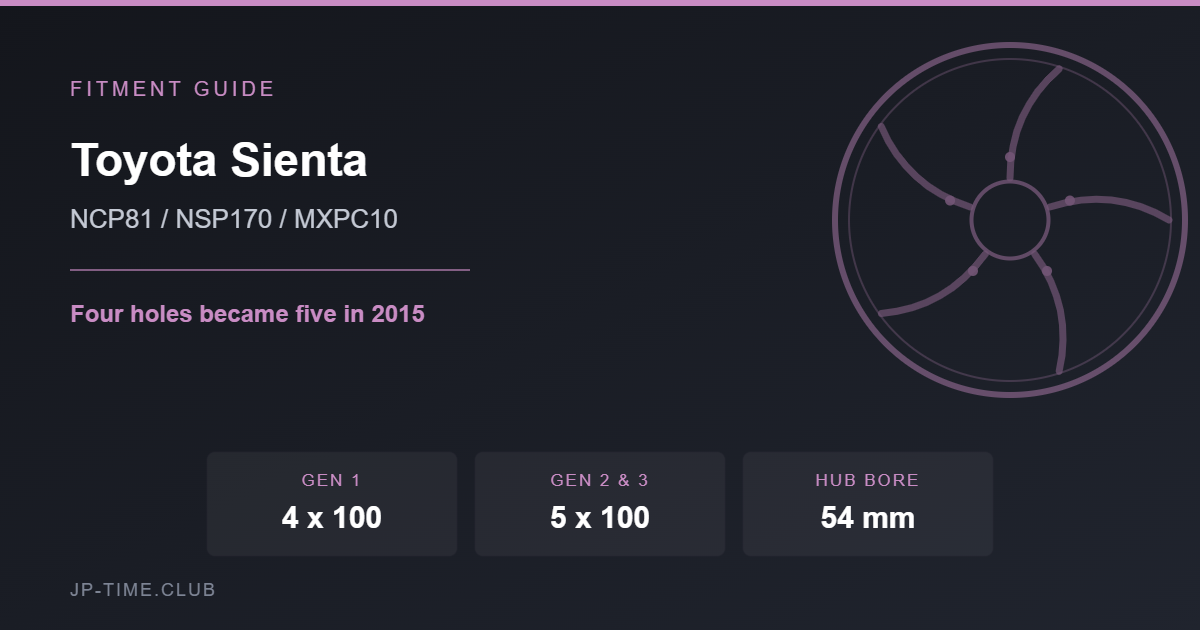
- Four holes became five in 2015. And the PCD stayed at 100 mm.
- The bore is 54 mm throughout, all three generations.
- No badge twin. The Sienta is Toyota-exclusive.
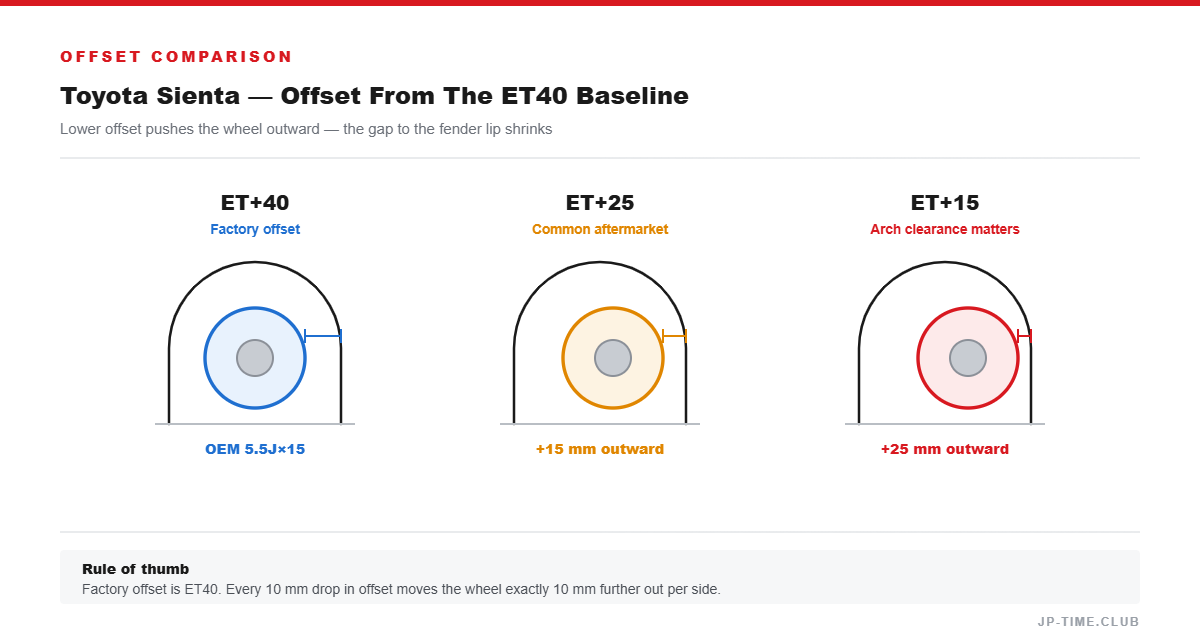
- Offset climbs from +33 to +40 across the generations.
Five Studs on a Hundred Millimetres
The Sienta does something we have only seen once before in this series, on the Carina and Corona family: it uses 5×100.
That is an unusual pattern in the Japanese market. Five studs normally means 114.3; 100 mm normally means four studs. Toyota used 5×100 on its mid-size front-drive cars in the 1990s, and it brought it back for the second-generation Sienta.
| Generation | Chassis | Period | Wheel | PCD | Holes | Bore |
|---|---|---|---|---|---|---|
| Gen 1 | NCP81, NCP85 | 2003–2015 | 5J or 5.5J×14 +33 | 100 | 4 | 54 |
| Gen 2 | NSP170, NCP175, NHP170 | 2015–2022 | 5.5J×15 +39 | 100 | 5 | 54 |
| Gen 3 | MXPC10, MXPL10 | 2022– | 5.5J×15 +40 | 100 | 5 | 54 |
So a first-generation Sienta wheel will not fit a second-generation one, and the reverse. The bolt circle is the same and the stud count is not, which is an unusual way round — most changeovers we document move the circle rather than the count.
Count the studs. Four is 2003–2015. Five is 2015 onward.
The Bore Did Not Move
Worth noting because it is the rarer outcome. Across a stud-count change and two full model changes, the hub bore stays at 54 mm — Toyota’s small-car figure throughout.
That means a hub ring bought for one generation works for the other, even though no wheel does.
Nobody Else Sells This Car
We checked, because this batch is largely about rebadges. The Sienta has no badge-engineered twin in either database, across all three generations. It is Toyota’s own, sold only as a Toyota.
That is worth stating in a market where the Roomy is also a Tank, a Thor and a Justy. Not every Japanese small MPV is four cars.
Buying
5×100 is your constraint and it is a real one. The pool is smaller than either 4×100 or 5×114.3, and it overlaps mostly with:
- The Carina, Corona, Carina ED and Corona EXiV family — but those are 60 mm bore, not 54
- The GC8 Impreza and other 5×100 Subarus — 56.1 mm bore
- A good deal of European stock, mostly bored 57.1 mm for Volkswagen
Note that none of those share the Sienta’s 54 mm bore. Every one of them is larger, so they will bolt on and sit loose rather than refusing to fit. A hub ring is not optional here; it is the whole job. See our hub rings and spacers reference.
The first-generation car on 4×100 / 54 mm is much easier — that is the most abundant fitment in Japan.
Sizing
+33 on the first generation is low for a small Toyota; +39 to +40 on the later cars is conventional. The realistic move is 15×6J in the +38 to +45 band, and on a car this narrow there is not much room beyond that.
Importing
The Sienta launched in 2003, so first-generation cars become eligible for US import from 2028 onward.
It was never sold in North America. The first generation is the interesting import — a genuinely tiny sliding-door seven-seater, on a footprint smaller than a Corolla.
What We Could Not Verify
- Tyre sizes by grade.
- Whether the hybrid grades (NHP170, MXPL10) differ from the petrol cars in any factory wheel option. The PCD, holes and bore match.