
Introduction
The Mazda Miata (MX-5) has been a favorite lightweight platform for wheel enthusiasts since 1989, prized for its low weight and perfectly balanced chassis. Three of its four generations — NA, NB and ND — share 4×100 with a 54.1 mm hub, which makes wheels interchangeable between them. The NC is the exception, and getting that wrong is the single most common Miata fitment mistake. This guide breaks down OEM specifications, safe fitment ranges, and three real-world builds to help you choose the right wheel setup for your Miata, whether you’re keeping it stock-height or pushing an aggressive stance.
Section 1: OEM Wheel Specifications by Generation
| Generation | Years | Variant | OEM Size | Bolt Pattern | Offset | Hub Bore |
|---|---|---|---|---|---|---|
| NA | 1990–1998 | All | 5.5Jx14 · 6Jx14 · 6Jx15 ET40 | 4×100 | ET38–42 | 54.1 mm |
| NB | 1998–2005 | All | 6Jx14 · 6Jx15 ET40 | 4×100 | ET38–42 | 54.1 mm |
| NC | 2006–2015 | All | 6.5Jx16 · 7Jx17 | 5×114.3 | ET40–55 | 67.1 mm |
| ND | 2015–present | All | 6.5Jx16 · 7Jx17 | 4×100 | ET40–45 | 54.1 mm |
Key takeaway — the NC breaks the pattern. NA, NB and ND all use 4×100 with a 54.1 mm hub, which is why wheels move freely between them. The NC (2006–2015) does not: it is 5×114.3 with a 67.1 mm hub. NA/NB/ND wheels will not fit an NC, and NC wheels will not fit the others.
Section 2: Recommended Fitment Ranges
Conservative Fitment (Daily-Driver Safe)
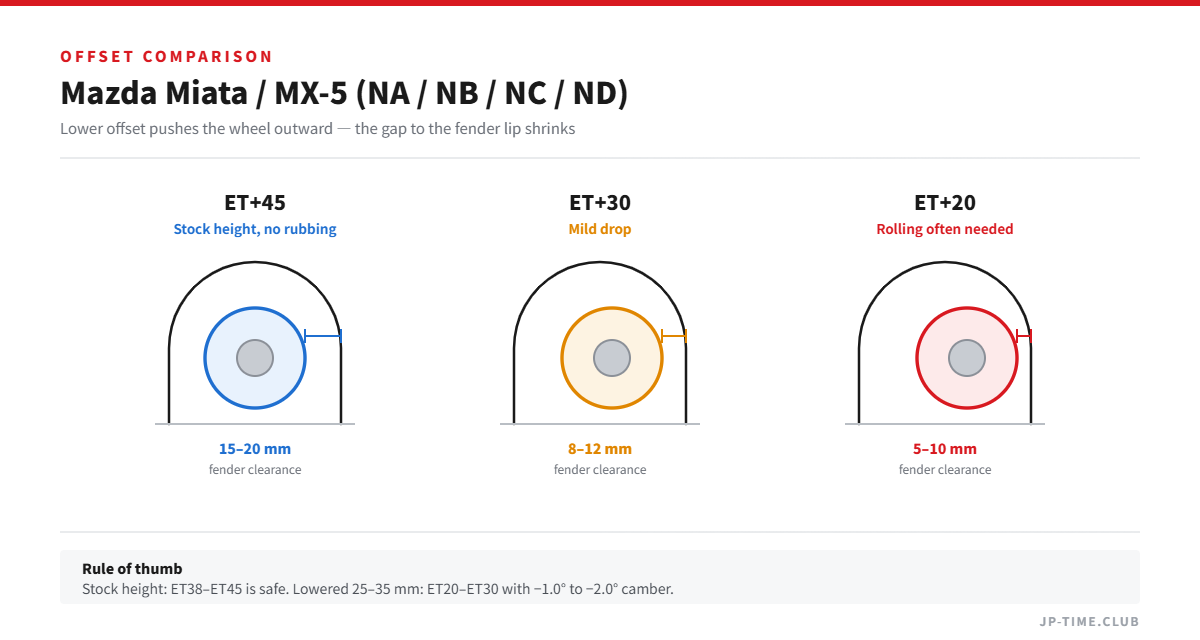
Recommended Offset Range: +38 to +45
- Wheel size: 15×6.5J to 16x7J
- Ride height: Stock or up to 15mm lowered
- Fender clearance: 15–20mm from fender lip, no rubbing under full compression
- Best for: Daily drivers, track day beginners, owners prioritizing reliability
For Miata owners keeping a practical daily-driver setup, this range ensures safe clearance under all suspension conditions. A NA with 15x6J +43 or NC with 16x7J +40 delivers an attractive stance without requiring suspension modifications.
Aggressive Fitment (Show/Stance Builds)
Recommended Offset Range: +20 to +30
- Wheel size: 16x7J to 17x8J
- Ride height: 25–35mm lowered with camber adjustment (-1.0° to -2.0°)
- Fender clearance: 5–10mm from fender lip — requires fender rolling or lip trimming in most cases
- Camber adjustment: Highly recommended; often necessary
- Best for: Static stance builds, show cars, low-speed cruising only
Important note: Aggressive fitment beyond -1.5° camber and 30mm of lowering on the Miata typically hits the practical limit before fender contact occurs. Going further generally requires camber plates, fender flares, or rolled fenders.
Instagram Embed Strategy
To source real-world fitment photos and verify community feedback before committing to a build, search these hashtags on Instagram:
Conservative Fitment Search Keywords:
Primary Tags (verified post counts):
- #MazdaMiata (818K)
- #MX5 (2.9M)
- #Miata (3.7M)

Generation Tags:
- #NAMiata (218K)  #NBMiata (109K)
- #NCMiata (66K)  #NDMiata (83K)
- #EunosRoadster (229K)  #MiataNation (431K)

Wheel Brand Tags:
- #BBSWheels (1.1M)  #RAYSWheels (776K)
- #WORKWheels (1.9M)  #EnkeiWheels (413K)
Aggressive Fitment Search Keywords:
Primary Tags (verified post counts):
- #LoweredMiata (3.1K)
- #StancedMiata (3.7K)
- #MiataStance (44K)

Community Tags:
- #StanceNation (12.6M)  #Hellaflush (2.4M)
- #StaticFitment (30K)  #FitmentGoals (6.4K)
- #MiataLife (761K)
Editor Selection Criteria:
– Clear, well-lit photos showing wheel fitment
– Visible suspension height and clearance
– Posts with 300+ engagement (indicator of quality build)
– Account with 1K+ followers (credibility check)
– Build setup matching article theme (conservative vs aggressive)
Real-World Build References
The builds below are ND-generation Miata owner posts that name the exact wheel model fitted. They show wheel styles proven on the ND chassis — they are reference images for style and stance, not verified measurements of the offset ranges listed above.
Low-angle shot showing wheel face, tyre profile and fender clearance — via @_haaaeru_
Near-stock ride height with white TE37V — via @mx5_na6ce_jdm
Section 3: Real Build Examples
Example 1 — NA/NB, Stock Ride Height
- Wheels: BBS RS-GT 15×6.5J +40
- Fender clearance: ~20mm (safe margin)
- Ride height: Unmodified, factory suspension
- Installation notes: Direct bolt-on, no modifications needed
- Owner feedback: “The weight savings alone made a noticeable difference in throttle response. Still fits over stock brakes with room to spare, and I never worry about curb rash from tight clearance.”
Example 2 — NC, Lowered 30mm
- Wheels: RAYS VOLK RACING CE28 16x7J +25
- Suspension: 30mm lowering springs + -1.5° camber adjustment
- Fender clearance: ~5mm (at the practical limit)
- Installation notes: Camber plate adjustment performed pre-install
- Owner feedback: “This is as low as it goes without cutting or rolling the fenders. Any lower and the tire starts kissing the liner over bumps. It’s aggressive but still streetable — just don’t hit any speed bumps fast.”
Example 3 — ND, Stock Ride Height
- Wheels: WORK EMOTION 17x7J +35
- Ride height: Unmodified
- Weight reduction: ~1.8kg per wheel vs OEM
- Owner feedback: “Went with a lighter wheel instead of lowering the car, and it paid off — quicker acceleration feel, a slight bump in fuel economy, and zero fitment issues. Full factory safety margin retained.”
Section 4: Selection Tips and Cautions
Critical Safety—Do NOT attempt:
– Offsets below 0 (wheels protruding dangerously beyond fender)
– Wheel widths exceeding 8J without lowering/camber (weight transfer becomes unstable)
– Lowering beyond 40mm without camber plates (tire rub becomes inevitable)
Fitment Verification Checklist:
- ✓ Verify brake caliper clearance before installation
- ✓ Measure fender clearance at all four corners
- ✓ If lowering: confirm current camber and suspension geometry
- ✓ Check tire sidewall clearance to fender liner
- ✓ Confirm tire sizing (aspect ratio affects final diameter and clearance)
Key Advantages of Miata Fitment:
- Bolt pattern varies — check your chassis code: NA, NB and ND share 4×100 / 54.1 mm, so used wheels move freely between those three. The NC is 5×114.3 / 67.1 mm and is not interchangeable with them
- Lightweight platform response: Even modest wheel downsizing (15 to 16 inches, or upgrading to lighter construction) produces noticeable handling improvements
- Aftermarket wheel popularity: Thousands of Miata owners have documented their builds on Instagram—making research and parts sourcing straightforward
Conclusion
The Miata is one of the easiest platforms to fit aftermarket wheels on — provided you check which generation you have first. NA, NB and ND share 4×100; the NC does not. Whether you’re restoring an NA to stock elegance or building an aggressive ND stance car. Start conservative if this is a daily driver, verify real-world clearance photos via the Instagram hashtags above, and always account for camber and tire width alongside wheel offset. With the right combination, the Miata’s lightweight chassis rewards even modest upgrades with a noticeably sharper feel.
Ready to plan your own Miata wheel fitment? Submit a Request and our team will help you match the right wheel size, offset, and camber setup to your generation and ride height goals.
Seen on the road
Which wheels are you looking for? Tell us the wheel, the size and the fitment — send us a request and we will go and find it.
Wheel identification is taken from the hashtags the owner applied to their own post.
Related Fitment Guides
- Toyota MR2 SW20 — the other lightweight Japanese mid-engined answer
- Toyota AE86 — why smaller and lighter is the performance choice
- Toyota GR86 & Subaru BRZ — the modern successor to this idea
- Mazda RX-7 FC3S — Mazda’s other 1990s sports fitment
Every guide in this series is built the same way: verified factory specifications, an offset diagram, and an honest account of what fits and what does not.