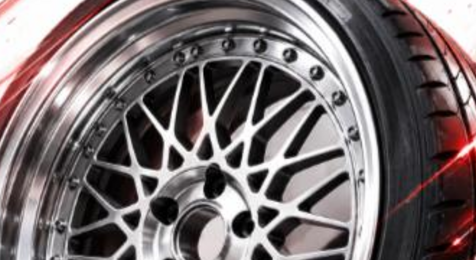
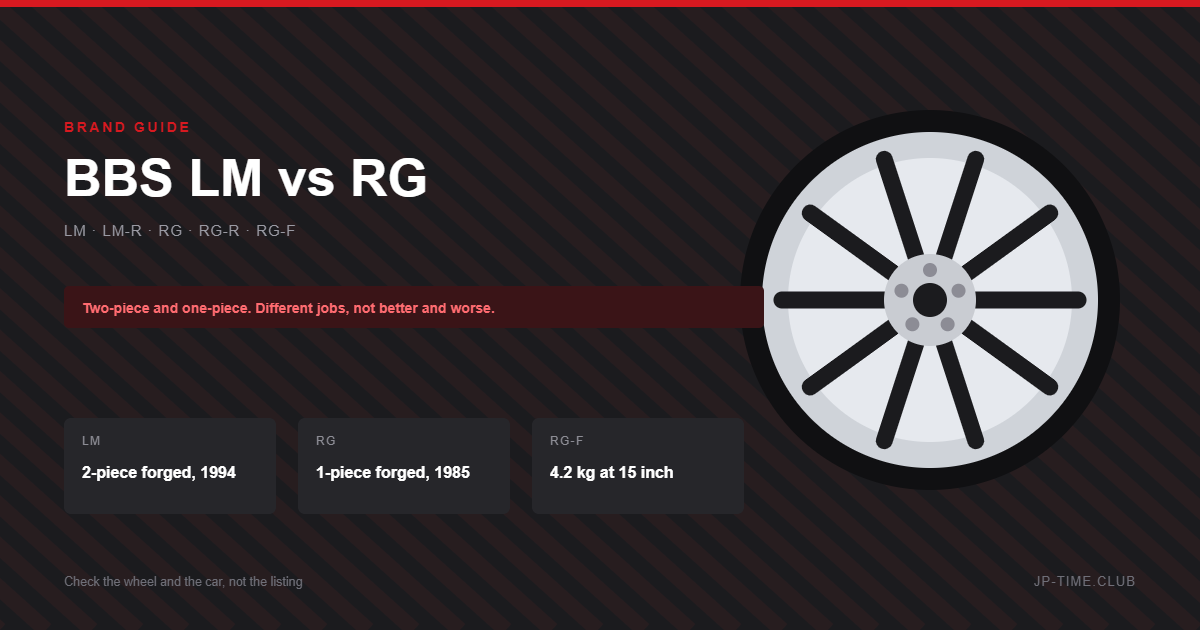
If you are choosing between a BBS LM and a BBS RG, you are choosing between two-piece and one-piece forged construction. That is the whole decision, and it is not a question of which is better.
The Short Version
- RG came first — 1985, and it was a world first: the first mass-produced one-piece forged wheel with a complex mesh face.
- LM came in 1994, two-piece forged, named after Le Mans, launched alongside the SUPER-RS.
- The plain RG name is gone. Today the one-piece forged line is RG-R and RG-F.
- LM and LM-R are still in production as of 2026.
- RG-F is remarkably light — 4.2 kg at 15 inches, on 4×100, for kei and compact cars.
RG: The One That Was a World First
The RG arrived in 1985, and BBS Japan’s own corporate history is unambiguous about why it mattered: nobody had managed a complex mesh face in a single forged piece before. Three-piece was how you got that look. Doing it in one piece meant no assembly bolts, no sealant, and no air path through a joint.
It won the Technical Innovation Award at the SEMA show in the United States that year, and it brought BBS Japan its first OEM contract — an option fitment on the Nissan Skyline, also in 1985.
A date to be careful with. English-language sources frequently give 1987 for the RG. BBS Japan’s own history says 1985, for both the wheel and the SEMA award. We are going with the manufacturer. The 1987 date may be a confusion with the November 1987 WEC race at Fuji, which appears in the same corporate history as a separate entry.
LM: Named After a Race
The LM launched in 1994, the same year as the SUPER-RS. It is a two-piece forged wheel — a forged disc and a separate rim — and it descends directly from the wheels BBS was supplying to Le Mans entrants.
BBS Japan’s own product copy says the wheel is named after that race. That is as close to official confirmation of “LM = Le Mans” as exists; we did not find a trademark document spelling it out.
LM-R followed in 2007 — a seven-spoke reinterpretation drawing on the racing wheels BBS built for the Porsche Carrera Cup. It was pitched as LM’s successor, and both are still in the catalogue in 2026.
The Lines Side by Side
| Model | Launched | Construction | Sizes | Weight range |
|---|---|---|---|---|
| RG | 1985 | One-piece forged, mesh | — | — (name retired) |
| LM | 1994 | Two-piece forged, 10 spoke | 17–21″ | 8.7–14.5 kg |
| LM-R | 2007 | Two-piece forged, 7 spoke | 19–21″ | 10.7–14.0 kg |
| RG-R | current | One-piece forged, 8 spoke | 17–19″ | 7.5–9.6 kg |
| RG-F | current | One-piece forged, 10 spoke | 15–16″ | 4.2–6.4 kg |
Read that weight column and the positioning becomes obvious without anyone having to explain it. RG-F at 4.2 kg is a wheel for a kei car or a light compact — and it is offered in 4×100. LM at up to 14.5 kg in 21 inches is a wheel for a large, heavy, fast car.
What Two-Piece Actually Buys You
The honest answer is: repairability, at a weight cost.
A two-piece wheel has a separate rim. Kerb the outer edge badly and the rim section is, in principle, a serviceable component in a way that a one-piece wheel’s is not. That matters more on a 21-inch wheel with a thin lip than on a 16-inch kei wheel.
A one-piece forged wheel is lighter for the same strength, has no joint to seal, and has nothing to come loose. It is also cheaper to make, which usually shows in the price.
Neither is the premium option. They are answers to different questions, and the size ranges tell you which question BBS thought each was answering.
Which One Suits What
RG-F — kei cars, light compacts, anything where 4.2 kg per corner is a meaningful fraction of the unsprung mass. 4×100.
RG-R — mid-size sport saloons and coupes, 17 to 19 inches. The sensible one-piece choice for most Japanese performance cars.
LM / LM-R — larger and heavier cars, European saloons, anything running 19 inches and up. Also the one you choose if you want the look, which is a legitimate reason and worth saying out loud.
What We Could Not Verify
- Whether “LM” is formally registered as standing for Le Mans. The marketing copy says the wheel is named after the race; no trademark document was found.
- The exact English title of the 1985 SEMA award. The Japanese is 技術革新大賞; renderings vary.
- Whether the plain RG was formally discontinued. It is absent from the current catalogue, which implies it, but we found no announcement.
- 1985 versus 1987 for the RG. We have gone with BBS Japan’s own date and flagged the conflict rather than hiding it.
Related Guides
- BBS: the German brand that is made in Toyama
- BBS RS: real, replica or counterfeit — the three-piece that started it
- How to read the markings on a Japanese wheel
Looking for a Set
Used LM and RG sets come through Japan regularly. Tell us the car, the size and whether you care more about weight or about being able to replace a rim later — that last question decides more than most people expect. The Request page is the place.