The Minicab is the kei truck most likely to waste your money, and it is not the truck’s fault. It is the only one in its class that changed bolt pattern mid-life, and the generation with the odd pattern is exactly the generation that is cheap, plentiful and old enough to import.
It is also the only kei truck that was sold as an electric vehicle, and the only one whose current version is built by a competitor.
The Short Version
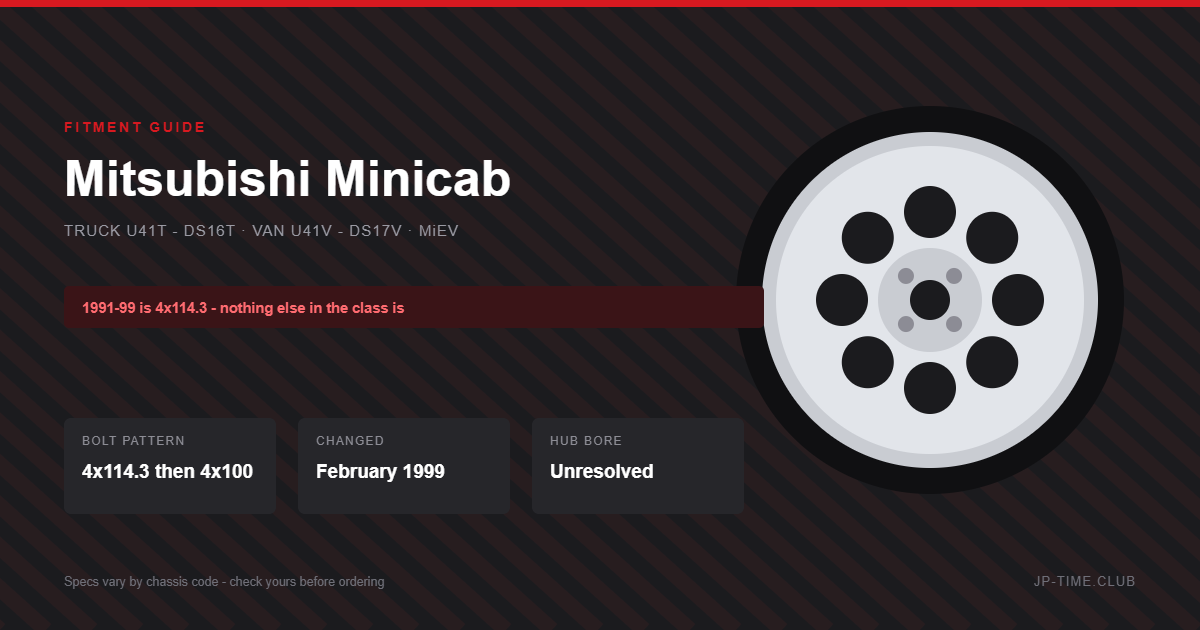
- 1991 to January 1999 (U41T / U42T): 4×114.3. Nothing else in the kei class uses this. A wheel that fits every other kei truck will not bolt on.
- February 1999 onward (U61T / U62T): 4×100, like everyone else. The change happened at the generation break, alongside the 1998 revision of the kei-car regulations.
- From 27 February 2014 the Minicab is a Suzuki. DS16T is a Carry; DS17V is an Every.
- Hub bores are genuinely unresolved. The Japanese fitment databases that give clean numbers for every other kei truck leave the Minicab field blank. We are not going to invent one.
- The Minicab MiEV was electric, about 200 kg heavier, and rode on 8PR tyres where the petrol version used 6PR.
The Bolt Pattern Change
This is the whole reason this guide exists.
4×114.3 is a pattern you find on a Silvia, a Datsun, an old Toyota — full-size Japanese cars. Finding it on a kei truck is genuinely strange, and it means the enormous supply of cheap 4×100 kei truck wheels is useless to you if you own a 1990s Minicab.
The switch to 4×100 came with the U61T / U62T generation in February 1999, prompted by the October 1998 revision of Japan’s kei-car dimensional and engine standards. That generation then ran, remarkably, for fifteen years to February 2014 under a single chassis code, through facelifts in 2000, 2002, 2004, 2005, 2007, 2008 and 2011.
We found no evidence of any further pattern change within that fifteen-year run.
| Chassis | Years | Bolt pattern | Built by | US 25-year status |
|---|---|---|---|---|
| U41T / U42T truck, U41V / U42V van | Feb 1991 – Jan 1999 | 4×114.3 | Mitsubishi | Eligible |
| U61T / U62T truck, U61V / U62V van | Feb 1999 – Feb 2014 | 4×100 | Mitsubishi | Eligible up to July 2001 |
| Minicab MiEV van (U67V / U68V) | Dec 2011 – | 4×100 (assumed) | Mitsubishi | Not eligible |
| Minicab MiEV truck (U68T) | Jan 2013 – May 2017 | 4×100 (assumed) | Mitsubishi | Not eligible |
| DS16T truck | Feb 2014 – | 4×100 | Suzuki Carry | Not eligible |
| DS64V van | Feb 2014 – Mar 2015 | 4×100 | Suzuki Every (outgoing body) | Not eligible |
| DS17V van | Mar 2015 – | 4×100 | Suzuki Every | Not eligible |
Note the truck and van are out of step. The truck switched to Suzuki in one move on 27 February 2014. The van switched the same day but only to an interim generation on Suzuki’s outgoing Every body, and did not reach the current DS17V until March 2015. That mismatch persists today.
The Hub Bore Problem
We want to be direct about this, because it is unusual.
For every other kei truck in this class we could find a hub bore figure and corroborate it: Daihatsu 54 mm, Honda 56 mm, Suzuki around 60 mm, rear-engined Sambar 59 mm. For the Minicab, the same Japanese fitment databases leave the field blank, across every sub-code we checked.
Secondary sources float 53 mm, 58 mm and 59 mm for the U41T/U42T. None of them is confirmed and they cannot all be right. We are not going to pick one and present it as the answer.
What this means practically: if you own a Minicab, measure your hub. A caliper across the machined face of the hub, where the wheel centres. Send us the number and we will publish it with credit — this is a gap that deserves filling.
Engines
The 3G83, a 657 cc inline-three, ran the whole Mitsubishi-built era from 1990 to 2014 — naturally aspirated, with multi-point injection on upper grades, and an intercooled turbo on later van grades.
A supercharged version existed, but on the earlier and smaller 3G81 (548 cc), used until around 1991. It did not carry over to the 3G83. This is worth knowing because the Sambar did keep a supercharger available right through its life, and the two are often discussed as if they were equivalent. They were not.
The Electric One
The Minicab MiEV van launched on 8 December 2011 with Toshiba lithium-ion batteries in 10.5 kWh and 16.0 kWh forms — roughly 100 and 150 km on the JC08 cycle. The MiEV truck followed on 17 January 2013 in a single grade with the smaller battery, and was discontinued in May 2017 after poor sales.
For wheel purposes there is one documented and quite interesting difference. The MiEV rides on 145R12 8PR tyres where the petrol Minicab uses 6PR. That is a heavier ply rating, and it is consistent with roughly 200 kg of additional vehicle weight from the battery pack. The spare was relocated into the cabin.
We could not find published wheel or hub dimensions for the MiEV specifically. But the tyre change is a clear signal: this vehicle carries more weight than it looks like it should, and if you are choosing wheels for one, the load rating is not a formality. Our overview guide covers what the JWL-T mark and the VIA-T load figure actually mean.
Bravo Is a Trim, Not a Model
A standalone Minicab Bravo existed from 1989 to 1999. It was then discontinued, and revived from November 2011 purely as a grade name within the Minicab Van range — continuing through the DS64V and DS17V Suzuki-built vans.
Bravo and Bravo Turbo grades get full wheel covers over steel wheels. Those are not alloys, and we found no evidence of a genuine cast alloy wheel on any Minicab grade in any generation, petrol or electric. If a listing says “Bravo alloys,” look at the photograph.
Buying Wheels for a Minicab
Establish the year before anything else. January 1999 and February 1999 are different vehicles with different bolt patterns. If the seller cannot tell you the build month, that is the first thing to resolve.
If it is 4×114.3, widen your search. You are no longer shopping in the kei truck aisle. 4×114.3 in a 12-inch diameter is unusual in any market, and the realistic options are used original wheels or something from the wider Japanese 4×114.3 world in a small size — with the load rating checked, because most 4×114.3 wheels were designed for passenger cars.
If it is 2014 or later, shop for a Suzuki. DS16T is a Carry DA16T; DS17V is an Every DA17V. Our Suzuki Carry and Every guide applies directly — including the unresolved question about the DA16T hub bore, which the Minicab inherits.
What We Could Not Verify
- Hub bore for any Minicab, in any generation. The most significant gap in this guide.
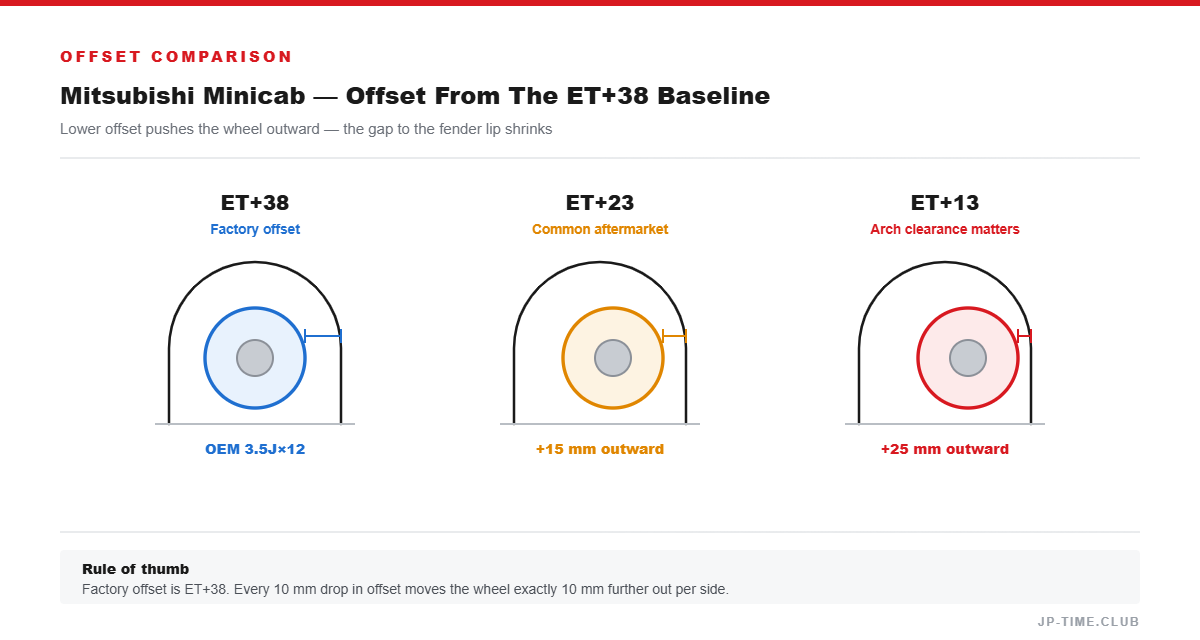
- Factory wheel width and offset for most sub-codes. +38 is the most frequently reported offset for the U61T era.
- Wheel and hub dimensions for the MiEV specifically.
- The bolt pattern of the MiEV. It is built on the U61V chassis so 4×100 is near-certain, but we did not confirm it independently.
- Whether any Minicab ever had a genuine factory alloy. We found none.
Related Fitment Guides
- Kei trucks and kei vans overview — rebadging, bolt patterns and JWL-T
- Suzuki Carry & Every — what a post-2014 Minicab actually is
- Subaru Sambar — the other kei truck that changed identity
- Kei trucks in the USA
Getting Minicab Wheels From Japan
Tell us the chassis code and the build month, because with this vehicle the month matters. The Request page is the place. And if you measure your hub bore, tell us that too — we would like to close that gap.