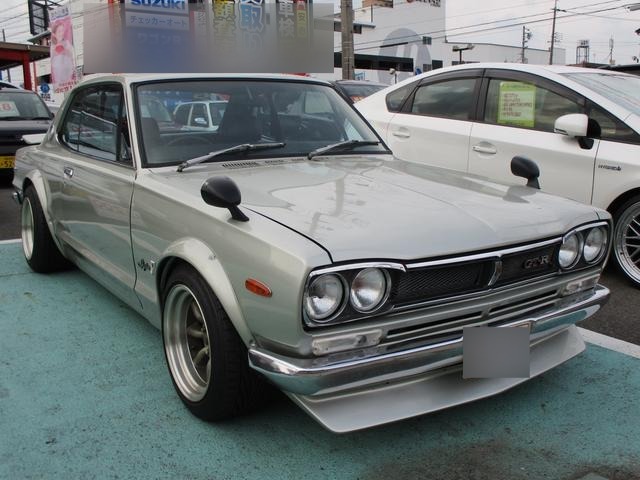
The car in these photos wears the badge, the wheels, and the fenders of a Skyline GT-R. It is not one of the 1,197 real ones. That is not a knock on it — it is the whole story, and the seller told us plainly: this is a Skyline GT with an L20-based 2.6-liter engine, not a factory GT-R.
Two Cars, One Body
The C10-generation Skyline hardtop was sold with two very different engines under a nearly identical shell. The four-door PGC10 (1969–1970, 832 built) and two-door KPGC10 (1970–1972, 1,197 built) carried the S20: a DOHC, four-valve-per-cylinder 2.0-liter straight-six adapted from Prince’s R380 race engine, rated at 160 hp. Every other Skyline GT and GT-X of the same generation — chassis codes GC10 and KGC10 — ran the L20, a simpler SOHC six shared across ordinary Nissan passenger cars. Same body, unrelated engine, and a production gap wide enough that a genuine KPGC10 is now one of the rarer Japanese classics on the road.
This car, per the listing, is registered as a 1972 (S47) Skyline GT with 84,000 km on the clock — not a GT-R chassis code.
Building the Look
Taking a GT and dressing it as a GT-R is a tuning tradition in Japan that goes back decades, generally called “R仕様” (R-spec) or “GT-Rルック.” It isn’t a scam when it’s presented honestly, and it has produced some genuinely well-engineered cars. One documented example from Nostalgic Hero’s tuning coverage: a 1970 KGC10 Skyline HT 2000 GT rebuilt around an L20 block bored out to 2,563cc using a forged 83mm piston and an L28 crankshaft for the extra stroke, running on RS Watanabe eight-spoke wheels (15-inch, 9J front / 9.5J rear) under bolt-on front over-fenders. That particular car used fuel injection rather than carburetors, but the recipe — L-series bore-up, Watanabe wheels, over-fenders, GT-R styling — is the same family this car belongs to.
This Car’s Build, As Described
According to the seller’s listing, the specification is:
- Engine: L20 bored to 2.6 liters, dual Solex 44mm and 50mm sidedraft carburetors
- Wheels: GT-R-spec 15-inch RS Watanabe “AW”
- Suspension: adjustable coilovers
- Aero: front and rear spoilers, over-fenders (attributed by the seller to “Protec”)
- Color: silver
- Registration: 1972 (S47), 84,000 km
We’re reporting these as the seller’s own description, not as something we independently measured on the car.
What the Badge Doesn’t Prove
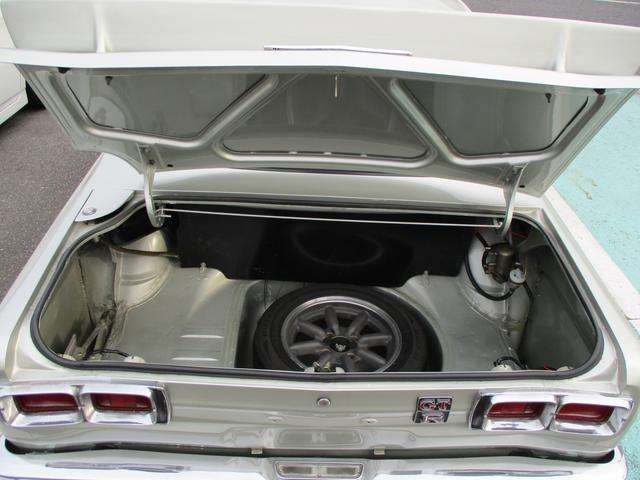
Because R-spec builds have gotten good, enthusiast guides to the genuine article now focus on details a badge swap can’t fake: the chassis plate stamped PGC10- or KPGC10- (versus GC10/KGC10 for the L-series cars), the DOHC S20 engine itself, clear rather than tinted glass on factory GT-R cars, and factory panel work on the rear fender cut where the two-door GT-R’s over-fenders bolt on. We have not inspected this car’s chassis plate or engine bay, and we are relying on the seller’s own description of it as a Skyline GT — which we take as the operative fact here, not the grille badge.
Wheels and Fitment
Every C10-generation Skyline — GT, GT-X, and both GT-Rs — shares the same 4×114.3 bolt pattern; the fitment differs mainly in whether the car has over-fenders. We cover the full RS Watanabe offset table, including the wider over-fender fitment this car’s stance calls for, in our Hakosuka wheel fitment guide.
What We Could Not Verify
- The car’s exact chassis code (GC10 sedan-based vs. KGC10 hardtop) — not determinable from the photos supplied
- Which cylinders each Solex carburetor (44mm / 50mm) feeds, and the exact carburetor model
- The identity of the “Protec” over-fender maker. A company of that name (株式会社プロテック, based in Kanagawa) currently sells motorcycle electronics — fuel gauges, alarms, LED lighting — and nothing on its site references classic-car over-fenders. It is likely a different company with the same name; we could not confirm a maker match.
- Whether this car’s rear fenders are factory-line-cut or aftermarket-cut, per the identification cues discussed above — we have not physically inspected the panel
- The precise production or first-registration date beyond the 1972 (S47) year given