The Short Version
- SP1R is not a different spoke design. SSR’s own Japanese product copy calls it the フルリバースモデル — the full-reverse-rim model. Same face family as the SP1, different barrel.
- Type C is not part of the Professor line at all. It is its own model line, and it is a one-piece forged monoblock, not a three-piece.
- The JAWA mark appears on SSR products only from January 2020. A genuine SSR wheel made before then legitimately has no JAWA mark. Do not use its absence as a fake test.
- We could not find any official SSR counterfeit notice. Other brands publish one. SSR appears not to, and we are not going to invent a citation.
- The “export SSRs have no JWL” theory does not hold up. SSR’s own US-facing material says the opposite.
SP1 versus SP1R: The Distinction Everyone Blurs
Search English-language listings for the difference between the Professor SP1 and the SP1R and you will get vague answers about “a styling variant” or “the sportier one”. SSR’s own Japanese product pages are much more specific, and the distinction is structural rather than cosmetic.
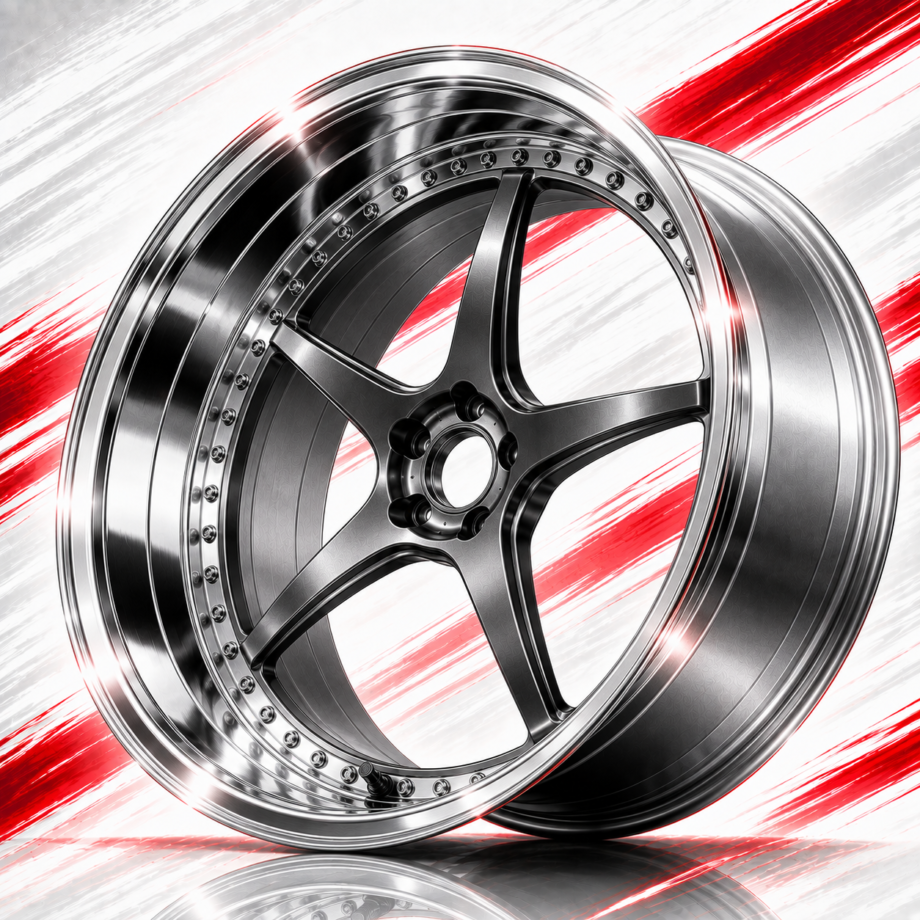
The SP1 is described as the ピュアスポーツルック — the pure sports look — with a standard-face disc. The SP1R carries the フルリバースモデル designation: full reverse. In three-piece construction, a reverse rim inverts the barrel so the outer lip sits proud and the disc is set deep, producing the concave, stepped-lip look. Same disc family, different rim assembly, different resulting profile.
Practically this means two things. First, if you are matching a set, an SP1 and an SP1R of nominally the same size will not look the same on the car, so do not mix them front to rear expecting symmetry. Second, when a seller cannot tell you which one they have, look at the barrel, not the spokes.
The size ranges also differ in SSR’s current catalogue: the SP1 is shown at 18 and 19 inches, the SP1R at 16 and 17. Older stock exists outside those bands and we have not verified the full historical size list.
The Professor Range, Briefly
| Model | Construction | Face | Catalogue sizes |
|---|---|---|---|
| Professor SP1 | Three-piece | Standard-face five-spoke | 18–19 in |
| Professor SP1R | Three-piece | Same face, full reverse rim | 16–17 in |
| Professor SP4 | Three-piece | Solid rounded five-spoke | 19 in |
| Professor SP5 | Three-piece | Ten-spoke, shares the disc design with SSR’s Super GT wheel | 19 in |
| Professor MS1 | Three-piece | Fine mesh, light-weight focus | 19 in |
| Professor MS3 | Three-piece | Seven-spoke coarse mesh, stepped rim | 19 in |
One point worth stating plainly because English sources muddle it: the whole Professor line is three-piece. If someone is selling you a “Professor” that is obviously a single casting with decorative bolt heads around the face, it is not a Professor.
Type C Is a Different Animal
Type C sits in SSR’s lineup as its own line, not under Professor. It debuted in 2000 and was marketed at the time as the lightest wheel in its size. The current Type C FORGED is a one-piece forged monoblock: SSR’s Japanese page describes a 10,000-tonne press followed by spinning and machining. Visible tells on the current wheel include an SSR / FORGED logo machined into the flange and a knurled bead seat.
This matters for authentication because the checks are completely different. On a three-piece Professor you are examining assembly hardware, rim seams and the join between disc and barrel. On a one-piece Type C there is no hardware to examine — you are looking at the machining quality, the flange logo and the weight. A Type C that is noticeably heavy for its size is the single loudest warning sign, because the entire point of the wheel is that it is not.
We have not been able to reconcile the exact forging process description between SSR’s Japanese page and the semi-solid forging language used by some English-market sellers for the earlier Type C-RS. Treat the two as related but do not assume they are the same specification.
Marks: What Is Actually Required, and the 2020 Trap
SSR publishes a quality-standard page in Japanese that sets out what each mark means. Three things come out of it that matter to a buyer.
- JWL is the Japanese technical standard mark required on aftermarket alloy wheels sold for road use in Japan.
- VIA is the layer above — it indicates the wheel was registered with the light-alloy wheel testing council and that testing was confirmed by a body other than the manufacturer itself.
- JAWA is a voluntary association mark, and on SSR products it appears only on new products from January 2020 onward.
That third point is the one that catches people. There is good general advice circulating that a JAWA hologram is an anti-counterfeit feature worth looking for — and it is, on a recent wheel. But adoption dates are set brand by brand. A genuine SSR Professor from 2014 was never going to carry a JAWA mark, and a seller who tells you otherwise either does not know or is pricing something.
We wrote separately about the difference between JWL and VIA, which is the single most useful distinction in Japanese wheel certification and applies to every brand, not just this one.
The Export-Model Theory, Tested
A theory that circulates in US forums holds that SSR wheels sold through American retail channels are a different specification from JDM ones, possibly built elsewhere, possibly without JWL or VIA marks — which would break the usual heuristic that a missing JWL mark means a fake.
We went looking and the evidence points the other way. SSR’s own US-facing material states that SSR wheels are put through JWL testing before road or track use. That is the brand’s own marketing to American buyers, and it treats JWL as standard rather than as a Japan-only formality. We could not confirm any current US retail listing one way or the other, and we could not find evidence that SSR wheels are manufactured outside Japan.
So: treat “it is an export model, that is why there is no JWL” as an unsupported claim, and ask more questions when you hear it.
What a Genuine Three-Piece SSR Should Show You
SSR’s technical page describes its three-piece assembly as hand-built, with the inner and outer rim halves joined after the assembly hardware is fitted. That gives you a small set of things to examine in person:
- The hardware is structural, not decorative. On a genuine three-piece the fasteners hold the wheel together. On a faux three-piece they are cosmetic heads glued or cast into a one-piece face.
- The rim seam should be consistent all the way round, and consistent between the four wheels of a set.
- Weight should match the claim. A three-piece SSR is not a heavy wheel. Put it on a scale.
- Marks should be crisp and correctly placed, not stickers standing in for stamps.
We are deliberately not giving you a serial-number decoding table. We could not verify from any SSR or Tanabe source where the serial sits on a genuine wheel or what format it takes, and a made-up decoder is worse than no decoder. If you have a documented genuine set and can photograph the barrel stamps, we would like to see them and will publish what they show.
What We Could Not Verify
- Barrel stamp and serial number location and format on genuine SSR wheels.
- Any official SSR or Tanabe counterfeit notice. We found none. Do not repeat a claim that one exists.
- Whether the current Professor SP1 and SP1R centre discs are forged or cast. SSR documents the forging process for Type C explicitly; the Professor pages describe the rim process only.
- Full PCD ranges for SP1, SP4, SP5, MS1 and MS3 across all sizes. The published spec sheets are image-based and did not yield reliable text.
- Whether SSR wheels have ever been manufactured outside Japan.
- Whether the current Type C FORGED process is continuous with the year-2000 original.