“Are these real WORK wheels?” is the most-asked question in the whole JDM wheel market. It is asked on Subaru forums, Honda forums, Lexus forums and Nissan forums, constantly, about the same handful of models.
The useful starting point is that WORK itself publishes a notice about it.
The Short Version
- WORK has a standing counterfeit notice on its own site, and separate consumer guidance telling buyers what to check.
- WORK says look for three things: the
JWLorJWL-Tmark, theVIAmark, and the JAWA quality certificate sticker. - The Equip test is the cleanest: a genuine multi-piece Equip has real through-bolts. The common fake is a one-piece casting with fake bolt heads.
- The Meister S1R has around forty rivets, each stamped with a small W.
- There is no public serial lookup. We searched; WORK does not appear to offer one.
What WORK Actually Says
WORK maintains a notice on work-wheels.co.jp about imitation product. In summary: counterfeits are circulating on Japanese auction and e-commerce sites using WORK’s logo and trademarks without authorisation; they come in sizes and materials that do not correspond to anything in WORK’s range; and WORK is pursuing legal action.
A separate consumer notice gives the check. WORK tells buyers to look for:
- The
JWLorJWL-Tmark - The
VIAmark - The JAWA quality certificate sticker
We photographed exactly this on our own stock for the WORK markings guide: JWL and VIA cast into the front face beside the valve, where they can be read with the wheel on the car, and the Japanese JAWA certificate label still stuck inside the rim after twenty years.
One caveat WORK cannot state and we will: all three of those can be copied. They are a floor, not a ceiling. Our cross-brand guide explains why JWL in particular proves less than people assume.
The Models That Get Copied
| Model | The tell |
|---|---|
| Equip 01 / 03 | Genuine two- and three-piece Equips are joined by real through-bolts. The knock-off is a one-piece casting with simulated bolt heads |
| Meister S1 / S1R | Roughly 40 rivets, each stamped with a small W. Check the assembly hardware is real |
| RSZ-R | Reported faked; general checks apply |
| VS series, Emotion | Widely discussed; no single distinctive tell found |
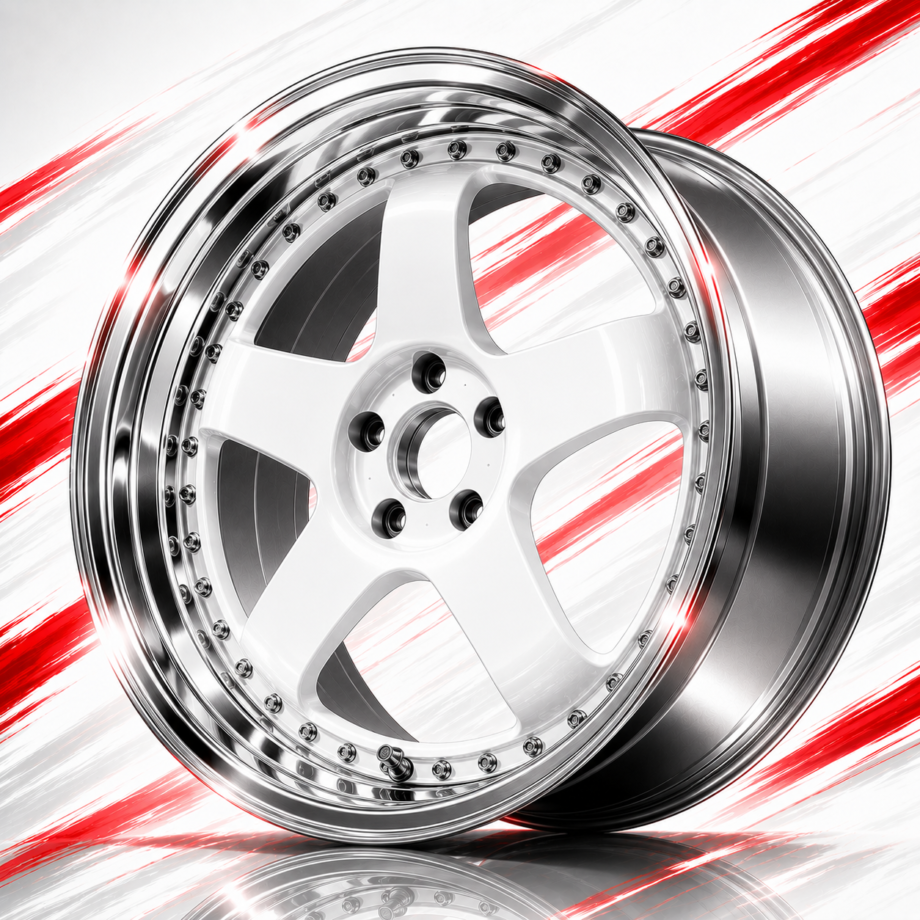
The Equip test is the best one in this whole subject because it requires no expertise, no scale, and no comparison sample. A multi-piece wheel is held together by bolts that pass through it. If the “bolts” are cast lumps on a single piece of aluminium, you are looking at a different object entirely. It is visible in an ordinary photograph.
What WORK Publishes About How Its Wheels Are Made
This matters for authentication because it tells you what a genuine wheel should look like on the inside.
WORK’s own technology page describes four production methods: low-pressure casting, gravity die-casting, die forging, and solid forging — the last reserved for flagship models and the full-custom SION line.
It also describes something more specific: WORK manufactures rim barrels from a single flat disc, a process it says many competitors abandon and on which it holds patents. Assembly is by hand using piercing bolts, torque-controlled by machine.
On testing, WORK claims a regime beyond the VIA and JAWA baseline — rotating bending fatigue, radial load durability, impact, plus a self-imposed vertical impact test — with random spot-testing of production. Whether every claim holds we cannot audit, but it tells you what the company thinks its standard is.
Every wheel gets a minimum seven-point manual visual inspection plus machine runout, appearance, balance and function tests.
The Checks, in Order of Usefulness
1. Count the pieces. On any Equip or Meister, this settles most cases.
2. Look for the bolts and rivets. Real hardware, correct count, and on the S1R the small W stamp on each rivet.
3. Find MADE IN JAPAN and check it is engraved. Cast or stamped into the metal, not painted and not a sticker. Ours is cast.
4. Find the size and serial on the barrel. On our Meister S1R the full specification is pin-stamped into the barrel — model code, size, offset, PCD, colour code. Faint, and easy to miss on a dirty wheel.
5. Weigh it and compare to WORK’s published figure. Useful for large discrepancies, unreliable for small ones.
6. Look at stamp and casting quality. Blurred, shallow or misaligned lettering is a common report.
7. Check the valve hardware and general finish. Wrong valve stems come up repeatedly in owner reports.
One Thing We Learned From Our Own Wheels
When we photographed our VS-KF set, all four carried the same serial. It was tempting to conclude that matching serials across a set is an authenticity test.
Then we photographed a Meister S1R set and the serials were different on each wheel.
So that test does not work, and we retracted it. We mention it here because it is the kind of plausible-sounding check that circulates on forums and would have cost somebody a good set of wheels.
What We Could Not Verify
- What
SCFmeans. It is cast into the back of the spokes on our own WORK wheels, next to the///WORKlogo. We could not find a definition on WORK’s site, at any retailer, or on any forum, in English or Japanese. If you know, tell us. - Whether WORK operates any serial registration or lookup scheme. We found none. A dealer-only system may exist; we cannot confirm or rule it out.
- A distinctive tell for the VS series or Emotion. Both are widely discussed as faked; neither yielded a single clean check.
Related Guides
- How to read the markings on a WORK wheel — two sets from our own stock, photographed mark by mark
- How to spot a fake JDM wheel — what JWL and VIA actually prove
- WORK Wheels brand profile
- BBS RS: real, replica or counterfeit
If You Are Looking at a Set Right Now
Send us the photographs. WORK is the largest single line in our stock and we handle these wheels constantly. We would rather tell you to walk away than watch you buy badly. The Request page reaches us.