
Introduction
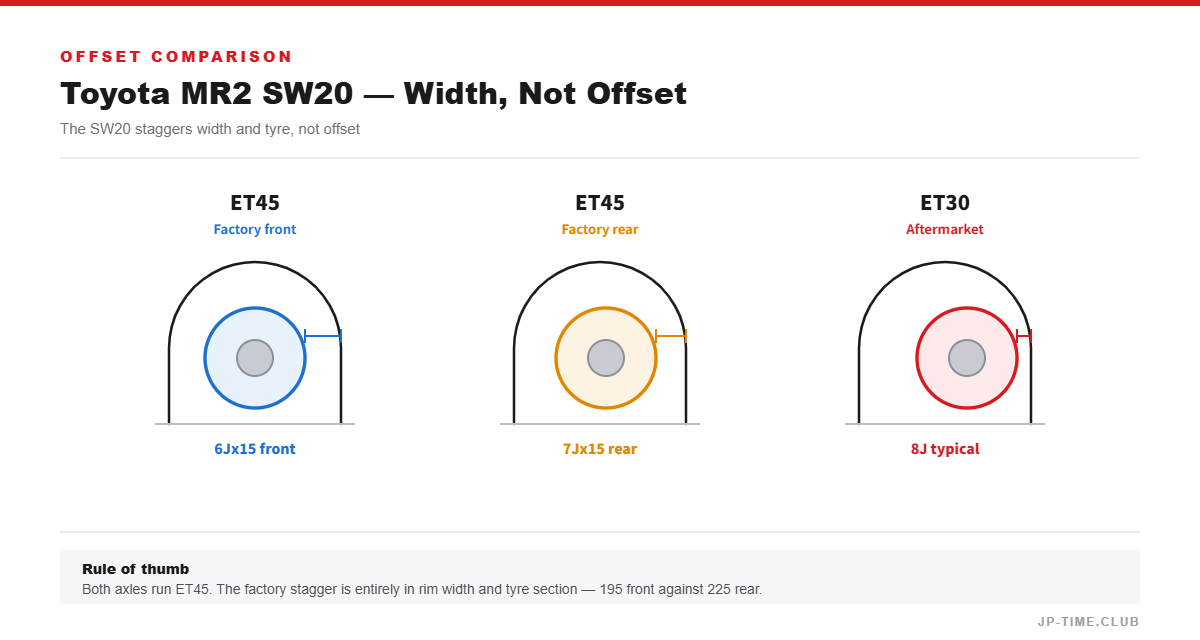
The SW20 is mid-engined, so it carries most of its weight over the rear axle and runs a substantial rear tyre to match. What it does not do is change the offset to achieve that. Both axles sit at ET45; the entire factory stagger is in rim width and tyre section. That makes the SW20 unusually easy to shop for — as long as you buy the right width for each end.
Section 1: OEM Wheel Specifications
Every SW20 uses 5×114.3 with a 60.1 mm hub bore and M12 x 1.5 lug nuts — the standard Toyota combination also found on the Supra A70 and A80, the LS430 and the GS.
| Variant | Years | Front Wheel | Rear Wheel | Front Tyre | Rear Tyre | Hub Bore |
|---|---|---|---|---|---|---|
| 2.0 / 2.0 Turbo (14-inch) | 1989–2000 | 6Jx14 ET45 | 7Jx14 ET45 | 195/60R14 | 205/60R14 | 60.1 mm |
| 2.0 / 2.0 Turbo (15-inch) | 1989–2000 | 6Jx15 ET45 | 7Jx15 ET45 | 195/55R15 | 225/50R15 | 60.1 mm |
| 2.2 (US) | 1989–2000 | 6Jx14 ET45 | 7Jx14 ET45 | 195/60R14 | 205/60R14 | 60.1 mm |
Look at the 15-inch tyre pairing: 195/55 front against 225/50 rear. That is a 30 mm section difference on rims only 1J apart. The MR2 achieves its rear grip through tyre width rather than by pushing the wheel outboard, which is why the offset stays constant.
What the shared Toyota hub means
The 5×114.3 / 60.1 mm combination is common across Toyota and Lexus of this era. In practice that gives the SW20 access to a wide pool of used JDM wheels — but the SW20’s rim widths (6J and 7J) are far narrower than what a Supra or LS430 wore, so most of that pool is the wrong size even when it is the right fitment.
Section 2: Recommended Fitment Ranges
Factory-Faithful
Verified OEM: ET43–47 at both axles, 6J front and 7J rear.
- 14-inch and 15-inch were both factory fitments depending on market and year
- Keep the width stagger. A square set removes the rear grip advantage the car was designed around
Aftermarket Fitment
- Common range: ET30 to ET45 on 7J–8J front and 8J–9J rear
- Mid-engine weight distribution punishes mistakes. Changing the front-to-rear tyre balance on this chassis alters handling more than it would on a front-engined car — this is not purely a styling decision
- These are scene norms, not manufacturer specifications. Measure your own car
Instagram Search Keywords
Post counts verified July 2026:
Chassis Tags:
- #SW20 (249K)      #MR2SW20 (29K)
- #ToyotaMR2 (216K) #MR2Turbo (74K)

Wheel Brand Tags:
- #WORKWheels (1.9M)  #RAYSWheels (776K)
- #BBSWheels (1.1M)
Section 3: Selection Tips and Cautions
- Same offset, different widths. Front and rear wheels are still not interchangeable
- 60.1 mm hub bore — shared with Supra A70/A80, LS430 and GS. Many aftermarket wheels are bored larger and need rings
- M12 x 1.5 lug nuts. Toyota pitch, not the Nissan M12 x 1.25
- Respect the tyre stagger. The rear runs a much wider section for a reason
- Period 14 and 15-inch wheels in 6J and 7J are getting scarce — narrower widths are less commonly reproduced than 8J and up
Fitment verification checklist:
- ✓ Confirm ET45 unless deliberately changing stance
- ✓ Confirm front and rear widths separately
- ✓ Confirm 60.1 mm bore or correct hub rings
- ✓ Confirm M12 x 1.5 lug nuts
- ✓ Keep front-to-rear tyre balance in mind on a mid-engined car
Conclusion
The SW20 is one of the simplest cars in this series to specify: one offset, two widths, one hub bore shared with half of Toyota’s range. The difficulty is not fitment but supply — the narrow rim widths it needs are the ones the aftermarket has largely stopped making.
Looking for period JDM wheels in narrow widths? Submit a Request and we will search our networks in Japan for the size and offset you need.
Seen on the road
Which wheels are you looking for? Tell us the wheel, the size and the fitment — send us a request and we will go and find it.
Wheel identification is taken from the hashtags the owner applied to their own post.
Related Fitment Guides
- Toyota Supra — the same Toyota 5×114.3 / 60.1 mm
- Toyota Celica — a Toyota that is NOT 5×114.3
- Mazda MX-5 / Miata — the lightweight comparison
- Honda / Acura NSX — the other Japanese mid-engined car
Every guide in this series is built the same way: verified factory specifications, an offset diagram, and an honest account of what fits and what does not.