Almost every English-language page about SSR wheels will tell you the letters stand for “Speed Star Racing.” Almost none of them tell you that Speed Star Racing was a real racing team, that it won its first race, or that the company behind it went under in 2005 and the brand you can buy today belongs to a suspension manufacturer.
All of that is in the public record in Japanese. Here is what it says.
The Short Version
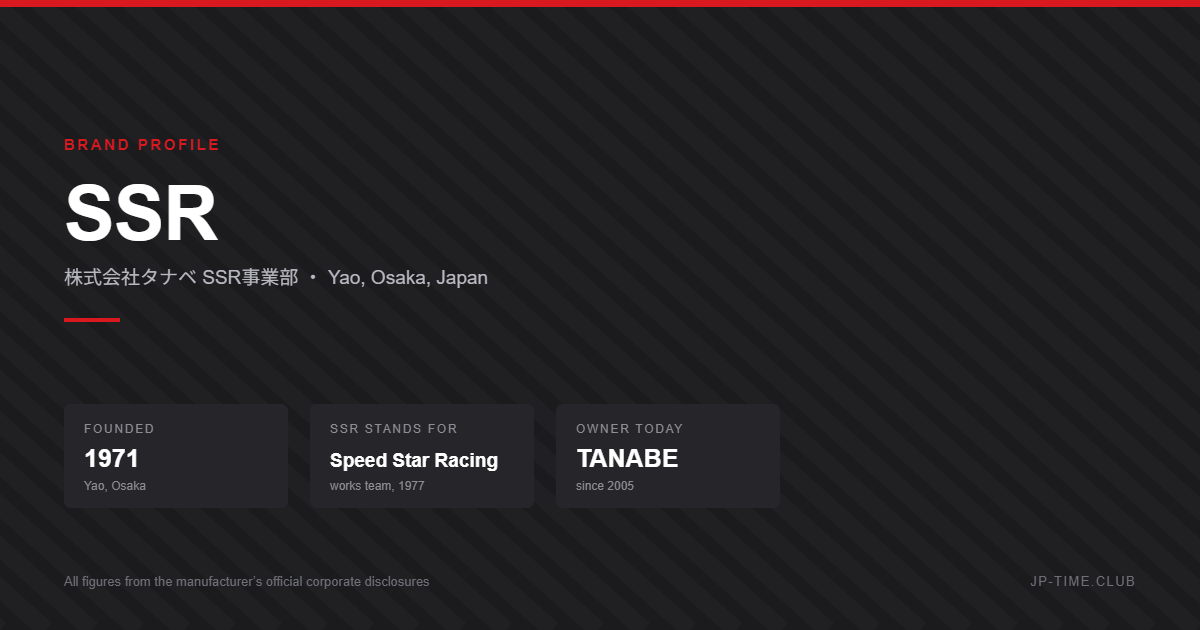
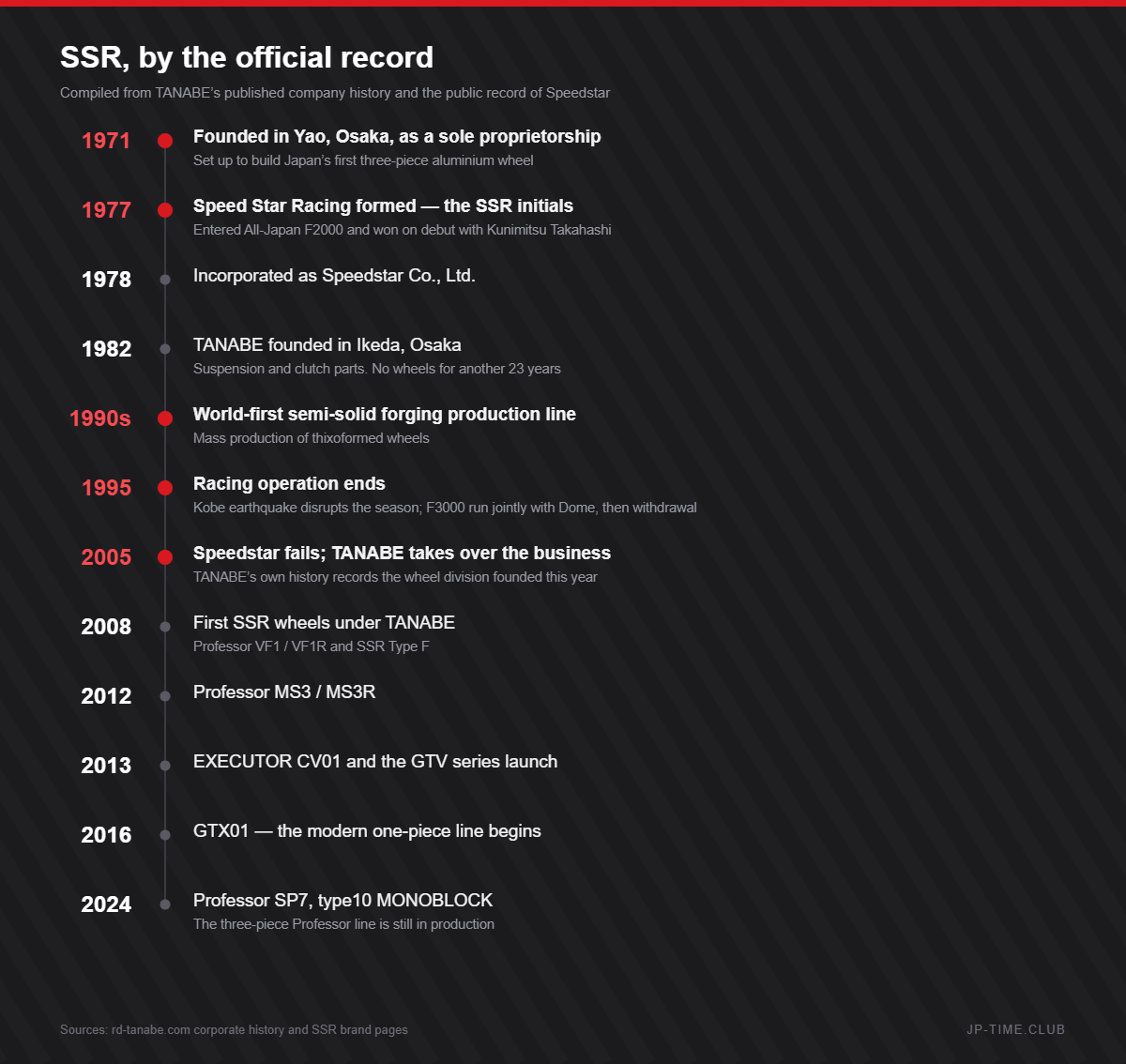
- SSR started in 1971 in Yao, Osaka, as a one-man business set up to build what is credited as Japan’s first three-piece aluminium wheel.
- SSR is the abbreviation of a works racing team — Speed Star Racing, formed in 1977 to contest All-Japan F2000 on the company’s own wheels.
- The racing stopped in 1995. The 1995 Kobe earthquake disrupted the season; the team ran jointly with Dome, then withdrew for good.
- The company failed in 2005. Its business was taken over by TANABE, an Osaka suspension and exhaust manufacturer that had never built a wheel.
- Twenty years later the brand is still in production at the Yao plant, and TANABE still lists disc and rim replacement for three-piece SSR wheels.
The Letters Are a Race Team
In 1977 the company formed the Speed Star Wheel Racing Team, abbreviated SSR, and entered the All-Japan F2000 championship — the top single-seater series in Japan at the time, which later became All-Japan F2 and then F3000. The driver was Kunimitsu Takahashi, and the record says the car won on its debut, on the company’s own aluminium wheels.
That is the whole marketing strategy of the 1970s Japanese wheel industry in one sentence. You did not advertise a wheel; you entered a championship on it and let people watch.
The team went on through F2 and F3000 and the Fuji Grand Champion series. It ended in 1995: the Great Hanshin earthquake in January of that year put the season in doubt, the team ran in partnership with Dome, and at the end of the year SSR withdrew from racing altogether. Dome continued alone.
So the letters on your wheel are not a slogan. They are the name of a team that stopped existing thirty years ago, and they have stayed on the product ever since.
Japan’s First Three-Piece Wheel
The company was founded in 1971 specifically to manufacture and sell a three-piece aluminium wheel — a design credited as the first of its kind in Japan. It incorporated as Speedstar Co., Ltd. in 1978.
That matters for two reasons. It puts SSR at the origin of the format that WORK, RAYS and half the Japanese aftermarket later built businesses on. And it explains why so much of SSR’s current catalogue is still three-piece when most manufacturers have drifted to one-piece: Professor, Formula, MINERVA and the SPEED STAR MK series are all multi-piece designs.
The other technical claim in the record is that in the 1990s the company completed the world’s first mass-production line using semi-solid forging — forming aluminium in a state between liquid and solid, which is a genuinely awkward process to industrialise. We have not been able to confirm the “world first” part from a primary source, and we flag it below.
2005: The Company Failed. The Brand Did Not.
In 2005 Speedstar’s business was taken over by TANABE. TANABE’s own corporate history records the year plainly, as a one-line entry among that year’s product launches: Speedstar Wheel Division established.
What makes this unusual is who the buyer was. TANABE was founded in January 1982 in Ikeda, Osaka, with two million yen of capital, selling uprated suspension, metal clutch discs and flywheels. Its history for the next twenty-three years is a list of dampers, exhausts, strut braces and stabiliser bars — SUSTEC suspension, medalion exhausts. There is not a single wheel in it before 2005.
Then a wheel manufacturer with a thirty-year racing history became available, and a suspension company bought it. The first SSR wheels released under TANABE arrived in 2008: the Professor VF1 / VF1R and the SSR Type F.
What TANABE Actually Is
Worth knowing, because it is the company standing behind the warranty on a wheel you buy today.
| Founded | January 1982, Ikeda, Osaka |
| Head office | Onohara-Higashi, Minoh City, Osaka |
| Capital | ¥60 million |
| Shiga plant | Yasu City, Shiga — suspension and springs, ISO 9001 since 1999 |
| Yao plant | Yao City, Osaka — wheels. The same city Speedstar was based in |
| Overseas | TANABE Racing Development USA, Torrance, California, since 2003 |
| Motorsport | Continuous since 1982: N1, JTCC, Super Formula, Super GT. Supplier to Super GT and Formula Nippon from 2006 |
Two details from TANABE’s sustainability disclosures are more informative than most marketing copy. The company uses powder coating rather than liquid paint on the basis that it emits no volatile organic compounds. And it reports a 96% permanent-employee ratio — an unusual thing to publish, and a reasonable proxy for whether the people finishing your wheels have been doing it for years.
The Repair Question, and Why It Is the Best Reason to Buy SSR
Buried in TANABE’s environmental disclosures is the single most useful sentence for a used buyer. Describing waste reduction, the company states that when an SSR three-piece wheel is damaged — stone chips, kerb damage, deformation — it supports repair by replacing only the damaged part: disc replacement or rim replacement, rather than requiring a new wheel. It presents this as both a cost advantage to the owner and a resource-efficiency measure.
That is a manufacturer confirming, in writing, that the parts exist and the service is offered. For anyone buying a twenty-year-old three-piece wheel from Japan, that is worth more than any performance claim. A kerbed one-piece wheel is a repair problem. A kerbed three-piece SSR is a parts problem.
The Model Families
SSR’s current catalogue is unusually broad, and the names are not obviously related to each other. From TANABE’s own brand lineup:
| Family | Construction | Examples |
|---|---|---|
| Professor | Three-piece | MS1 / MS1R, MS3 / MS3R, SP1–SP7, TF1, MESH, SPX |
| Formula | Three-piece | MESH, MESH HC, AERO MESH, AERO SPOKE |
| EXECUTOR | Two- and three-piece | CV01–CV07, EX07, RC06 |
| REINER | Two-piece and monoblock | type6 / type7 / type10 / type12, M10 |
| GT (GTX / GTV) | One-piece, cast and forged | GTX01–GTX05, GTV01–GTV06 |
| DEVIDE | SUV, van and off-road | SP1 Trail, MK-6, X03J, ZS, G:M |
| SPEED STAR | Three-piece, the original line | MK-I, MK-II, MK-III, FL-II |
| MINERVA / ABELA / Blikker | Three- and two-piece | MINERVA, TW10R, 01F / 01M |
The SPEED STAR MK series is the interesting one. Those are the original designs, still catalogued, still sold — described by the manufacturer as the wheels that keep shining alongside old cars. If you are building a period-correct 1970s or 1980s Japanese car, that line was never discontinued.
What This Means When You Are Buying
Pre-2005 and post-2005 SSR are the same brand under different owners. A Professor MS1 from the Speedstar era and a Professor SP7 from last year come from the same lineage and, as far as the public record shows, the same city. But they were made by legally different companies, and warranty or parts questions on very old stock are a matter for TANABE, not for a company that no longer exists.
Three-piece is the point of this brand. If you are choosing between an SSR one-piece and a three-piece at similar money, the three-piece is the one you can still get parts for. That is the manufacturer’s own stated position, not ours.
Check what “SSR” is being sold to you. The catalogue runs from forged three-piece Professors to cast SUV wheels. The badge is the same. The product is not.
JAWA matters here. TANABE links JAWA — the Japan Light Alloy Wheel Association — directly from the SSR site and runs an inspection campaign under it. On a used SSR, the JWL and VIA marks and any surviving JAWA label are worth photographing before you commit.
What We Could Not Verify
- The exact circumstances of the 2005 failure. TANABE’s history records only that the wheel division was established in 2005. Secondary Japanese sources state that Speedstar went bankrupt in January 2005 and that TANABE acquired the business that October. We could not find a primary document confirming those dates.
- The founder’s name. Secondary sources give it, but with inconsistent characters between them, so we have not printed it.
- “Japan’s first three-piece aluminium wheel” and “world’s first semi-solid forging production line.” Both appear in the Japanese-language record of the company. Neither is stated on TANABE’s current site, and we found no independent confirmation.
- The 1977 debut win. The record says the Speed Star Racing car won its first All-Japan F2000 race with Kunimitsu Takahashi. We could not confirm it against a race result.
- Which models are made where. TANABE lists a wheel plant in Yao and publishes an equipment list, but does not publish a model-by-model production-location table.
- What happened to the Vienna and WERFEN brands. Both appear in TANABE’s history and in older brand lists but not in the current lineup. We do not know whether they were discontinued or absorbed.
FAQ
What does SSR stand for?
Speed Star Racing — the company’s works racing team, formed in 1977 to contest All-Japan F2000 on its own wheels. The team stopped racing in 1995; the initials stayed on the product.
Is SSR still in business?
Yes, as the SSR wheel division of TANABE Co., Ltd. of Osaka. The original company, Speedstar Co., Ltd., ceased to exist in 2005.
Are SSR wheels made in Japan?
TANABE operates a wheel plant in Yao City, Osaka. It does not publish a model-by-model production-location list, so the reliable check on any individual wheel is the country of manufacture cast into it.
Can a damaged SSR three-piece wheel be repaired?
TANABE states that its three-piece SSR wheels support replacement of the damaged part — disc or rim — rather than replacement of the whole wheel. Availability for a specific twenty-year-old model is a question for a dealer.
What is the difference between Professor and Formula?
Both are three-piece lines. Professor is the light, dress-oriented family — MS, SP and TF series. Formula recreates older designs to modern specification, including the MESH that gives it its name.
Sources
The corporate profile, company history, plant locations, brand lineup, repair policy and manufacturing disclosures in this article are taken from TANABE’s own site at rd-tanabe.com, including the SSR brand pages, read in the original Japanese. The history of Speedstar Co., Ltd. before 2005 — the 1971 founding, the 1977 racing team, the 1995 withdrawal and the semi-solid forging line — is drawn from the Japanese-language public record, and we have marked above the specific claims in it that we could not corroborate.
Related Guides
- WORK Wheels — the neighbouring company that took the opposite approach
- RAYS — 5×114.3 / 66.1 mm, the classic TE37 application
- Toyota AE86 — 4×114.3, one of the few modern forged options left for the pattern
- Toyota GR86 & Subaru BRZ — 5×100, and why Toyota wheels do not fit it
- Lancer Evolution IV–IX — 5×114.3 / 67.1 mm
Looking for a specific set? We specialise in genuine Japanese wheels — RAYS, Volk, Enkei, SSR, WORK, BBS Japan and the rare discontinued sets that never left the country. Tell us the wheel, the fitment, the year — our team searches our networks until we find it.