
The Short Version
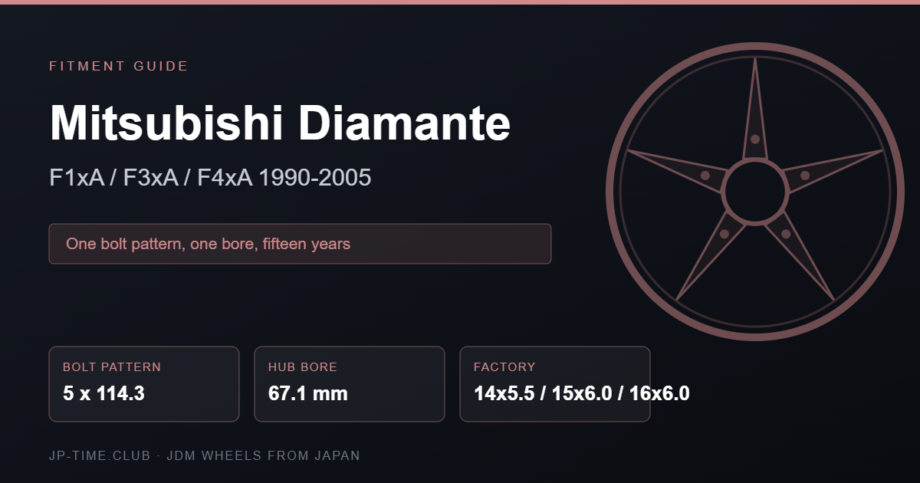
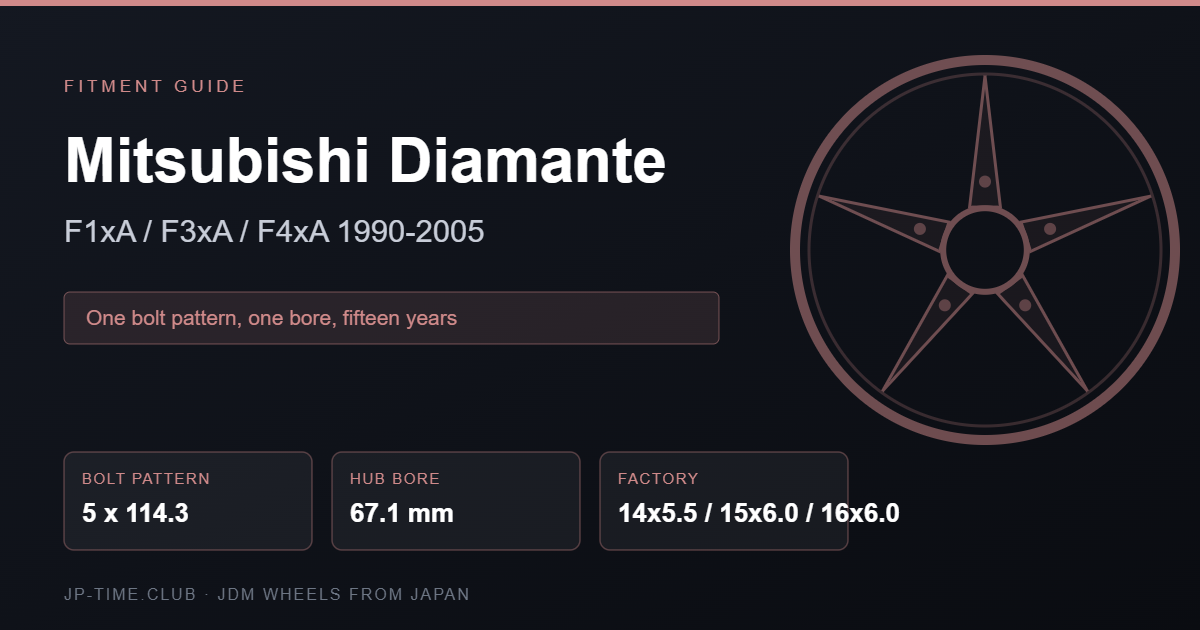
- 5×114.3 with a 67 mm hub bore, unchanged from 1990 to 2005. Two full generations, four facelifts, front-wheel drive and four-wheel drive, and not one change to either number.
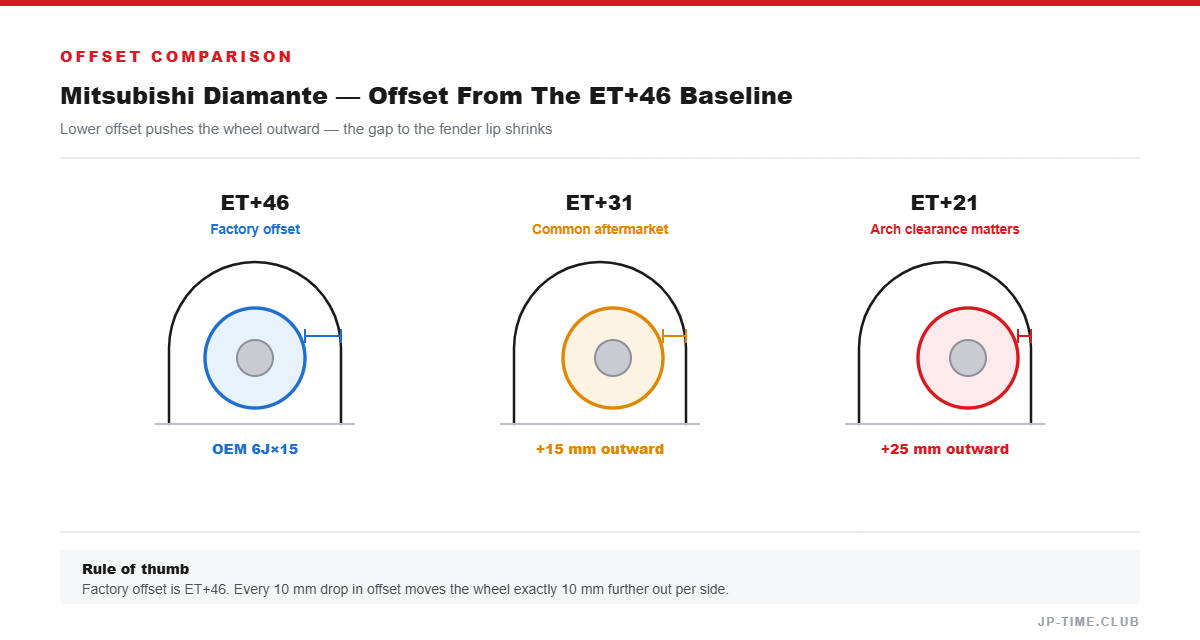
- Factory offset is +46 on every grade in the Japanese table. Not +45 — +46.
- Wheel size tracks the grade: 14×5.5 on the base 20E/25E, 15×6.0 on the V and R grades, 16×6.0 on the later SE cars.
- The Australian Magna / Verada connection only holds from 1996. Earlier Australian cars are a different lineage — do not assume shared fitment.
A Genuinely Boring Bolt Pattern, Which Is Good News
Most of our fitment guides exist because something changed mid-model and buyers get caught out. The Diamante is the opposite case, and it is worth publishing precisely for that reason: there is nothing to catch you out. From the May 1990 launch of the F1xA to the end of production in December 2005, every Diamante in the Japanese factory wheel database carries 114.3 in the PCD column, 5 in the hole count, and 67 in the bore column.
That includes the 4WD grades (E-F25A and E-F27A), which on a lot of Japanese cars of the era are exactly where a bolt pattern or bore quietly diverges from the front-drive cars. Here they do not. The same wheel bolts to a 1990 20E and a 2005 25V-SE.
We can also confirm the 67 mm bore from a second, independent direction: the hub-ring matching table published by a Japanese wheel-hardware maker lists the Diamante in its 67 mm group. When the factory table and the hardware maker’s own fitment chart agree, the number is solid.
Factory Specification by Generation
| Generation | Chassis | Years | Grades | Factory wheel | PCD / Holes / Bore |
|---|---|---|---|---|---|
| 1st (F1xA) | E-F11A / F13A | 1990.05–1994.08 | 20E, 25E (2WD) | 14×5.5 +46 | 114.3 / 5 / 67 |
| 1st (F1xA) | E-F15A / F17A | 1990.05–1993.11 | 25V, 30R (2WD) | 15×6.0 +46 | 114.3 / 5 / 67 |
| 1st (F2xA) | E-F25A / F27A | 1990.05–1994.06 | 25V, 30R (4WD) | 15×6.0 +46 | 114.3 / 5 / 67 |
| 2nd | E-F31A / F36A | 1995.01–1997.08 | 25E, 25V, 30M, 30R | 15×6.0 +46 (16×6.0 SE) | 114.3 / 5 / 67 |
| 2nd | E-F36A | 1997.08–1999.09 | XE, SE-V, SE-G, SE-R | 15×6.0 +46 (16×6.0 SE) | 114.3 / 5 / 67 |
| 2nd (facelift) | GF/GH-F31A / F36A | 1999.09–2002.10 | 25V, 25V-SE, 30R, 30R-SE | 16×6.0 +46 | 114.3 / 5 / 67 |
| 2nd (final) | LA/ABA-F34A | 2002.10–2005.12 | 25V-SE, Sports | 15×6.0 / 16×6.0 +46 | 114.3 / 5 / 67 |
The +46 Offset, and Why It Matters More Than It Looks
Mitsubishi specified +46 rather than the +45 that most of the industry rounds to. One millimetre is not a handling issue and nobody will feel it. It matters for a different reason: when you search an aftermarket catalogue for “Diamante” and every result comes back at +45 or +50, you now know that +45 is one millimetre from factory and +50 is four millimetres inboard of it. Both are usable. Anything below about +38 starts to change how the front tyre sits relative to the strut and the arch liner.
For upsizing, the 16×6.0 factory fitment on the later cars is narrow by modern standards and the arches take a 17×7 to 17×7.5 in the +40 to +48 range comfortably. Because the factory bore is 67 mm and Japanese aftermarket wheels are typically bored larger, budget for 67 mm hub-centric rings as part of the purchase.
Magna, Verada and the Australian Question
Australian readers ask this constantly, so here is the careful answer. The relationship between the JDM Diamante and the Australian Magna / Verada is generation-specific, not universal.
The second-generation Australian Magna and Verada (TE series, from 1996) were developed from the second-generation JDM Diamante, and that car was in turn exported to the United States as the Diamante. From that point the platform is genuinely shared and the 5×114.3 / 67 mm fitment applies.
The first-generation Australian Magna (TR / TS, 1991–1996) is not a Diamante. It descends from the Sigma line and is a different car underneath. We have not verified its bolt pattern or bore from a primary source and we are not going to guess at it here. If you have a TR or TS Magna, measure the hub before ordering Diamante wheels.
Importing to the United States
Mitsubishi sold the Diamante new in the US, so the nameplate is familiar and parts support exists. For importing a JDM car, the whole first generation and most of the second are past the 25-year mark. The final F34A cars, built from October 2002 to December 2005, become eligible on a rolling basis from late 2027 through to the end of 2030.
The JDM cars worth importing are generally the ones the US never got: the first-generation four-door hardtop with the pillarless body, and the 30R with the 3.0 V6. Those are all comfortably eligible now.
What We Could Not Verify
- Factory tyre sizes per grade. The wheel table we used does not carry tyre data.
- Bolt pattern and hub bore of the first-generation Australian Magna (TR / TS). Flagged as unverified and likely different, since that car is not Diamante-derived.
- Whether the wagon body styles carry any load-rating requirement that changes the practical wheel choice, as distinct from the fitment itself.