The Short Version
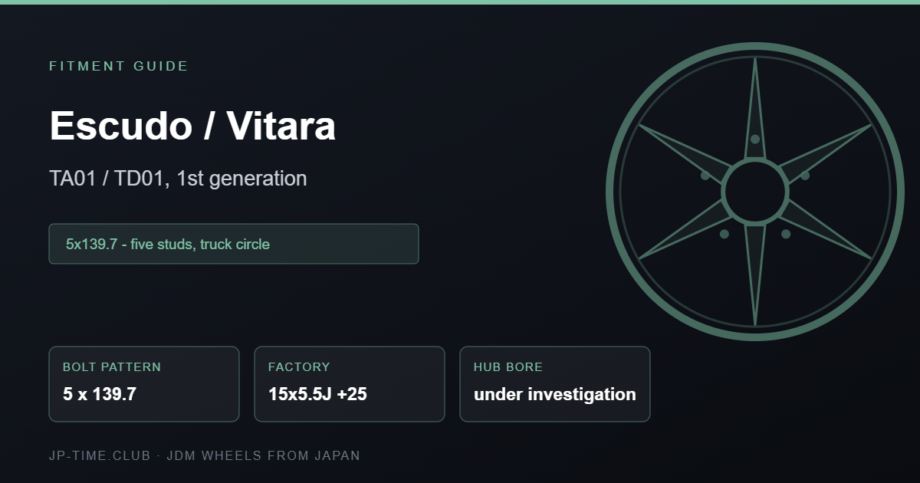
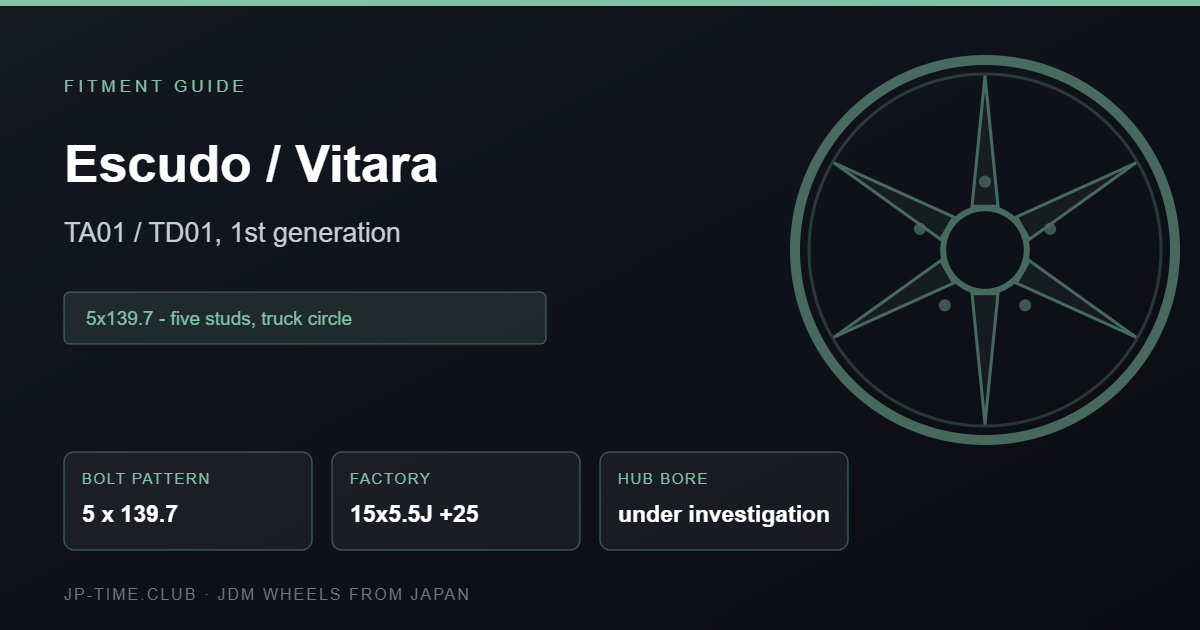
- 5×139.7. Five studs on the truck bolt circle — an unusual combination, and it is right.
- 15×5.5J at +25 on 195SR15, unchanged from the first 1989 cars to the 1993 Nomad.
- Both Japanese databases mark the hub bore “under investigation”, on grades five years apart.
- We could not establish whether there is a hub register at all. That question stays open, and we explain why below.
Five Studs, Truck Circle
139.7 mm is the light-truck bolt circle — the Hilux Surf, the Pajero and the Bighorn all use it. But those are six-stud vehicles.
The first-generation Escudo is five studs on the same 139.7 circle. That is a genuinely uncommon combination and it is the thing to get right before shopping: a 6×139.7 wheel from any of those larger vehicles will not fit, and neither will a 5×114.3 passenger-car wheel.
We confirmed it on two separate grades from two separate databases — the very first January 1989 G-Limited and a 1993 Nomad — and both give the same wheel too: 15×5.5J at +25 on 195SR15. Suzuki appears to have held that specification across the whole run.
Factory Specification
| Chassis | Period | Grade | Wheel | Tyre | PCD / Holes / Bore |
|---|---|---|---|---|---|
| E-TA01W | 1989.01–1990.02 | 4WD 3-door G-Limited hardtop 3AT | 15×5.5J +25 | 195SR15 | 139.7 / 5 / under investigation |
| E-TD01W | 1993.10–1994.12 | 4WD 5-door Nomad 5MT | 15×5.5J +25 | 195SR15 | 139.7 / 5 / under investigation |
| CBA-TD54W (3rd gen, for contrast) | 2005 on | XG | 16×7J +40 | 235/70 | 114.3 / 5 / not published |
Note the last row. By the third generation the Escudo had moved to 5×114.3 — a passenger-car pattern. That is a real change, and it means a modern Escudo and a first-generation one share nothing. Where exactly it happened, we could not establish: the second generation (1998–2005) is not in the sources we checked.
Is There a Hub Register? We Do Not Know
Our own backlog carried a warning that some Suzuki vehicles have no hub boss at all — that the wheel locates entirely on the tapered nuts, the way the classic Hakosuka fitments do. If that were true of the Escudo it would explain a lot.
We could not confirm it. Here is exactly what we found: both Japanese databases print their “under investigation” marker in the hub bore cell, on two grades five years apart, independently of each other. That marker means the compiler has not researched the figure. It does not mean the figure is zero.
We also searched Japanese-language sources for any statement that the Escudo is hub-less or nut-centred and found nothing on topic.
So the honest position is: two independent databases have declined to publish this number across a five-year span, which is suggestive, and no source says the car has no register. If you own one, put a caliper on the hub and tell us what you find. That single measurement would settle it.
The Badge Variants
North America got this car as the Geo Tracker, later the Chevrolet Tracker, and as the Suzuki Sidekick and Vitara. Australia and much of Europe got it as the Vitara.
Those are export badges and the Japanese databases do not carry them, so we have not verified whether their wheel specification matches the JDM Escudo. The platform is the same. The spec is unverified. If you have a Tracker, count the studs before assuming.
Sizing
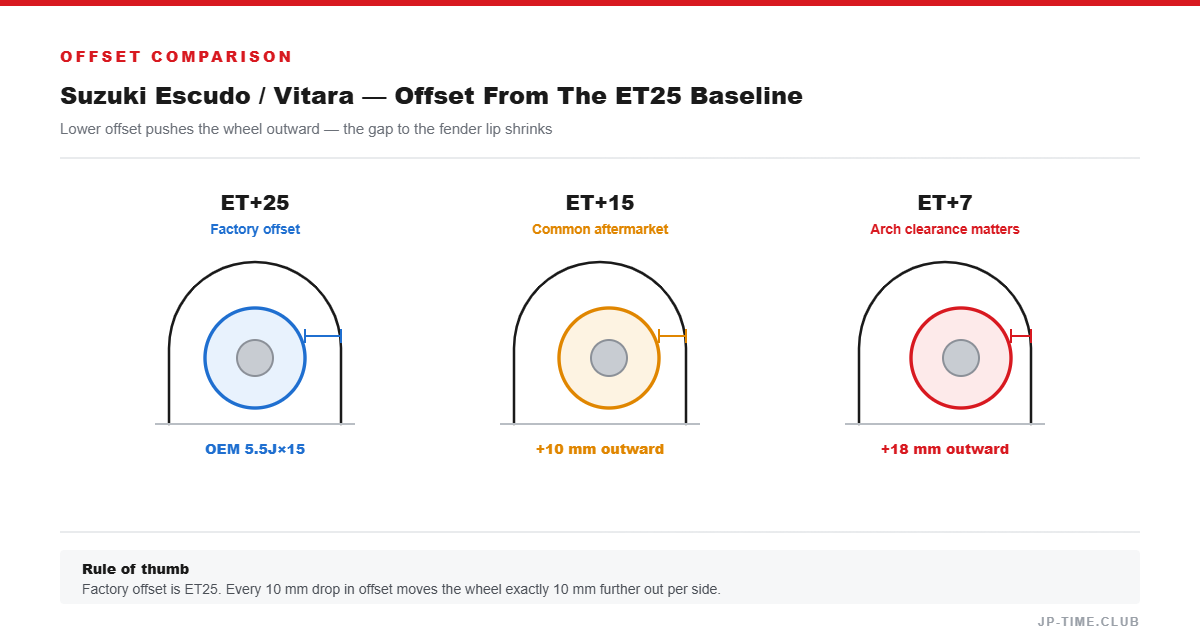
15×5.5J at +25 is narrow and fairly deep for a small 4×4. The common move is 15×7J or 16×7J in the 0 to +25 range, often with a lift.
Because 5×139.7 is a small market, wheel choice is the real constraint here rather than offset. Plan the wheel first and the tyre second.
Importing
The first-generation Escudo ran 1988 to 1997, so the whole generation is past the US 25-year mark. The US had the Tracker and the Sidekick locally throughout, so a JDM Escudo is an unusual import rather than a necessary one — the reasons to bring one in are the diesel and the JDM-only grades.
What We Could Not Verify
- Hub bore, or whether one exists. Both databases explicitly mark it unresearched. No source states the car is nut-centred.
- The second-generation Escudo (1998–2005), which is absent from the sources we checked — so the exact point of the 139.7-to-114.3 changeover is unestablished.
- Whether Geo, Chevrolet and Suzuki export badge variants share the JDM specification.