
The Short Version
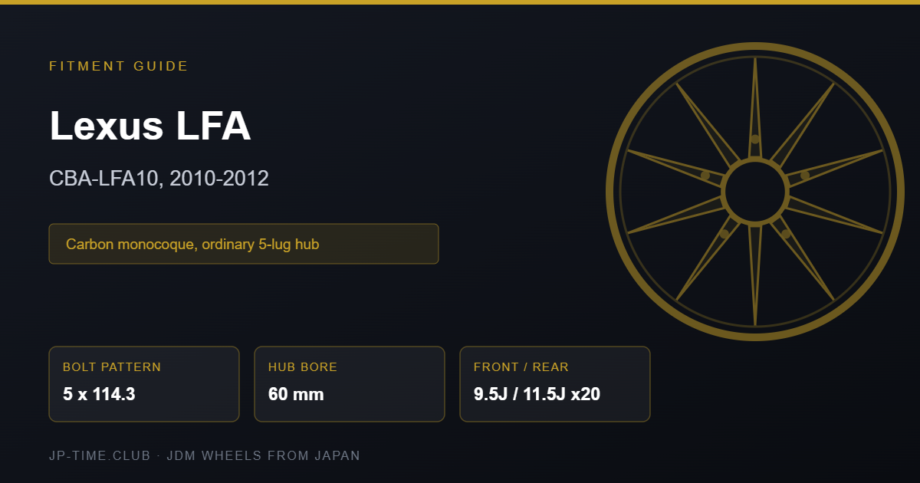
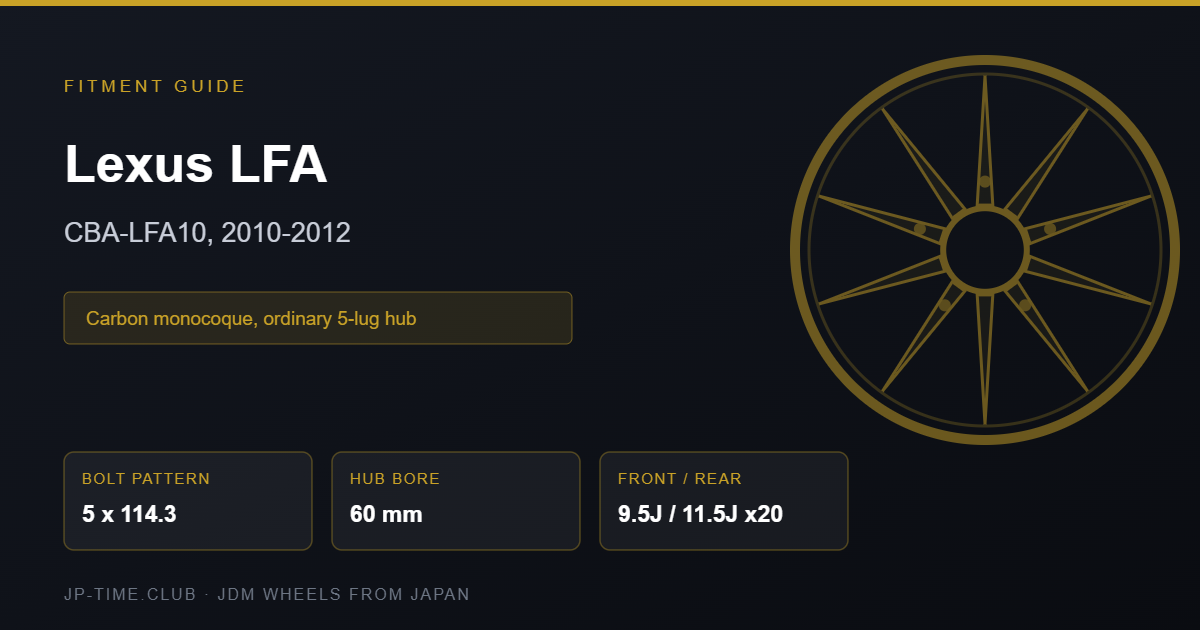
- 5×114.3 with a 60 mm hub bore. A completely ordinary Lexus fitment.
- It is not centre-lock. The carbon monocoque and the forged wheels do not extend to an exotic hub — it is five studs, like an IS or a GS.
- Front 9.5J×20 at +45 on 265/35R20. Rear 11.5J×20 at +45 on 305/30R20.
- The international fitment databases leave this car blank, which is why it has a reputation for being unlisted. The Japanese factory table has it in full.
We Had This Car Blocked. It Should Not Have Been.
The LFA sat in our backlog for months marked unverified, on the reasoning that the international fitment database leaves every field empty for it and it is absent from the main Japanese hub-ring tables. We assumed the carbon-fibre monocoque might mean something unusual at the hub.
It does not. The Japanese factory wheel database carries the LFA in full, and we opened the page ourselves: PCD 114.3 mm, 5 holes, hub bore 60 mm. Front 20×9.5J, rear 20×11.5J, both at +45, on 265/35R20 and 305/30R20.
That is the same bolt pattern and the same register as a great many other Toyota and Lexus rear-drive cars. The LFA’s wheels are special — forged, and made to a specification you will not find elsewhere — but the way they attach to the car is not.
Factory Specification
| Chassis | Years | Position | Wheel | Tyre | PCD / Holes / Bore |
|---|---|---|---|---|---|
| CBA-LFA10 | 2010–2012 | Front | 20×9.5J +45 | 265/35R20 | 114.3 / 5 / 60 |
| CBA-LFA10 | 2010–2012 | Rear | 20×11.5J +45 | 305/30R20 | 114.3 / 5 / 60 |
What This Actually Means for an Owner
Almost nothing, in the sense that nobody is putting aftermarket wheels on an LFA. Only 500 were built and they are museum pieces.
It matters in two narrower ways. First, if you are sourcing a replacement — a kerbed rim, a cracked wheel — the fitment is conventional, which widens what a specialist can work with. Second, it settles a persistent question. The LFA is often described as having some special mounting arrangement, and the blank database fields feed that. It does not.
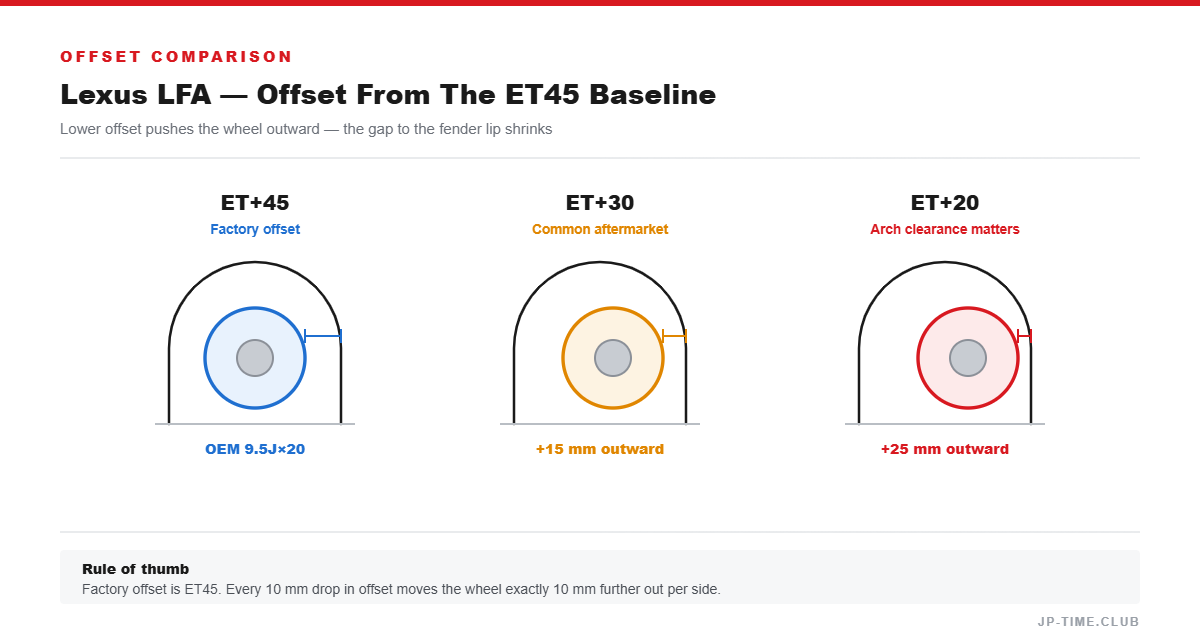
The stagger is worth noting on its own terms: two inches of extra width at the rear, at the same +45 offset, so all of it goes outboard. That is a serious rear-drive setup and it is why the car’s rear arches look the way they do.
Why the International Databases Are Blank
We checked, and the international crowd-sourced database genuinely does leave both the bolt pattern and the centre bore fields empty for the LFA while populating the rim and tyre rows. That is a gap in that database, not a property of the car.
It is a useful illustration of something we run into constantly: the Japanese factory tables and the international aggregators do not have the same coverage, and neither is a superset of the other. For obscure JDM grades the Japanese sources win. For export-market variants they often do not.
Importing
The LFA was built from 2010 to 2012 and was sold new in the United States, so the 25-year rule is not the relevant question — US-market cars are already there. A JDM car would not be eligible until 2035 at the earliest.
What We Could Not Verify
- The Nürburgring Package specification. The database carries only the base grade, and the Nürburgring cars had different aerodynamics and suspension. Whether the wheels differ, we do not know.
- The exact BBS model designation and forging process for the factory wheel, and any published torque figure. We did not access Lexus press archives or BBS’s OEM material in this pass.