The Short Version
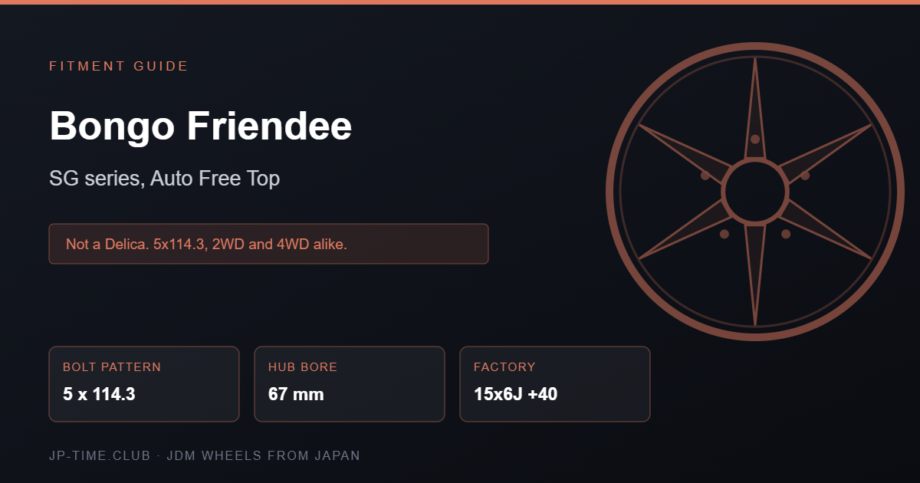
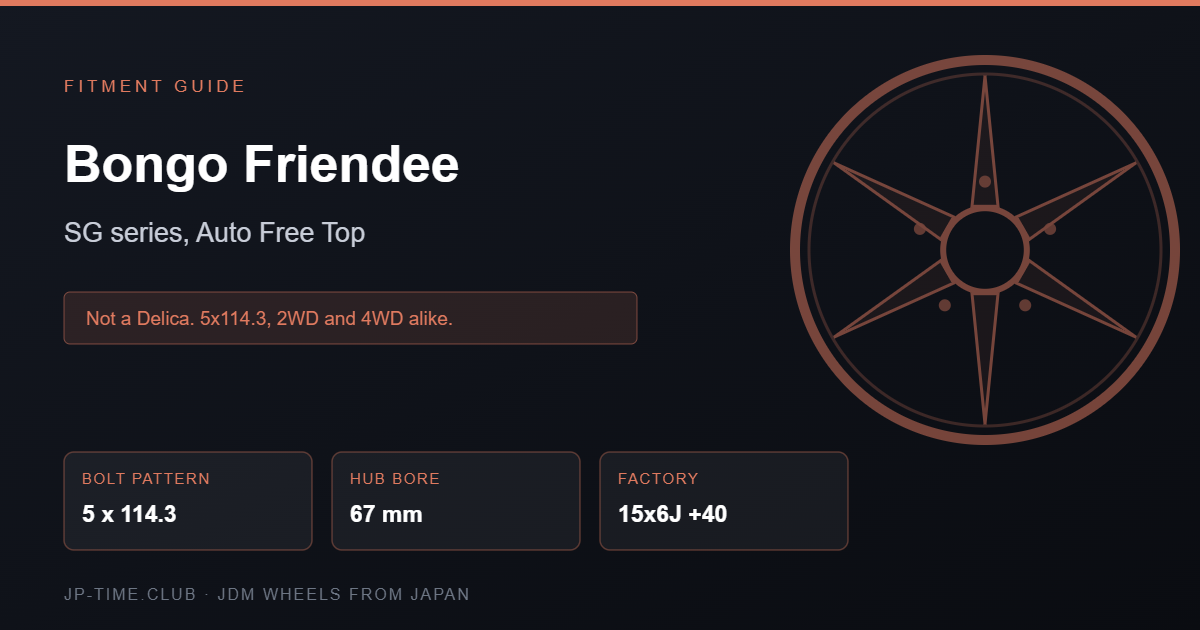
- 5×114.3 with a 67 mm hub bore on the Bongo Friendee, 1995 to 2005.
- 2WD and 4WD are identical. Unlike the Delica, there is no six-stud version.
- The Auto Free Top camper cars are the same fitment as the normal-roof vans.
- Factory: 15×6J at +40, with a staggered tyre — 195/70R15 front, 215/65R15 rear.
Not a Delica
The obvious comparison for a Bongo Friendee is the Delica, and on the Delica the drivetrain decides the hub: two-wheel drive is 5×114.3, four-wheel drive is 6×139.7.
The Bongo does not work that way. Every Friendee grade we checked — two-wheel-drive RS-V, four-wheel-drive RF-S, and the four-wheel-drive RF-V camper with the Auto Free Top — reads 5×114.3 with a 67 mm bore, on 15×6J at +40.
Mazda kept the Bongo on a passenger-van hub throughout. So if you have been assuming your 4WD Friendee needs truck wheels, it does not.
Note also that the hub bore here is a real published number, not an “under investigation” marker. That is worth saying because it is unusual in this corner of the database — the Stagea and the Forester in this same batch both came back unresearched.
Factory Specification
| Model | Chassis | Period | Grade | Wheel | Tyre | PCD / Holes / Bore |
|---|---|---|---|---|---|---|
| Bongo Friendee | E-SGEW | 1995.06–1999.02 | 2WD RS-V 2.0, normal roof | 15×6J +40 | 195/70R15 F, 215/65R15 R | 114.3 / 5 / 67 |
| Bongo Friendee | E-SGE3 | 1995.06–1999.02 | 2WD RS-V 2.0, Auto Free Top | 15×6J +40 | 195/70R15 F, 215/65R15 R | 114.3 / 5 / 67 |
| Bongo Friendee | KH-SGLR | 1999–2001 | 4WD RF-S 2.5, normal roof | 15×6J +40 | 195/70R15 F, 215/65R15 R | 114.3 / 5 / 67 |
| Bongo Friendee | KD-SGL5改 | 2001–2005 | 4WD RF-V camper, Auto Free Top | 15×6J +40 | 195/70R15 F, 215/65R15 R | 114.3 / 5 / 67 |
| Bongo Van (facelift) | ADF-SK82V | 2008.10–2010.07 | 2WD 1.8 low floor | 14×4.5J +50 | 165R14 6PR | 114.3 / 5 / under investigation |
| Bongo Van (facelift) | ADF-SK82M | 2007.08–2008.10 | 4WD 1.8 low floor DX | 14×5J +50 | 185R14 6PR | 114.3 / 5 / under investigation |
The Friendee Is Staggered by Tyre
Easy to overlook. The wheel is the same front and rear — 15×6J at +40 — but the tyre is not: 195/70R15 at the front and 215/65R15 at the rear.
That is a rear-biased setup for a vehicle carrying weight at the back, and it means a set of four identical tyres is not the factory specification. If you are re-tyring a Friendee, check what it left the factory with rather than what is on it now — plenty have been put onto four matching tyres by previous owners.
The Plain Bongo Van Has a Data Gap
We can confirm the 2007 onward facelift Bongo Van at 5×114.3, with 2WD and 4WD again identical — both at +50, differing only in rim width and tyre.
What we cannot confirm is anything earlier. Neither database carries plain Bongo Van data before August 2007. We checked the earliest year band on both and that is where coverage starts. So the 1999–2006 van and everything before it is unverified here.
If you are buying for a pre-2007 Bongo Van rather than a Friendee, measure or ask us.
Sizing a Friendee
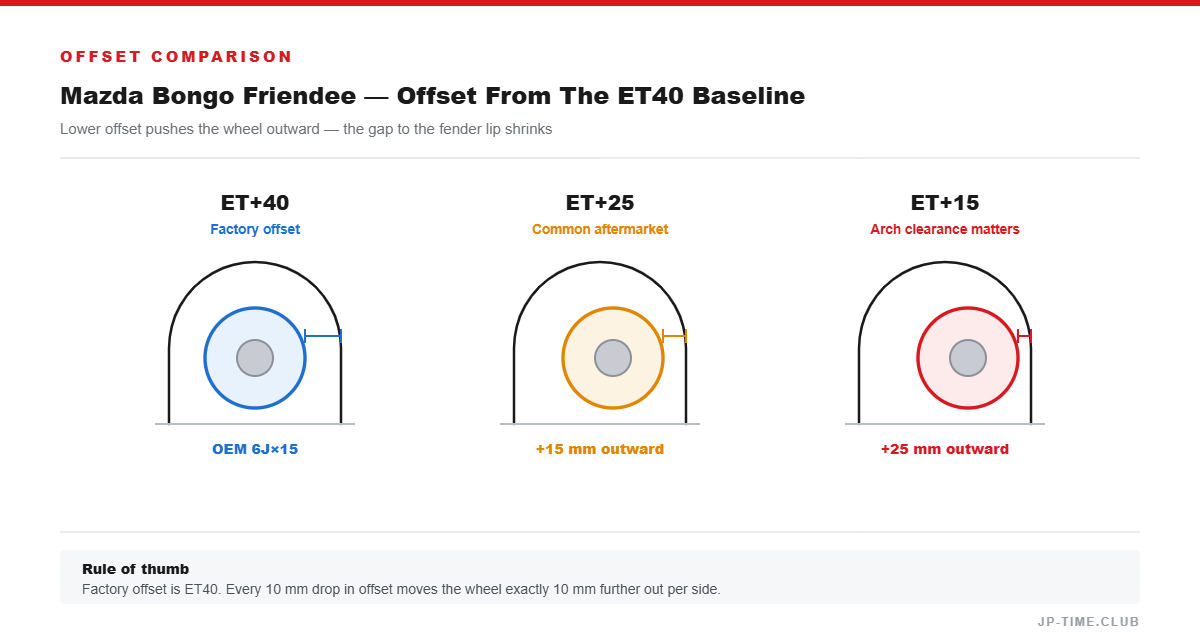
15×6J at +40 is modest, and these vehicles are usually built for camping rather than for looks. The practical window is 15×7J or 16×7J in the +30 to +42 range, with an emphasis on tyre load rating rather than wheel width.
A Friendee with the Auto Free Top and a full camper interior is heavy, and the roof adds weight high up. Our load rating guide covers why a light wheel made for a saloon is the wrong part for this kind of vehicle.
67 mm hub rings will be needed with most aftermarket wheels — the same figure as the 2WD Delica and a great many other Mazdas.
Importing
The Friendee ran 1995–2005. Cars built through August 2001 are eligible for US import now, with the rest following to 2030. The Auto Free Top camper cars from the late 1990s are comfortably in.
The Friendee has become a genuinely popular import in Canada, the UK and New Zealand precisely because of the pop-top — it is a compact camper that fits in a normal parking space.
What We Could Not Verify
- Plain Bongo Van before August 2007. Neither database carries it.
- Hub bore for the 2007-onward Bongo Van, marked “under investigation”.
- Whether the badge-engineered Nissan Vanette and Mitsubishi Delica Van versions share the Mazda specification. Not checked.
- The Bongo Truck, which was outside this pass.