
The Short Version
- The Hiace has two different hubs, and the split is not where you think. It is not H100 versus H200. It is passenger versus commercial, within the H100.
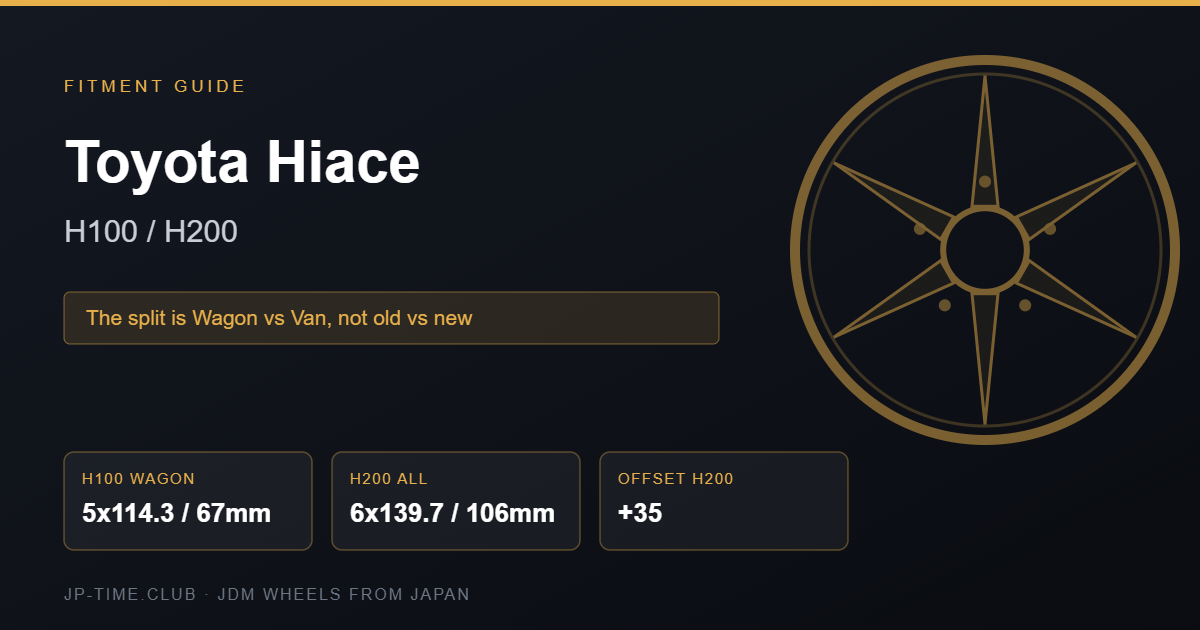
- H100 Hiace Wagon, top grades: 5×114.3 with a 67 mm bore, 15×6J at +29. We read this off the factory table ourselves.
- H200, everything: 6×139.7 with a 106 mm bore, 15×6J at +35. Van and Wagon, narrow and wide, 2WD and 4WD, 2004 to the current cars.
- The H100 Grand Hiace stayed 6×139.7 even though it was sold alongside the 5-lug Wagon.
- Commercial-registered Hiace needs JWL-T wheels, not just JWL. That is the truck and bus standard and it is a different test.
The Split Nobody Explains Properly
Ask what bolt pattern a Hiace uses and you will be told six studs at 139.7, and most of the time that is right. But we pulled the Japanese factory table for a 1999–2004 Hiace Wagon in the 3.0 Living Saloon EX grade and it reads, in plain numbers: 15×6J +29, PCD 114.3, 5 holes, hub bore 67 mm.
That is a passenger-car hub on a Hiace. It exists because Toyota split the H100 by purpose. The commercial Van kept the light-truck hardware. The passenger Wagon — the one sold through a different dealer channel, with the softer ride and the captain’s chairs — got a passenger-car hub with a smaller bolt circle and a much smaller register.
Then, when the H200 arrived in 2004, Toyota put everything back on one specification. Van and Wagon, DX through the current Dark Prime, narrow body and wide, two- and four-wheel drive: 6×139.7, 106 mm bore, 15×6J at +35. We confirmed that on a current 2026-build Super GL, and it matches what RS Watanabe publishes on its own matching sheet for the 200 series.
Factory Specification
| Vehicle | Chassis | Period | Wheel | Bolt pattern | Bore |
|---|---|---|---|---|---|
| Hiace Wagon, 3.0 top grades | KZH100G / KZH106G / KZH106W | 1999.07–2004.04 | 15×6J +29 | 5×114.3 | 67 |
| Grand Hiace (wide-body luxury) | VCH10W / VCH16W / KCH10W / KCH16W | 1999.08–2002.05 | 15×6J +29 | 6×139.7 | not published |
| Hiace Van and Wagon, H200 | TRH200V/K, GDH201V / 206V / 211K / 226K etc. | 2004–current | 15×6J +35 | 6×139.7 | 106 |
| Hiace Van, H100 commercial | LH1xx / KZH106V / RZH10x | 1989–2004 | not verified | not verified here | not published |
What This Means If You Are Buying Wheels
It means the word “Hiace” on a listing is not enough. You need the chassis code, and you need to know whether the vehicle is a Wagon or a Van.
A set of 6×139.7 wheels from an H200 will not go on an H100 Wagon of the 5-lug type. A set of 5×114.3 wheels from an H100 Wagon will not go on anything else in the family. And a 106 mm bore wheel from an H200 is a completely different register from the 67 mm on the H100 Wagon, so even the hub rings do not carry over.
The H200 is the easy case and the one most people are buying for. 6×139.7, 106 mm, +35 is a large and well-supplied fitment, and the aftermarket for it in Japan is enormous because the Hiace is the country’s default working vehicle. Going wider than 6.5J or dropping much below +30 starts to interfere with the front arch liner at lock on a loaded van.
JWL Is Not Enough. You Want JWL-T
This is the part that matters more than the numbers, and it is routinely ignored in export listings.
Japan has two wheel standards. JWL is the passenger-car standard. JWL-T is the standard for trucks and buses, and it is a materially harder test — the rotary bending fatigue requirement alone is more than double the passenger-car figure. A Hiace registered in Japan on a commercial plate falls under the truck side.
The practical consequence for an overseas buyer is this: a lightweight aftermarket wheel carrying only a JWL mark was tested for a car, and a Hiace is not a car. It is a vehicle that is regularly loaded to a tonne over its kerb weight. Detailed Japanese sources on Hiace fitment go further and note that even passenger-registered Wagons are factory-fitted with van-specification load-rated tyres — so treating the whole family as truck-standard is the safe assumption rather than a cautious one.
We have written separately about load ratings on van and camper conversions, and the reasoning transfers directly.
The Gap We Have to Admit
We could not pull a factory grade table for the base H100 commercial Van — the DX and GL cargo models — from either Japanese database, despite trying several chassis codes. Enthusiast consensus says 6×139.7, and every adjacent H100 variant we could confirm points that way, but we did not read it off a factory table and so we are not putting a number in that row.
If you are buying for an H100 Van specifically, count the studs and measure the hub before you order, or send us the chassis code and we will check it against a physical wheel.
Importing
The H100 ran from 1989 to 2004, so everything built up to August 2001 is eligible for US import now, with the rest following through to 2029. That includes the 5-lug Wagon grades. The H200 launched in 2004 and starts becoming eligible in 2029.
The Hiace has never been sold new in the United States, which is precisely why the import demand is what it is. Canada’s 15-year rule and the UK’s and Australia’s own routes are considerably more forgiving.
What We Could Not Verify
- Bolt pattern and hub bore for the H100 commercial Van (DX, GL) from a primary factory table.
- Whether the lower and mid H100 Wagon grades — the non-3.0 cars — share the 5×114.3 / 67 mm specification we confirmed on the 3.0 top grades, or stayed on the truck hub.
- Hub bore for the Grand Hiace, which is blank on every grade.
- A primary regulatory text specifically exempting passenger-registered Hiace Wagons from the JWL-T requirement. We did not find one.
Seen on the road
Which wheels are you looking for? Tell us the wheel, the size and the fitment — send us a request and we will go and find it.
Wheel identification is taken from the hashtags the owner applied to their own post.
Looking for a specific set? We specialise in genuine Japanese wheels — RAYS, Volk, Enkei, SSR, WORK, BBS Japan and the rare discontinued sets that never left the country. Tell us the wheel, the fitment, the year — our team searches our networks until we find it.