
The Short Version
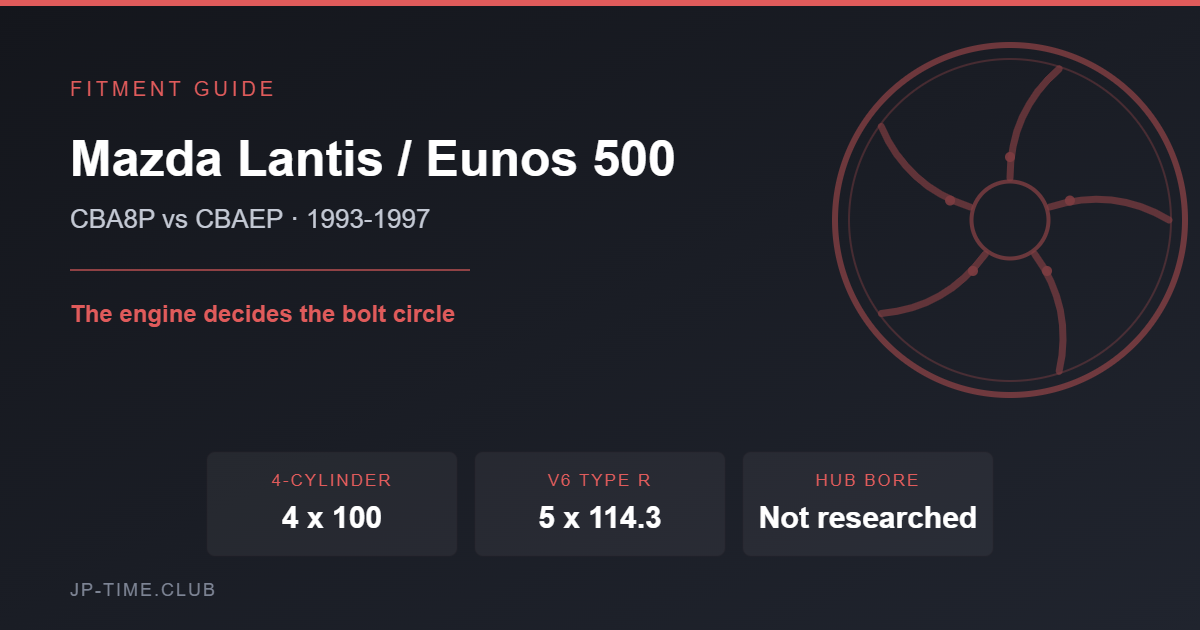
- The engine decides the bolt pattern. Four-cylinder cars are 4×100. V6 cars are 5×114.3.
- The Type R is always the five-lug car and never shares the base car’s pattern.
- No Lantis or Eunos 500 bore has ever been researched.
- The Eunos 500 is 5×114.3 throughout — it does not split.
Two Chassis Codes, One Car, Two Bolt Patterns
We have documented six cars where one chassis code carries two bolt patterns. The Lantis is a related but distinct case, and arguably a more logical one: the split follows the engine, and the chassis code follows with it.
| Chassis | Engine | Grades | Wheel | PCD / Holes / Bore | Rows |
|---|---|---|---|---|---|
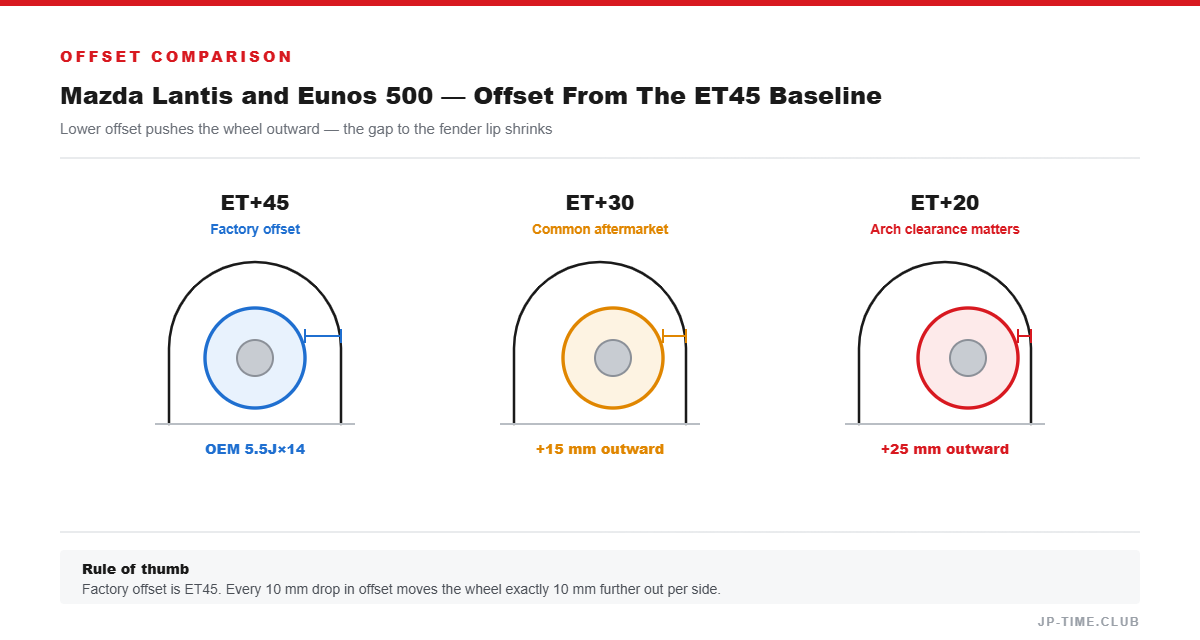
| E-CBA8P | 1.8 four-cylinder | Type G, Type S, Type X — 5-door, 4-door and coupe | 5.5J×14 +45 | 100 / 4 / Not researched | 30 |
| E-CBAEP | 2.0 V6 (KF-ZE) | Type R, Type X-V6, Mazdaspeed Version | 6.5J×16 +45 | 114.3 / 5 / Not researched | 22 |
So the two versions were sold side by side for four years, in the same bodies, with completely different wheels. Four studs on 100 mm, or five studs on 114.3 mm — there is no overlap at all.
The useful shortcut: 14-inch means four-lug, 16-inch means five-lug. The wheel that came on the car tells you the answer faster than the chassis plate does. That is the same rule we found on the Mitsubishi RVR, and it keeps holding.
Why This Trips People Up
Because the grade names overlap. There is a Type X on the four-cylinder chassis and a Type X-V6 on the six. Read a listing quickly and you can easily conclude that “Lantis Type X” is one thing.
It is not, and the consequences are total — a wheel from one will not go near the other. Establish the engine before you buy. If you cannot, count the studs.
The Type R
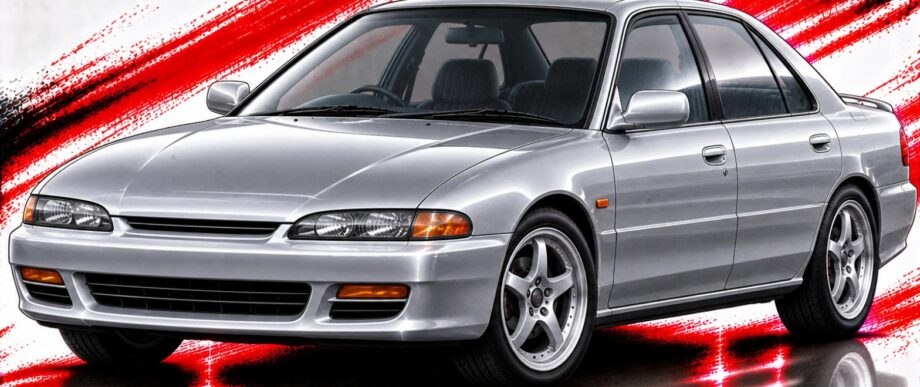
The Type R, with the 2.0-litre KF-ZE V6, is the reason people import a Lantis. A naturally aspirated V6 in a 1990s five-door hatch is a specification nobody builds any more.
It is always E-CBAEP, always 5×114.3, and always on 6.5J×16 at +45 with 205/50R16. Same for the Mazdaspeed Version.
That is good news for wheel availability — 5×114.3 is the largest pool in the Japanese market. It also means a Type R can wear wheels from almost any 1990s Mazda, Nissan or Toyota of similar size, subject to the bore question below.
The Bore Nobody Has Published
Every Lantis row and every Eunos 500 row leaves the bore blank, and the individual grade pages confirm 調査中 — under investigation. That includes the Type R.
Mazda’s larger-car figure is 67 mm and its small-car figure is 54 mm. On a five-lug Lantis, 67 is the reasonable expectation; on a four-lug one, 54. Neither is published, so measure. Our reference explains how and it takes ten minutes.
This matters more than usual on the four-cylinder car, because 4×100 wheels are made for three different bores — 54.1 Toyota, 56.1 Honda, 59.1 Nissan — and you cannot pick between them without a measurement.
The Eunos 500 Does Not Split
The Eunos 500, the saloon sold through Mazda’s Eunos channel, is 5×114.3 on every grade we read — the 1.8 18E and 18J, the 2.0 20E, 20F and 20GTI. Wheels run 14×5.5J at +45 on the smaller grades and 15×6J at +50 on the larger.
So the engine-based split is a Lantis phenomenon specifically. If you are buying a Eunos 500, five studs is the answer regardless of grade.
The Badge That Is Not There
The Xedos 6 — the European name for this car — does not appear anywhere in the Japanese database. That is expected rather than surprising; it was an export badge and these are domestic-market tables. If you are researching a Xedos 6, read the Eunos 500 page.
Importing
The Lantis and Eunos 500 both launched in 1993 and are eligible for US import in full. Neither was sold in North America; the closest relative there was the Mazda 626 family, which is a different car.
The Type R is the one worth the freight, and the Mazdaspeed Version is the rare one.
What We Could Not Verify
- Hub bore for any Lantis or Eunos 500 grade, including the Type R. Universally unresearched.
- Whether the four-cylinder and V6 cars genuinely have different hub hardware, or whether the chassis code change reflects something else. The two pattern figures are unambiguous; the engineering behind them is not stated.
- Any Xedos 6 data, which is absent by design.