
The Short Version
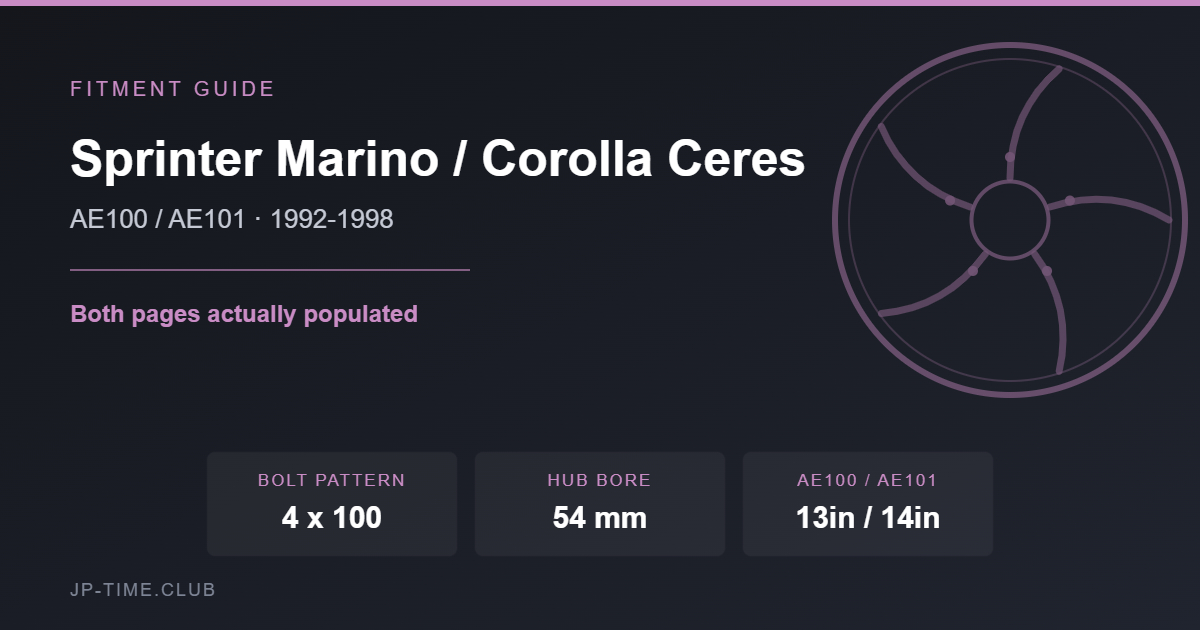
- 4×100 on a 54 mm bore — a real published figure, not unresearched.
- Both badges are equally populated. For once, no gap.
- AE100 is 13-inch at +39. AE101 is 14-inch at +45.
- There is no 4A-GE 20-valve grade — and that is correct, not a database gap.
The Pillarless Pair
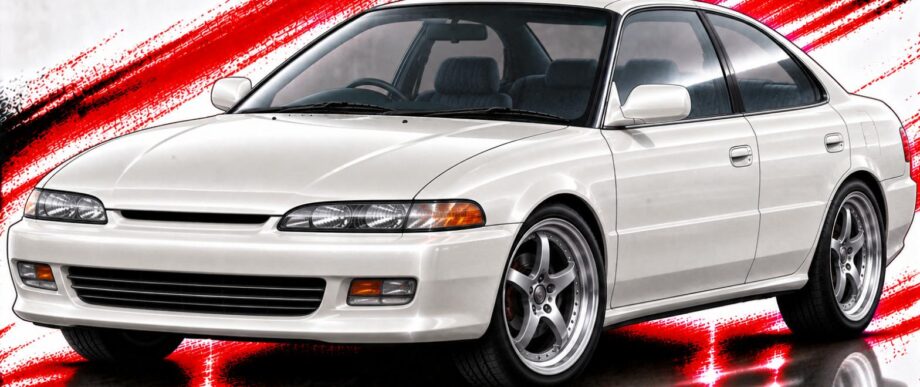
The Sprinter Marino and Corolla Ceres are the same four-door pillarless hardtop, sold through two Toyota dealer channels from 1992 to 1998. They are among the last cars anyone built to that shape, and they have a following because of it.
Their fitment is straightforward and, unusually for this series, fully documented on both pages:
| Chassis | Period | Engine / grades | Wheel | PCD / Holes / Bore |
|---|---|---|---|---|
| AE100 | 1992.05–1998.07 | 1.5 F-type, incl. Extra Package, Limited, Black Special Edition | 13×5J +39 | 100 / 4 / 54 |
| AE101 | 1992.05–1998.07 | 1.6 X-type and G-type, incl. Black Ceres trim | 14×5.5J +45 | 100 / 4 / 54 |
For Once, Both Twins Are Populated
This is worth remarking on because it has not been the pattern.
We have now hit three cases where badge-engineered twins have unequal data: the Carina ED has a bore where the Corona EXiV does not, the Wingroad has one where the AD Wagon does not, and the Corolla II is missing two whole generations that the Corsa and Tercel pages carry.
Marino and Ceres agree completely, and both give a real 54 mm figure rather than leaving it blank. If your car is either badge, you have a usable answer.
The 20-Valve That Was Never Fitted
A question we expected to answer and which turned out to have a cleaner answer than expected.
There is no 4A-GE 20-valve grade on either page. That is not a database gap — the silvertop and blacktop 4A-GE went into the two-door Levin and Trueno, not into the four-door pillarless cars.
So if you see a Marino or Ceres advertised as a 20-valve car, it has been swapped. That is a perfectly good thing to buy — a great many have been — but it is a modification, and its wheels will be whatever the previous owner chose rather than a factory specification.
Sizing
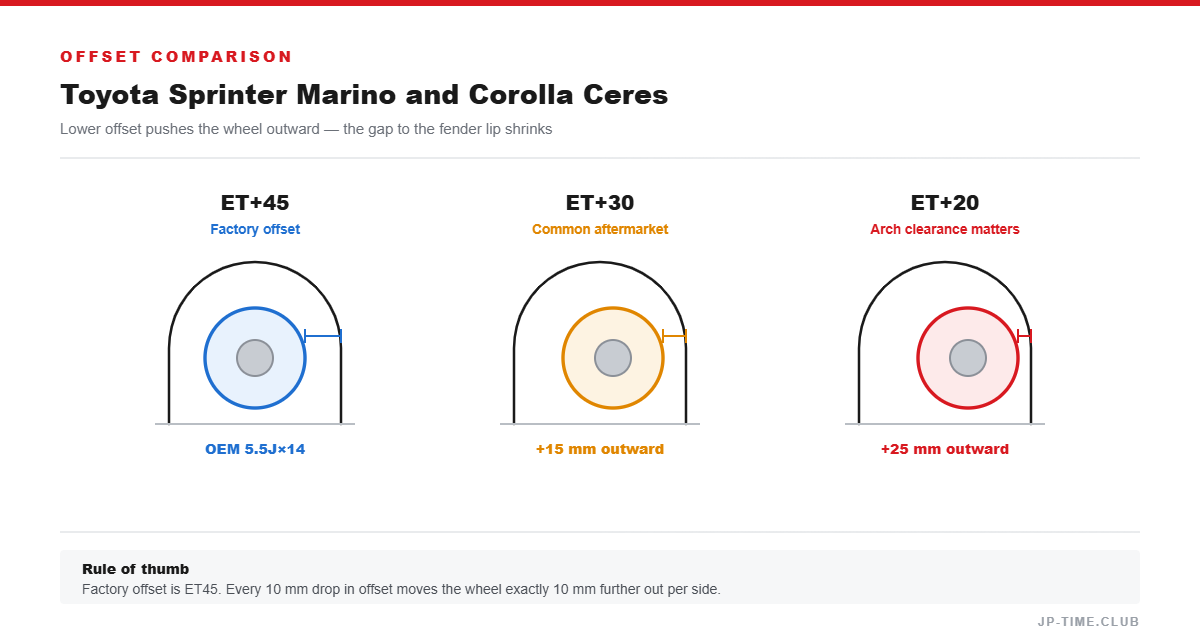
The offset difference between the two chassis codes is the thing to watch: +39 on the AE100 and +45 on the AE101. Six millimetres, and it tracks the wheel size, so in practice the two sit in roughly the same place.
4×100 with a 54 mm bore is the Toyota small-car standard, shared with the Starlet, the Vitz and the Corsa family. Wheels are plentiful.
The trap is the bore, as always on 4×100: wheels are made at 54.1 for Toyota, 56.1 for Honda and 59.1 for Nissan. A Honda-bored wheel is 2 mm loose on this hub and a Nissan-bored one is 5 mm loose. Both will bolt up. Neither is located.
The natural upgrade is 15×6.5J or 16×7J in the +38 to +45 band, which is where most Levin and Trueno wheels sit — and those share the pattern and the bore exactly.
Importing
Production ran from May 1992 to July 1998, so the early cars are eligible for US import now and the rest follow through 2023 onward.
Neither badge was sold in North America. The pillarless hardtop body is the reason to want one — it is a shape that regulation effectively killed, and the Marino and Ceres are among the last mass-produced examples.
What We Could Not Verify
- Nothing significant. Both pages are fully populated with a real bore figure across all grades and years.
- Factory tyre sizes, which the database leaves blank for most grades.