

The Short Version
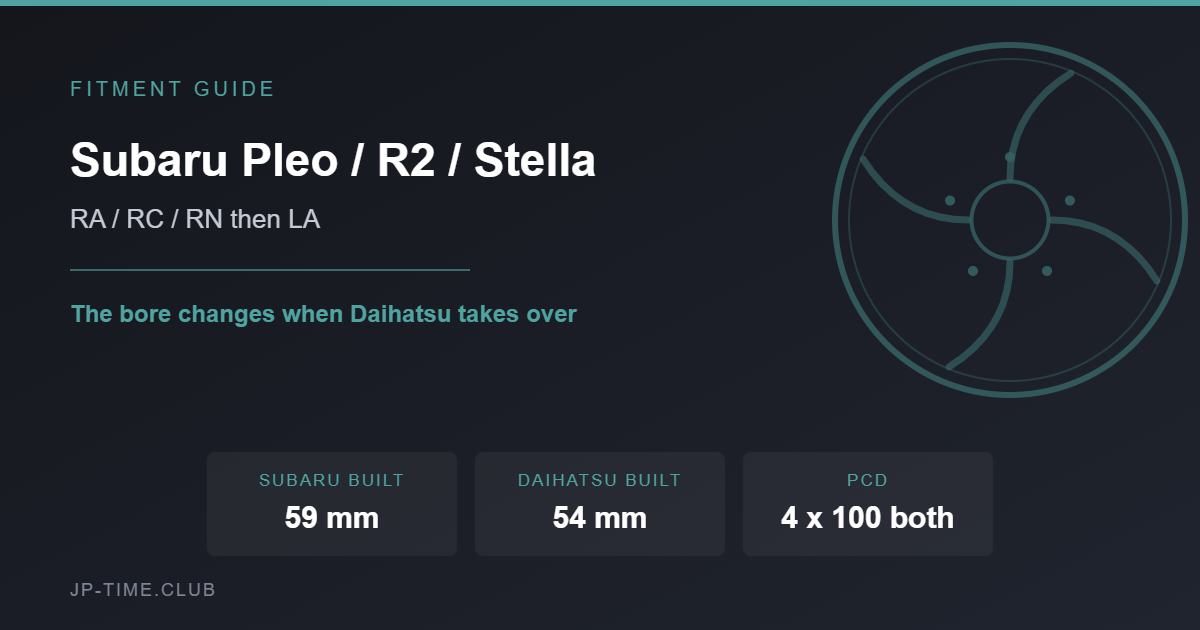
- Subaru-built kei cars use a 59 mm bore. Daihatsu-built ones use 54.
- 4×100 on both sides. Only the bore changes.
- The Pleo switched in April 2010. The Stella switched in May 2011.
- Same story as the Sambar, and now confirmed on the passenger cars too.
The Handover
We published earlier that the Subaru Sambar became a completely different vehicle when Subaru stopped building its own kei cars and started rebadging Daihatsus.
The passenger kei cars did the same thing, and the fitment records it precisely:
| Model | Chassis | Period | Built by | Wheel | PCD / Holes / Bore |
|---|---|---|---|---|---|
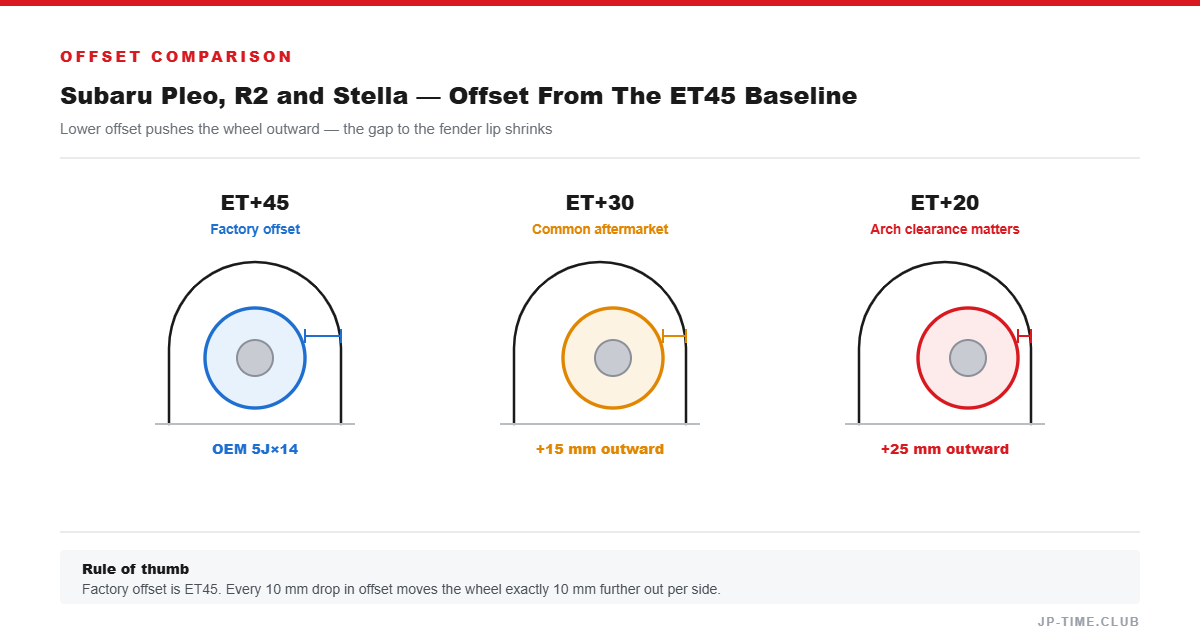
| Pleo | TA/GF-RA1 (2WD), RA2 (4WD) | 1998.10–2007.06 | Subaru | 4J×12 to 5J×14 +45 | 100 / 4 / 59 |
| Pleo Van | RV1, RV2 | — | Subaru | 4J×12 +45 | 100 / 4 / 59 |
| R2 | RC1 (2WD), RC2 (4WD) | 2003.12–2010.03 | Subaru | 4.5J×14 to 4.5J×15 +45 | 100 / 4 / 59 |
| Stella | RN1 (2WD), RN2 (4WD) | 2006.06–2011.05 | Subaru | — | 100 / 4 / 59 |
| Pleo | L275F (2WD), L285F (4WD) | 2010.04–2018.03 | Daihatsu | 4J×13 +40 | 100 / 4 / 54 |
| Pleo Plus | LA300F, LA310F, LA350F, LA360F | — | Daihatsu (Mira e:S) | — | 100 / 4 / 54 |
| Stella | LA100F, LA110F, then LA150F/LA160F, LA850F/LA860F | 2011.05– | Daihatsu | — | 100 / 4 / 54 |
Read the Chassis Code, Not the Badge
The tell is the chassis code prefix, and it is completely reliable:
- RA, RC, RN, RV — Subaru-built. 59 mm, offset +45.
- L275F, L285F, LA100F, LA110F, LA150F, LA160F, LA300F, LA350F, LA850F, LA860F — Daihatsu-built. 54 mm, offset +40 on the Pleo.
The Daihatsu codes are recognisably Daihatsu — the same L and LA family used by the Mira and the Tanto. If your Subaru’s chassis code looks like a Daihatsu’s, it is one.
Five Millimetres, and Which Direction Is Dangerous
The bolt pattern is 4×100 on both sides, so the wheels swap freely and the studs line up perfectly. That is the problem.
A 54 mm Daihatsu-built-Stella wheel will not go on a 59 mm Subaru-built Pleo hub — the hub is physically bigger than the hole. Annoying, obvious, harmless.
A 59 mm Subaru-built wheel on a 54 mm Daihatsu-built hub fits with a five-millimetre gap all round. It bolts up and drives and the hub is doing nothing to locate it.
Five millimetres is a large gap by hub-ring standards. If you are running that combination deliberately, you want a proper hub ring — see our hub rings and spacers reference, and note what RS Watanabe says there about generic rings.
The R2 Has No Successor
Worth a note. The R2 ran from December 2003 to March 2010 as a Subaru-built car on 59 mm, and the name was never revived on a Daihatsu-based platform. So the R2 is entirely a Subaru-built vehicle and there is no ambiguity about it at all.
The Pleo Plus is the opposite case: a pure Daihatsu Mira e:S rebadge with no Subaru-built ancestor. It is 54 mm from the start.
Why Subaru Stopped
Subaru left kei-car manufacturing around 2012 to concentrate on larger cars, after Toyota took a stake in the company. Daihatsu — a Toyota subsidiary — picked up the supply.
The result is that “a Subaru kei car” describes two entirely different engineering lineages depending on the year, and this is the second time we have documented it. The Sambar changed even more dramatically: the Subaru-built one is rear-engined with four-wheel independent suspension, and the Daihatsu-built one is a conventional Hijet.
Importing
The Pleo launched in October 1998 and the R2 in December 2003, so both Subaru-built cars are eligible for US import now or shortly.
The Subaru-built ones are the interesting imports. Subaru’s own kei engines were four-cylinder where almost every rival used three, and the R2 in particular is a genuinely well-engineered little car that nobody outside Japan has heard of.
What We Could Not Verify
- The exact month-by-month overlap during the transition for every grade. The Pleo’s Subaru rows run to 2007 and the Daihatsu rows start April 2010, so there is a gap in the data rather than a clean handover date.
- Pleo Custom, Pleo Nesta and Stella Revesta pages, which we did not open. The pattern is consistent across six other nameplate pages.